

Artificial Intelligence Solutions for Small Businesses
October 9, 2026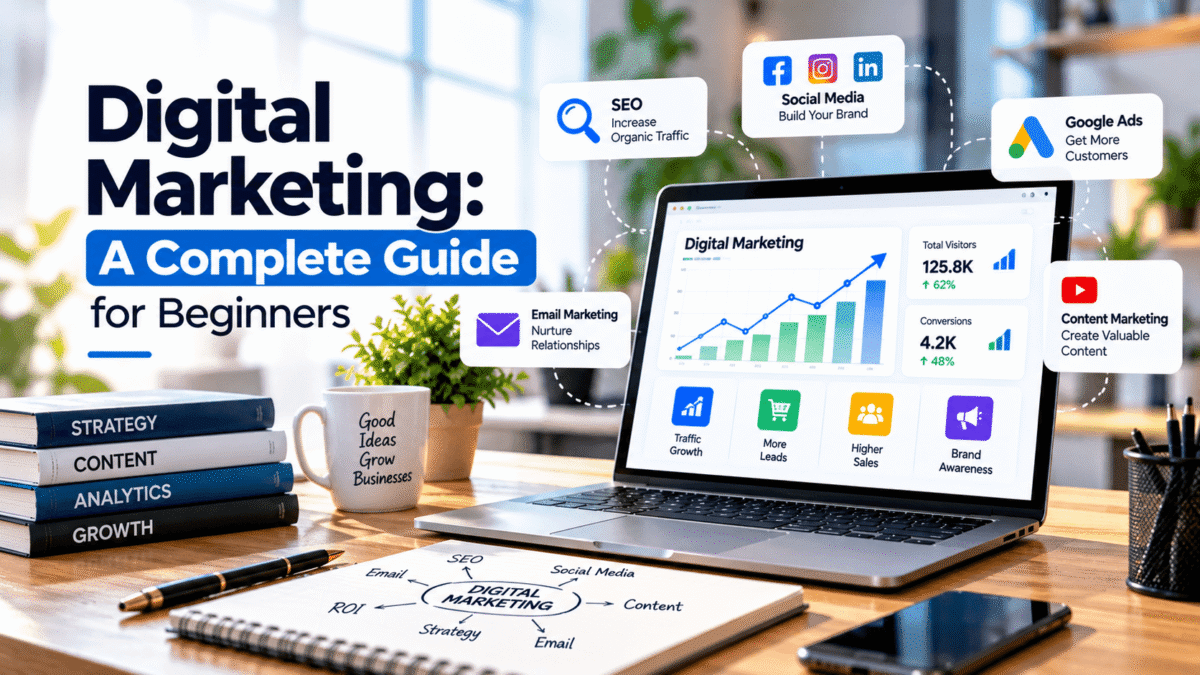
Digital marketing has become one of the most important ways for businesses, professionals, startups, and entrepreneurs to reach their target audience. As more people use search engines, social media platforms, websites, email, and mobile devices to discover information and make purchasing decisions, businesses need a strong digital presence to remain visible and competitive.
Whether you are a business owner trying to attract more customers, a student exploring a career in marketing, or a beginner who wants to understand how online promotion works, learning digital marketing can provide a strong foundation for long-term growth.
But digital marketing is much more than posting on social media or running advertisements. It involves a combination of strategies, channels, technologies, content, data, and customer experiences that work together to attract prospects, build trust, generate leads, and encourage conversions.
This complete guide explains the fundamentals of digital marketing, the major digital marketing channels, how they work, why they matter, and how beginners can build an effective digital marketing strategy.
What Is Digital Marketing?
Digital marketing is the process of promoting products, services, brands, or businesses through digital channels and online technologies.
These channels can include search engines, websites, social media, email, online advertising, content platforms, video platforms, and other digital communication channels.
Traditional marketing relies heavily on channels such as newspapers, magazines, television, radio, and physical advertising. Digital marketing, on the other hand, allows businesses to communicate with audiences through online platforms and measure how users interact with their campaigns.
For example, a business may use search engine optimization to appear in Google search results, publish educational articles to attract visitors, run social media campaigns to build awareness, and use email marketing to nurture potential customers.
The major advantage of digital marketing is its measurable nature. Businesses can track impressions, clicks, website visits, leads, conversions, engagement, and other performance indicators to understand what is working and where improvements are needed.
Why Is Digital Marketing Important?
The internet has changed how consumers research products and services. Before making a purchase, people often search online, compare options, read reviews, visit websites, watch videos, and interact with brands through social media.
This makes digital marketing an essential part of modern business development.
A well-planned digital marketing strategy can help a business:
- Increase online visibility
- Reach specific target audiences
- Generate qualified leads
- Build brand awareness
- Improve customer engagement
- Drive website traffic
- Increase sales and conversions
- Build long-term customer relationships
- Measure marketing performance
- Understand customer behavior
Digital marketing can also provide businesses with more flexibility. Campaigns can be tested, analyzed, adjusted, and optimized based on actual performance rather than relying entirely on assumptions.
How Does Digital Marketing Work?
Digital marketing generally follows a customer journey that begins with awareness and can eventually lead to conversion and retention.
A simplified digital marketing funnel includes four major stages.
Awareness
At this stage, potential customers discover your brand, product, service, or content.
Search engines, social media, videos, blogs, online advertisements, and other channels can help generate awareness.
Consideration
Once people know about your business, they may research your offerings in more detail. They may read articles, compare services, view product pages, download resources, or contact your business.
The objective at this stage is to provide useful information and establish credibility.
Conversion
A conversion occurs when a visitor takes a desired action. Depending on the business, this could mean purchasing a product, requesting a quotation, submitting a contact form, booking a consultation, downloading a resource, or signing up for a service.
Retention
Digital marketing does not stop after a customer makes a purchase. Businesses can use email marketing, useful content, customer support, remarketing, and personalized communication to encourage repeat purchases and long-term relationships.
Major Types of Digital Marketing
Digital marketing consists of several interconnected disciplines. Beginners should understand the purpose of each channel rather than treating them as completely separate activities.
Search Engine Optimization
Search Engine Optimization, commonly known as SEO, is the process of improving a website and its content so that it can achieve better visibility in organic search engine results.
When someone searches for a product, service, question, or solution, search engines analyze numerous factors to determine which pages are most relevant.
SEO typically involves several areas.
On-Page SEO
On-page SEO focuses on elements that exist directly on a webpage.
Important elements include:
- Page titles
- Headings
- Content quality
- Keyword usage
- Meta descriptions
- Internal linking
- Image optimization
- URL structure
- Search intent
- Content readability
Good on-page SEO helps search engines understand what a page is about while also making the content useful for visitors.
Technical SEO
Technical SEO focuses on the technical foundation of a website.
Important areas can include:
- Website speed
- Mobile usability
- Crawlability
- Indexability
- XML sitemaps
- Structured data
- HTTPS
- Canonical URLs
- Website architecture
- Core Web Vitals
A technically healthy website makes it easier for search engines to discover and understand its content.
Off-Page SEO
Off-page SEO refers to activities outside your own website that can contribute to its authority and visibility.
Link building, digital PR, brand mentions, industry references, and other forms of external recognition can contribute to a website’s overall authority.
However, SEO should not be approached simply as a process of collecting as many backlinks as possible. Quality, relevance, trust, and sustainable practices are more important than manipulating search rankings.
Content Marketing
Content marketing focuses on creating and distributing useful, relevant, and valuable content for a clearly defined audience.
Content can take many forms, including:
- Blog articles
- Guides
- Case studies
- Videos
- Infographics
- Ebooks
- Whitepapers
- Tutorials
- FAQs
- Social media content
- Website resources
The objective is not simply to produce a large amount of content. Effective content addresses the questions, problems, interests, and needs of the target audience.
For example, a web design company could publish articles about website performance, responsive design, SEO fundamentals, conversion optimization, and website security.
Over time, this content can attract organic traffic while demonstrating expertise.
Social Media Marketing
Social media marketing involves using social platforms to communicate with audiences, distribute content, build communities, and promote products or services.
A strong social media strategy begins with understanding where your target audience spends time.
Businesses may use social media for:
- Brand awareness
- Community building
- Content distribution
- Customer communication
- Lead generation
- Product promotion
- Customer support
- Reputation management
Different platforms also require different content approaches. Short-form videos, educational posts, visual content, discussions, and professional insights may perform differently depending on the audience and platform.
Consistency is important, but businesses should prioritize useful content and meaningful engagement over simply publishing frequently.
Pay-Per-Click Advertising
Pay-Per-Click advertising, or PPC, is a form of paid digital advertising where advertisers generally pay when users interact with their advertisements, such as clicking them.
Search advertising can be particularly useful when businesses want to reach people who are actively searching for specific products or services.
For example, someone searching for “website development services” has a different level of intent from someone casually viewing a social media post about websites.
PPC campaigns can involve:
- Keyword research
- Audience targeting
- Ad copy
- Landing pages
- Budget management
- Conversion tracking
- Bid strategies
- Campaign optimization
One important principle is that sending paid traffic to a poorly designed landing page can reduce campaign effectiveness. Advertising and conversion optimization should therefore work together.
Email Marketing
Email marketing allows businesses to communicate directly with people who have voluntarily provided their email addresses.
It can be used for:
- Newsletters
- Product updates
- Educational content
- Offers
- Lead nurturing
- Customer onboarding
- Event announcements
- Follow-up communication
Effective email marketing is based on relevance and value.
Sending large numbers of generic emails may not create meaningful engagement. Segmenting audiences and delivering useful information can produce a more personalized experience.
Affiliate Marketing
Affiliate marketing involves partnerships where individuals or organizations promote products or services and receive compensation based on defined results, such as sales or qualified leads.
This model can help businesses expand their reach by working with publishers, creators, websites, or other relevant partners.
The success of affiliate marketing depends on selecting suitable partners, establishing clear terms, tracking results, and maintaining transparency.
Influencer Marketing
Influencer marketing involves collaborating with individuals who have established audiences and influence within a particular niche.
The right collaboration depends less on follower count and more on audience relevance, credibility, engagement, content quality, and alignment with the brand.
For example, a specialized business may benefit more from working with a creator whose audience closely matches its target market than from choosing someone with a much larger but unrelated audience.
Video Marketing
Video has become an important component of digital marketing because it can communicate information quickly and create a more engaging experience.
Businesses can use video for:
- Product demonstrations
- Tutorials
- Customer education
- Behind-the-scenes content
- Brand storytelling
- Interviews
- Testimonials
- Short-form educational content
Video content should still have a clear purpose. A visually attractive video without a defined audience or message may not generate meaningful business results.
Local Digital Marketing
Local digital marketing focuses on reaching customers within a specific geographic area.
It is particularly relevant for businesses such as restaurants, healthcare providers, retailers, home service companies, professional services, and local stores.
Important local marketing activities can include:
- Optimizing business profiles
- Creating location-specific website content
- Maintaining consistent business information
- Collecting genuine customer reviews
- Creating locally relevant content
- Building local citations
- Improving local search visibility
For a local business, visibility for searches containing geographic intent can be highly valuable because the user may already be looking for a nearby solution.
Mobile Marketing
A large portion of internet activity occurs through smartphones and other mobile devices.
Mobile marketing can include:
- Mobile-optimized websites
- SMS campaigns
- Mobile applications
- Push notifications
- Mobile advertising
- Responsive email campaigns
A digital marketing strategy should therefore consider how content, forms, navigation, images, and calls to action appear on smaller screens.
A website that works well on desktop but provides a poor mobile experience can lose potential customers.
Digital Marketing Strategy
Digital marketing works best when individual channels are connected through a clear strategy.
A basic strategy can be developed through the following steps.
Define Your Marketing Goals
Start by deciding what you want digital marketing to accomplish.
Your goal might be:
- Increasing website traffic
- Generating leads
- Increasing online sales
- Improving brand awareness
- Increasing inquiries
- Growing an email list
- Improving customer retention
Goals should be specific enough to measure.
Instead of saying “get more customers,” a business could define a target such as increasing qualified website inquiries over a particular period.
Identify Your Target Audience
Understanding your audience is one of the foundations of effective marketing.
Consider:
- Age range
- Location
- Industry
- Job role
- Interests
- Problems
- Buying behavior
- Search behavior
- Budget
- Decision-making process
The goal is not to create assumptions about customers but to develop a useful understanding of their needs and behavior.
Research Search Intent
Search intent refers to the reason behind a user’s search query.
Common categories include:
- Informational intent
- Navigational intent
- Commercial investigation
- Transactional intent
For example, someone searching “what is SEO” is looking for information, while someone searching “SEO agency near me” may have stronger commercial intent.
Understanding intent helps you create content that matches what users actually want.
Perform Keyword Research
Keyword research identifies the terms and phrases people use when searching online.
A useful keyword strategy considers:
- Search relevance
- Search intent
- Competition
- Business value
- Search volume
- Long-tail variations
Beginners should not focus exclusively on highly competitive keywords. More specific long-tail keywords can sometimes provide opportunities to reach users with clearly defined needs.
Create a Content Strategy
A content strategy determines what you will publish, who it is for, which channels will distribute it, and what business objective it supports.
A strong content plan may include:
- Educational articles
- Service pages
- Product guides
- FAQs
- Case studies
- Videos
- Social posts
- Downloadable resources
Content should be organized around topics rather than random keywords. This helps create a more comprehensive resource for users.
Build a Conversion-Friendly Website
Your website is often the central destination for digital marketing campaigns.
A good website should provide:
- Clear navigation
- Fast loading times
- Mobile responsiveness
- Useful content
- Strong visual hierarchy
- Clear calls to action
- Trust signals
- Simple forms
- Secure browsing
- Easy access to contact information
Traffic alone does not guarantee business growth. Visitors need a clear path toward the next action.
Understanding Digital Marketing Metrics
Data is an important part of digital marketing because it allows marketers to evaluate performance and make informed decisions.
Some commonly monitored metrics include:
Website Traffic
Website traffic measures the number of visitors reaching your website.
Traffic can be divided into different sources, such as:
- Organic search
- Direct traffic
- Referral traffic
- Social traffic
- Paid traffic
- Email traffic
Conversion Rate
Conversion rate measures the percentage of users who complete a desired action.
For example:
Conversion Rate = Conversions ÷ Visitors × 100
If 1,000 people visit a landing page and 50 submit a form, the conversion rate is 5%.
Cost Per Lead
Cost per lead helps businesses understand how much they spend to generate a lead.
Cost Per Lead = Marketing Spend ÷ Number of Leads
This can help compare campaign efficiency.
Return on Investment
Return on Investment, or ROI, helps evaluate whether a marketing investment generated sufficient financial value.
A simplified formula is:
ROI = (Return − Investment) ÷ Investment × 100
Businesses should define which costs and returns are included to ensure consistent measurement.
Engagement
Engagement metrics can include likes, comments, shares, saves, video views, email interactions, and other actions.
Engagement can provide useful signals, but it should be interpreted alongside business objectives. High engagement does not automatically mean high revenue.
Common Digital Marketing Mistakes Beginners Should Avoid
Digital marketing can become complicated when businesses attempt to do everything at once.
One common mistake is focusing on too many channels without sufficient resources. It is often more practical to identify the channels most relevant to the target audience and build them properly.
Another mistake is creating content without understanding search intent. A page may contain the right keywords but still fail to satisfy users if it does not answer their actual questions.
Ignoring analytics is another problem. Without measuring results, it becomes difficult to understand whether a campaign is producing meaningful outcomes.
Businesses should also avoid expecting immediate results from every digital marketing channel. SEO, content marketing, social media, and brand-building activities may require consistent effort over time.
Finally, copying competitors without understanding your own audience can result in generic marketing. A strong strategy should be based on your business goals, customer needs, resources, and market position.
How to Start Digital Marketing as a Beginner
If you are completely new to digital marketing, start with the fundamentals instead of trying to master every channel immediately.
First, learn how search engines, websites, content, and social media work.
Next, build basic knowledge of SEO and content marketing. These skills can help you understand how people discover information online.
Then learn analytics and measurement. Knowing how to interpret data is essential because marketing decisions should increasingly be based on evidence.
After that, explore paid advertising, email marketing, social media strategy, and conversion optimization.
Practical experience is equally important. Create a simple website or project, publish content, experiment with different strategies, and analyze the results.
The objective is not to become an expert overnight. Digital marketing is a broad discipline, and expertise develops through continuous learning, experimentation, analysis, and adaptation.
How Businesses Can Improve Their Digital Marketing
Businesses should treat digital marketing as an ongoing process rather than a one-time project.
Regularly review website performance, search visibility, content quality, conversion rates, advertising results, and customer feedback.
Identify what is producing results and investigate why.
Then test improvements.
For example, you might experiment with:
- Different landing page headlines
- Alternative calls to action
- New content formats
- Different audience segments
- New keyword groups
- Improved page layouts
- Different email subject lines
- New advertising messages
Testing should be structured whenever possible. Changing many variables simultaneously can make it difficult to determine which change caused an improvement or decline.
The Role of Artificial Intelligence in Digital Marketing
Artificial intelligence is increasingly being used across digital marketing workflows.
AI tools can assist with:
- Content research
- Data analysis
- Customer segmentation
- Campaign ideas
- Content personalization
- Keyword research
- Predictive analysis
- Marketing automation
- Customer support
However, AI should support marketing expertise rather than replace strategic thinking.
Content still needs accurate information, human judgment, originality, brand consistency, and a genuine understanding of the audience.
Businesses should also review AI-generated material carefully before publishing it.
The Future of Digital Marketing
Digital marketing will continue to evolve as consumer behavior, search technology, artificial intelligence, privacy expectations, and online platforms change.
Search is becoming more conversational. Customers increasingly expect personalized experiences. Video continues to play an important role in online communication, while data and analytics remain central to measuring marketing effectiveness.
At the same time, businesses need to focus more strongly on trust, useful content, customer experience, and transparent communication.
The fundamentals, however, remain consistent: understand your audience, provide value, communicate clearly, measure results, and continuously improve.
Frequently Asked Questions About Digital Marketing
Is digital marketing difficult for beginners?
Digital marketing includes many specialized areas, so it can initially feel overwhelming. However, beginners can learn it step by step by starting with fundamental concepts such as SEO, content marketing, social media, paid advertising, email marketing, and analytics.
How long does it take to learn digital marketing?
The fundamentals can be learned relatively quickly, but developing practical expertise takes longer. Digital marketing is a constantly changing field, so continuous learning and hands-on experience are important.
Is SEO part of digital marketing?
Yes. SEO is one of the major disciplines within digital marketing. It focuses on improving organic visibility in search engines and attracting relevant visitors to a website.
Is social media marketing enough for a business?
Social media can be valuable, but relying entirely on one channel can create unnecessary risk. A broader digital marketing strategy can combine channels such as SEO, content marketing, email, paid advertising, and social media according to business objectives.
Can small businesses use digital marketing?
Yes. Digital marketing can be adapted to businesses of different sizes. Small businesses can focus on specific audiences, local search visibility, useful content, social media, email marketing, or other channels that align with their customers and available resources.
How much does digital marketing cost?
There is no universal cost. Expenses depend on the channels used, advertising budget, content requirements, technology, internal resources, and business goals. Some activities can be started with limited budgets, while competitive paid campaigns may require significant investment.
What is the most important digital marketing skill?
There is no single skill that guarantees success. Strong marketers generally need a combination of strategic thinking, audience research, communication, content creation, analytical ability, technical understanding, and continuous learning.
Final Thoughts on Digital Marketing
Digital marketing is a broad and continuously evolving field, but its fundamentals are straightforward: understand your audience, identify their needs, create useful experiences, reach them through relevant channels, and measure what happens.
SEO can help people discover your website. Content marketing can answer their questions. Social media can build relationships. Paid advertising can provide targeted visibility. Email marketing can nurture relationships. Analytics can show whether these activities are contributing to your objectives.
The most effective approach is not to use every possible digital channel simply because it exists. Instead, build a focused strategy around your audience and business goals.
If you are a business looking to establish or improve your online presence, a well-planned digital marketing strategy can help connect your brand with the right audience and create a measurable path toward growth.
Ready to strengthen your online presence and explore a digital marketing strategy tailored to your business? Digital Marketing: A Complete Guide for Beginners can be your starting point for understanding the opportunities and taking the next step toward a stronger digital presence.
Start Your Digital Marketing Journey
Digital marketing is not a single campaign or one-time activity. It is an ongoing process of attracting the right audience, delivering value, building trust, converting prospects, and improving based on measurable results.
Start with the fundamentals, choose the channels that align with your audience, create useful content, monitor your performance, and keep improving.
With a structured approach and consistent execution, digital marketing can become an important part of a sustainable business growth strategy.