
How to Design a Catalogue for Your Business
November 13, 2026
Social Media Marketing for Startups
November 18, 2026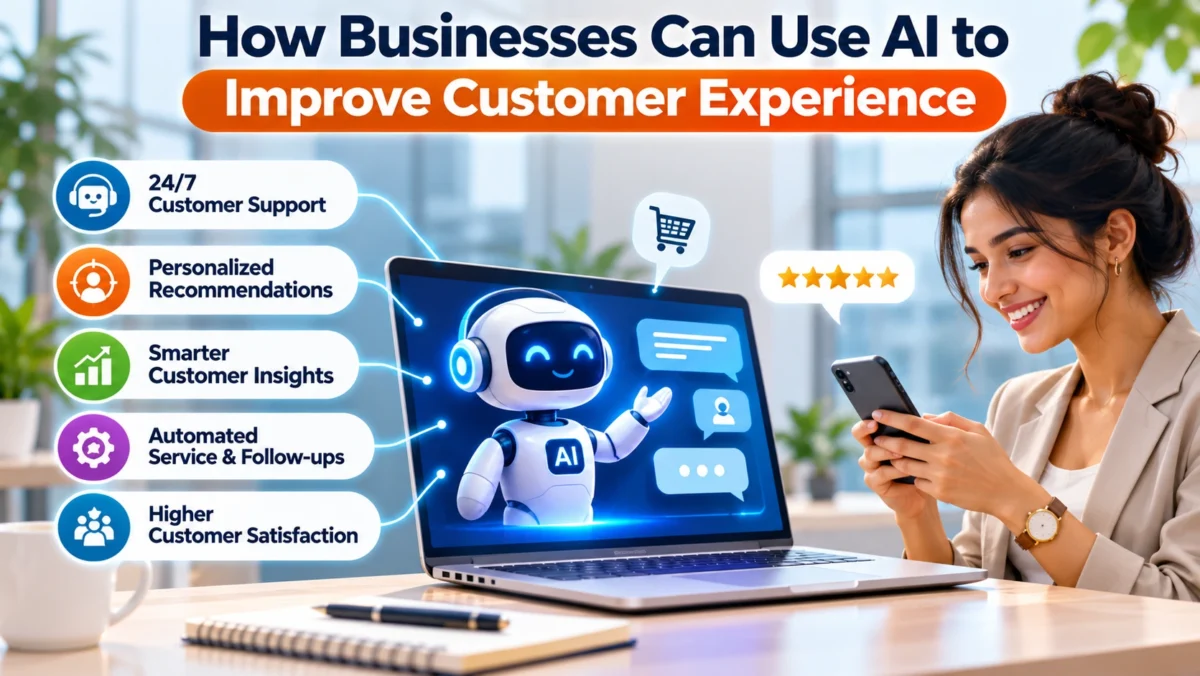
Customer expectations are changing faster than ever. People want quick responses, personalized recommendations, convenient communication, and consistent service across every digital touchpoint. For businesses, meeting these expectations manually can become difficult as customer interactions increase.
This is where artificial intelligence (AI) is becoming an important part of modern customer experience strategies. AI can help businesses understand customer behavior, automate repetitive interactions, deliver personalized experiences, and provide faster support while allowing employees to focus on more complex customer needs.
Understanding How Businesses Can Use AI to Improve Customer Experience is therefore not simply about adopting the latest technology. It is about using data, automation, machine learning, natural language processing, and predictive analytics to make every stage of the customer journey more relevant and efficient.
For businesses looking to build a stronger digital strategy, AI can become a practical tool for improving customer satisfaction, operational efficiency, and long-term customer relationships.
What Is AI-Powered Customer Experience?
AI-powered customer experience refers to the use of artificial intelligence technologies to improve the way customers interact with a business.
AI systems can analyze large volumes of customer data, recognize patterns, understand natural language, automate responses, and make predictions based on previous interactions. These capabilities can be integrated into websites, mobile applications, customer support systems, e-commerce platforms, CRM solutions, and other digital channels.
Instead of treating every customer interaction in exactly the same way, AI enables businesses to create more contextual experiences.
For example, an AI-powered system can identify what a customer is searching for, understand previous interactions, recommend relevant information, and provide an appropriate response without requiring a customer service representative to handle every basic request.
The objective is not to remove the human element from customer experience. Instead, AI can support employees and give them better information so they can provide more meaningful assistance.
Why Businesses Are Using AI to Improve Customer Experience
Customer experience has become an important differentiator across industries. Products and pricing are no longer the only factors influencing how customers perceive a business.
Customers also consider:
- How quickly their questions are answered
- How easy it is to find information
- Whether communication feels personalized
- How simple the purchasing process is
- Whether support is available when needed
- How consistently the business communicates
- How effectively problems are resolved
Traditional customer service models can struggle to maintain these standards as customer volume grows.
AI can help businesses address these challenges by processing information quickly and automating suitable interactions. It can also identify customer trends that may be difficult to detect through manual analysis.
The result can be a customer journey that feels faster, more convenient, and more personalized.
How Businesses Can Use AI to Improve Customer Experience
There are several practical ways businesses can integrate AI into their customer experience strategies. The right approach depends on the industry, customer journey, available data, and specific business objectives.
AI-Powered Customer Support
One of the most common applications of AI is customer support.
AI-powered conversational systems can answer frequently asked questions, guide customers through common processes, provide product information, and help users find relevant resources.
For example, a customer visiting a website may want to know:
- Where an order is located
- How a product works
- What payment options are available
- How to request a return
- What services a business provides
- How to schedule an appointment
Instead of requiring an employee to answer every repetitive question, AI can provide immediate assistance for routine requests.
More complex questions can then be transferred to human representatives.
This creates a hybrid support model in which AI handles suitable repetitive interactions while employees concentrate on situations requiring judgment, empathy, or specialized knowledge.
Personalized Customer Experiences
Personalization is another important area where AI can improve customer experience.
Modern businesses collect information from multiple customer touchpoints. This may include browsing behavior, purchase history, product interactions, search activity, preferences, and previous support conversations.
AI can analyze these signals and identify patterns.
Businesses can use those insights to personalize:
- Product recommendations
- Website content
- Email communication
- Promotional messages
- Search results
- Offers
- Customer support interactions
For example, an online store can use AI to recommend products based on a customer’s previous interactions rather than presenting exactly the same products to every visitor.
The objective is to make customers feel that the digital experience is relevant to their needs rather than generic.
AI for Faster Responses
Speed is an important part of customer experience.
A customer who waits several hours for an answer to a simple question may become frustrated, particularly when the information could have been provided immediately.
AI can help businesses respond to routine customer requests around the clock.
Automated systems can provide instant answers, direct customers to relevant information, and initiate support workflows without requiring an employee to be available at that exact moment.
This can be particularly useful for businesses serving customers across different time zones.
However, response speed should not come at the expense of accuracy. Businesses should continuously evaluate AI-generated responses and ensure that customers have a clear path to human support when necessary.
Predictive Customer Service
AI can also help businesses move from reactive customer service toward predictive customer experience.
Traditional customer service generally responds after a customer reports a problem.
Predictive systems can analyze historical and real-time data to identify potential issues before they become major customer complaints.
For example, an AI system could identify patterns associated with:
- Abandoned purchases
- Repeated support requests
- Subscription cancellations
- Delivery problems
- Product dissatisfaction
- Reduced customer engagement
Businesses can use these signals to take proactive action.
A customer showing signs of frustration could receive additional assistance. A potential delivery issue could trigger an early notification. A customer who repeatedly encounters the same problem could be directed to specialized support.
This approach can make customer service more proactive and responsive.
AI-Powered Product Recommendations
AI can improve product discovery by analyzing customer behavior and preferences.
Traditional product catalogs often require customers to search through large numbers of products. AI can reduce this friction by identifying products that are likely to match the customer’s needs.
Recommendation systems can consider factors such as:
- Previous purchases
- Product views
- Search queries
- Similar customer behavior
- Product attributes
- Purchase frequency
- Customer preferences
For businesses, better recommendations can improve product discovery and engagement.
For customers, the benefit is a more convenient shopping experience.
The key is relevance. Recommendations should genuinely help customers discover useful products rather than overwhelming them with excessive promotional content.
AI for Customer Journey Analysis
A customer journey can involve multiple stages:
Awareness → Research → Consideration → Purchase → Support → Retention
Customers may interact with a business through websites, social platforms, email, advertisements, applications, physical locations, and customer support channels.
Understanding how customers move between these touchpoints can be challenging.
AI can analyze customer journey data and identify common patterns.
Businesses can use this information to discover:
- Where customers leave the website
- Which pages receive the most engagement
- Which steps create friction
- Which products receive repeated searches
- Where customers request support
- Which interactions contribute to conversions
These insights can help businesses improve the overall customer journey instead of optimizing individual touchpoints in isolation.
AI-Powered Search and Navigation
Website search is another area where AI can make a significant difference.
Traditional search systems may rely heavily on exact keyword matching. AI-powered search can better understand user intent and natural language.
For example, instead of searching for an exact product name, a customer might enter:
“Something suitable for a small modern bathroom.”
An AI-powered search experience can interpret the intent behind the query and return more relevant products or information.
Better search functionality reduces the effort customers need to find what they are looking for.
This can be especially valuable for businesses with large product catalogs, extensive knowledge bases, or complex service offerings.
Sentiment Analysis for Customer Feedback
Customer feedback contains valuable information, but manually reviewing large volumes of reviews, surveys, emails, and support conversations can be time-consuming.
AI-powered sentiment analysis can categorize customer feedback based on emotional tone and recurring themes.
Businesses can use this technology to identify:
- Common complaints
- Frequently praised features
- Customer frustrations
- Product issues
- Service concerns
- Emerging customer expectations
For example, if customers repeatedly mention difficulties with the checkout process, the business can investigate the problem and improve the experience.
Sentiment analysis should complement human review rather than replace it. Context and nuance are important, particularly when feedback involves complex customer situations.
Using AI to Create Omnichannel Customer Experiences
Customers rarely interact with businesses through only one channel.
A customer may discover a business through search, visit its website, contact support through chat, receive an email, and later make a purchase through another device.
This creates an omnichannel customer journey.
AI can help businesses connect information across these touchpoints.
For example, when appropriate data integration is available, an AI-powered support system can use relevant information from previous interactions to provide more contextual assistance.
Customers do not necessarily want to repeat the same information every time they contact a business.
A connected experience can reduce friction and make interactions feel more consistent.
However, businesses must ensure that customer data is handled responsibly and that information is used only for legitimate and transparent purposes.
AI and Human Customer Service: Finding the Right Balance
AI should not be viewed as a complete replacement for human customer service.
Some customer interactions require empathy, negotiation, judgment, creativity, or emotional understanding.
A customer dealing with a complicated billing issue, service failure, or sensitive situation may need to speak directly with a human representative.
A strong AI customer experience strategy therefore combines automation with human expertise.
AI can handle tasks such as:
- Frequently asked questions
- Basic information retrieval
- Appointment scheduling
- Initial issue classification
- Order status requests
- Simple troubleshooting
- Routine data collection
Human employees can focus on:
- Complex complaints
- Escalated issues
- Relationship management
- Strategic customer interactions
- Sensitive conversations
- Complex problem-solving
This approach allows technology and people to complement each other.
How AI Can Improve Customer Experience for Small and Growing Businesses
AI is not limited to large organizations with extensive technology budgets.
Small and growing businesses can also use AI to improve customer experience by starting with specific, high-impact processes.
For example, a business could initially introduce AI for:
- Website FAQs
- Lead qualification
- Appointment scheduling
- Customer inquiry routing
- Product recommendations
- Email personalization
- Customer feedback analysis
Starting with one clearly defined use case can make implementation easier.
Businesses can then measure the results and gradually expand AI into other parts of the customer journey.
This approach is often more practical than attempting to automate every customer interaction at once.
Using Customer Data Responsibly With AI
AI customer experience systems depend heavily on data.
That makes data governance an essential part of implementation.
Businesses should understand what information they collect, why they collect it, where it is stored, who can access it, and how AI systems use it.
Important considerations include:
- Data security
- Customer consent
- Access controls
- Data minimization
- Retention policies
- Transparency
- Regulatory requirements
- Accuracy of customer information
Businesses should also avoid collecting unnecessary information simply because AI systems can process it.
Trust is an important part of customer experience. Customers are more likely to engage with personalized systems when they understand how their information is being used and feel that it is being handled responsibly.
Measuring the Impact of AI on Customer Experience
Implementing AI is not enough. Businesses need measurable objectives.
Useful customer experience metrics can include:
Customer Satisfaction
Customer satisfaction surveys can help businesses understand whether customers feel that their interactions have improved.
Customer Effort Score
Customer effort measures how easy or difficult it is for customers to complete a task or resolve an issue.
AI can potentially reduce effort by making information easier to access and automating repetitive processes.
First Response Time
Businesses can measure how quickly customers receive an initial response.
AI automation can significantly reduce response times for routine requests.
First Contact Resolution
This metric measures how many customer issues are resolved during the first interaction.
AI can help support teams identify relevant information and route inquiries to the appropriate resources.
Customer Retention
Businesses can also examine whether improvements in customer experience are associated with stronger retention.
Retention should be evaluated alongside other factors because customer behavior can be influenced by pricing, product quality, competition, and market conditions.
Conversion Rate
For digital businesses, AI-powered personalization and recommendations can be evaluated by examining changes in engagement and conversion metrics.
The important principle is to connect AI implementation with measurable business and customer outcomes.
Common Challenges When Implementing AI for Customer Experience
Although AI offers significant opportunities, implementation also presents challenges.
Poor Data Quality
AI systems depend on the quality of the data they receive.
Incomplete, outdated, duplicated, or inconsistent data can lead to poor results.
Businesses should establish reliable data processes before depending heavily on AI-driven decisions.
Over-Automation
Automating every interaction can make customer service feel impersonal.
Customers should have access to human assistance when automation is unable to resolve their issue.
Inaccurate AI Responses
AI systems can sometimes produce incorrect or incomplete information.
Businesses should establish testing, monitoring, escalation, and quality-control processes.
Integration Problems
AI tools often need to work alongside existing CRM, e-commerce, analytics, help desk, and communication systems.
Poor integration can create fragmented customer experiences.
Lack of Employee Training
Employees need to understand how AI systems work, when to trust their recommendations, and when human judgment is required.
Training is therefore an important part of successful implementation.
A Practical AI Customer Experience Strategy
Businesses can approach AI implementation through a structured process.
Step 1: Map the Customer Journey
Identify the major stages of the customer journey and document the interactions customers have at each stage.
Step 2: Identify Customer Friction
Find the points where customers experience delays, confusion, repetitive tasks, or unnecessary complexity.
Step 3: Select High-Value AI Use Cases
Choose use cases where AI can realistically improve customer experience.
Do not begin with technology simply because it is available. Begin with a customer problem.
Step 4: Prepare the Data
Review data quality, availability, security, and integration requirements.
Step 5: Introduce AI Gradually
Start with a controlled use case and establish measurable goals.
Step 6: Maintain Human Oversight
Create clear escalation paths for situations where AI should not operate independently.
Step 7: Measure and Improve
Track customer experience metrics and continuously refine the system.
This approach allows businesses to treat AI as an ongoing customer experience capability rather than a one-time technology project.
The Future of AI in Customer Experience
AI is likely to become increasingly integrated into digital customer journeys.
Future customer experiences may combine conversational interfaces, predictive analytics, intelligent search, automated workflows, personalization, and real-time decision-making.
Customers may not always recognize when AI is being used because it can operate behind the scenes.
For businesses, this means the focus should move beyond simply asking, “Where can we use AI?”
A better question is:
“How can AI remove friction and create a more useful customer experience?”
This shift in perspective can help organizations adopt AI based on customer needs rather than technology trends.
Final Thoughts on How Businesses Can Use AI to Improve Customer Experience
Understanding How Businesses Can Use AI to Improve Customer Experience is increasingly important for organizations that want to build efficient, personalized, and scalable customer journeys.
AI can support customer service, personalization, predictive assistance, product discovery, search, feedback analysis, and journey optimization. However, successful implementation requires more than adding an AI tool to a website.
Businesses need a clear strategy, reliable data, appropriate technology, human oversight, strong security practices, and measurable objectives.
The most effective approach is to identify genuine customer problems and determine where AI can reduce friction or improve the quality of interaction.
When implemented thoughtfully, AI can help businesses deliver faster responses, more relevant experiences, and more efficient customer service while allowing employees to focus on interactions where human expertise matters most.
Ready to Improve Your Customer Experience With AI?
Every business has different customers, processes, data, and digital touchpoints. That means an effective AI strategy should be designed around specific business requirements rather than using a one-size-fits-all approach.
If you are exploring how artificial intelligence can improve customer engagement, automate customer interactions, personalize digital experiences, or optimize your customer journey, the next step is to identify the opportunities that align with your business goals.
Talk to our team about your AI and digital customer experience requirements and explore how a practical AI strategy can help your business create more efficient and customer-focused digital experiences.