
Essential Elements of a Successful Brand Identity
November 20, 2026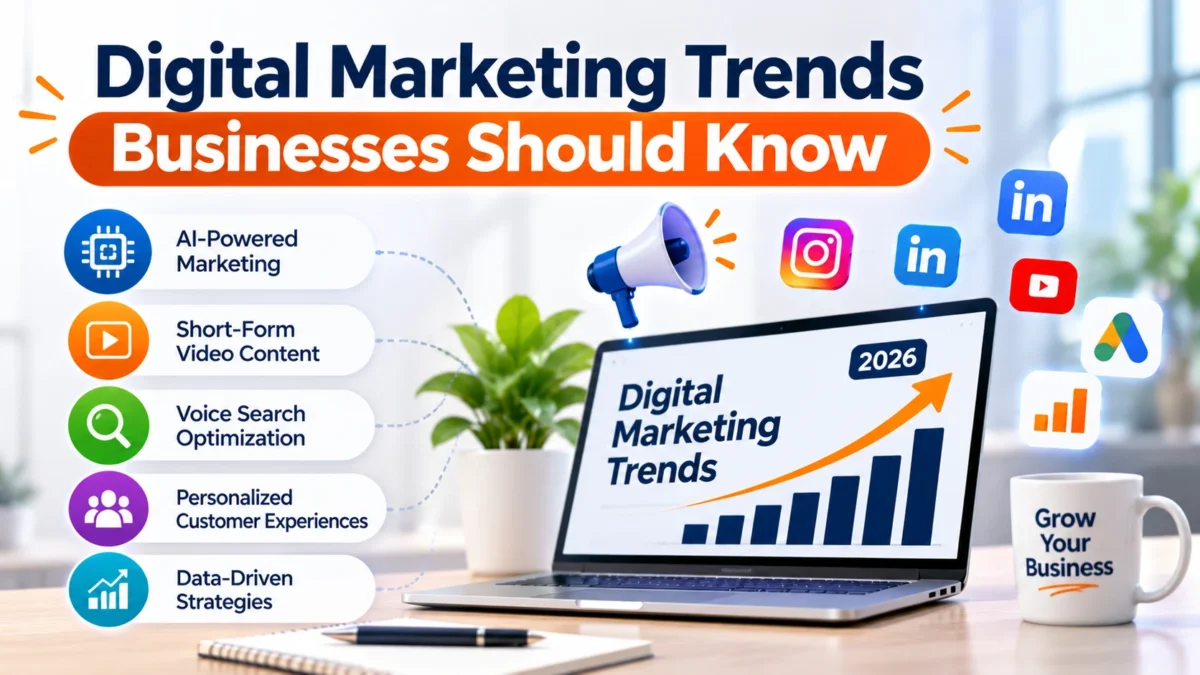
Digital marketing continues to evolve as customer expectations, technology, search behavior, and online platforms change. Businesses that once relied primarily on websites, search engines, email campaigns, and social media now have access to increasingly sophisticated ways to attract, engage, convert, and retain customers.
Understanding the Digital Marketing Trends Businesses Should Know is important for organizations that want to build sustainable online visibility and create meaningful customer experiences. The digital landscape is no longer driven by a single channel. Search, content, social media, artificial intelligence, video, data, personalization, automation, and user experience increasingly work together as part of one connected marketing ecosystem.
For businesses, keeping up with these developments does not mean adopting every new platform or technology. The goal is to understand which trends can support business objectives, improve customer interactions, strengthen brand visibility, and generate measurable results.
This guide explores the most important Digital Marketing Trends Businesses Should Know, how they are influencing modern marketing strategies, and how businesses can incorporate them into their digital growth plans.
Why Businesses Need to Follow Digital Marketing Trends
Digital marketing trends reflect changes in how people discover information, compare products, communicate with brands, and make purchasing decisions.
A customer may discover a business through a search engine, watch a short video about its product, visit the website, read customer reviews, interact with a social media post, and finally contact the company through a form or messaging platform. Each interaction contributes to the overall customer journey.
Businesses that treat every channel independently can create inconsistent experiences. A modern strategy instead connects channels around the customer.
Following digital marketing trends can help businesses:
- Improve online visibility
- Reach audiences at different stages of the buying journey
- Create more relevant content
- Improve website engagement
- Generate qualified leads
- Strengthen customer relationships
- Make better use of marketing data
- Improve marketing efficiency
- Adapt to changes in search behavior
- Build long-term digital authority
The key is not simply to follow trends but to understand why they matter and determine where they fit within a broader marketing strategy.
Artificial Intelligence Is Changing Digital Marketing
Artificial intelligence has become one of the most significant developments in modern digital marketing. AI can support businesses with content research, audience analysis, customer segmentation, predictive insights, automation, personalization, and campaign optimization.
AI-powered marketing tools can process large amounts of information much faster than traditional manual processes. This allows marketers to identify patterns, understand customer behavior, and make data-informed decisions.
However, effective AI marketing requires human oversight. Automatically generated content may lack originality, brand personality, context, or accuracy if it is published without proper review.
Businesses should therefore use AI as a productivity and intelligence layer rather than treating it as a complete replacement for marketing expertise.
A practical AI strategy can include:
- Identifying content opportunities
- Analyzing customer behavior
- Automating repetitive marketing tasks
- Creating content briefs
- Supporting keyword research
- Improving audience segmentation
- Personalizing customer communication
- Analyzing campaign performance
The strongest results usually come from combining automation with human creativity, strategic thinking, and quality control.
Search Engine Optimization Is Becoming More Intent-Focused
Search engine optimization remains an important part of digital marketing, but the way businesses approach SEO is changing.
Traditional SEO often focused heavily on individual keywords, backlinks, and technical optimization. These elements remain relevant, but modern search increasingly emphasizes search intent, topical relevance, content quality, user experience, and credibility.
Businesses should create content that answers the questions behind searches rather than simply inserting keywords into articles.
For example, someone searching for a digital marketing agency may be looking for:
- Services
- Pricing information
- Expertise
- Case studies
- Strategy guidance
- Local providers
- Industry-specific solutions
Understanding this intent allows businesses to create more useful landing pages and content.
A modern SEO strategy should consider:
- Search intent
- Topic clusters
- Semantic relevance
- Helpful content
- Website performance
- Mobile usability
- Internal linking
- Structured content
- Original insights
- Conversion-focused landing pages
SEO should ultimately connect visibility with business outcomes rather than focusing only on rankings.
Search Is Expanding Beyond Traditional Search Engines
One of the important Digital Marketing Trends Businesses Should Know is the diversification of search behavior.
People increasingly discover information through social platforms, video platforms, online communities, maps, marketplaces, voice interfaces, and AI-powered search experiences.
This means businesses should think beyond traditional search engine results pages.
A potential customer might search for a product through a social platform, watch a video demonstration, explore reviews, or ask an AI system for recommendations before visiting a company’s website.
This creates an opportunity for businesses to build a broader digital presence.
Content should therefore be developed for multiple discovery environments while maintaining consistent brand messaging.
Generative AI Search Requires Better Content
AI-powered search experiences are changing how people consume information. Instead of always browsing multiple pages, users may receive summarized answers generated from multiple sources.
This creates a new challenge for businesses: content must be useful enough to be understood, referenced, and trusted within increasingly sophisticated search experiences.
Businesses can prepare by developing content that demonstrates:
- Expertise
- Clear explanations
- Original insights
- Strong topical coverage
- Accurate information
- Transparent authorship
- Useful examples
- Well-structured answers
Businesses should not attempt to manipulate AI search systems with artificial content. Instead, they should focus on building authoritative resources that genuinely answer customer questions.
First-Party Data Is Becoming More Valuable
Data has always played an important role in digital marketing, but changes in privacy expectations and tracking technologies are making first-party data increasingly valuable.
First-party data is information a business collects directly through legitimate customer interactions. Examples include website inquiries, newsletter subscriptions, customer preferences, purchase history, account activity, and feedback.
Businesses can use this information to understand existing customers and develop more relevant marketing experiences.
A responsible first-party data strategy should prioritize:
- Clear consent
- Data security
- Transparent communication
- Relevant personalization
- Responsible data storage
- Appropriate data usage
Businesses should focus on collecting useful information rather than collecting data simply because it is available.
Personalization Is Moving Beyond First Names
Personalization has evolved from simple tactics such as adding a customer’s name to an email.
Modern personalization can involve adapting content, recommendations, offers, website experiences, and communication based on customer behavior and preferences.
For example, a returning visitor could receive content related to the services they previously explored. A customer who has already purchased a product may receive educational content related to that product instead of introductory promotional messaging.
Effective personalization should provide value rather than becoming intrusive.
Businesses should ask:
Does this personalization make the customer’s experience easier, faster, or more relevant?
If the answer is yes, personalization can become a powerful component of the customer journey.
Short-Form Video Continues to Influence Customer Attention
Short-form video has changed how people consume digital content. Concise videos can communicate ideas quickly while combining visual storytelling, demonstrations, education, and entertainment.
Businesses can use short-form video for:
- Product demonstrations
- Behind-the-scenes content
- Tutorials
- Customer questions
- Industry insights
- Educational tips
- Brand storytelling
- Frequently asked questions
The key is to avoid creating video simply because it is popular. Every video should have a clear purpose.
A strong short-form video can answer one question, demonstrate one feature, explain one concept, or communicate one useful idea.
Businesses should also consider accessibility by using readable captions and clear visual communication.
Video Marketing Is Becoming More Educational
Video marketing is no longer limited to advertisements.
Educational video can help businesses build trust before a customer is ready to purchase. Demonstrations, tutorials, expert explanations, product comparisons, and frequently asked questions can reduce uncertainty during the decision-making process.
For service businesses, educational video can also demonstrate expertise.
Instead of constantly promoting a service, businesses can explain common problems and show viewers how to approach them. This approach creates value while positioning the brand as a knowledgeable resource.
Social Media Is Becoming More Community-Driven
Social media marketing is shifting from one-way publishing toward community building.
Posting promotional content regularly is no longer enough to create meaningful engagement. Customers want opportunities to interact, ask questions, provide feedback, and participate in conversations.
Businesses can strengthen social communities through:
- Interactive posts
- Questions and polls
- Educational content
- Customer stories
- Behind-the-scenes content
- Industry discussions
- User-generated content
- Direct responses to comments
Community-focused marketing can help businesses build relationships that extend beyond individual campaigns.
User-Generated Content Can Strengthen Trust
Customers often want evidence from people who have already interacted with a business.
User-generated content can include reviews, testimonials, customer photos, videos, social mentions, case studies, and other forms of authentic customer feedback.
Businesses can encourage customers to share their experiences without manufacturing or manipulating reviews.
Authenticity is essential. The objective is to showcase genuine customer experiences rather than creating artificial social proof.
Influencer Marketing Is Becoming More Niche
Influencer marketing continues to evolve. Large audiences are not always the most important factor when selecting a creator.
A smaller creator with a highly relevant audience can sometimes provide a more contextually appropriate environment for a campaign.
Businesses should evaluate potential partnerships based on factors such as:
- Audience relevance
- Engagement quality
- Content style
- Brand alignment
- Audience demographics
- Transparency
- Previous campaign performance
The objective should be meaningful audience connection rather than follower count alone.
Content Marketing Is Moving Toward Expertise
Publishing large quantities of generic content is becoming less effective as digital content becomes increasingly crowded.
Businesses need content that demonstrates knowledge and provides something genuinely useful.
Expert-led content can include:
- Original research
- Industry analysis
- Detailed guides
- Practical frameworks
- Case studies
- Expert interviews
- Frequently asked questions
- Data-driven insights
A business website should ideally become a useful information resource for its target audience.
This also creates opportunities for internal linking. Related blog posts, service pages, guides, and case studies should be connected naturally so visitors can continue exploring relevant information.
Interactive Content Can Improve Engagement
Interactive experiences can encourage visitors to spend more time engaging with a website.
Examples include:
- Calculators
- Quizzes
- Assessments
- Interactive product selectors
- Cost estimators
- Surveys
- Configurators
Interactive content can also help businesses collect useful information about customer needs.
For example, a service-based business could create an assessment that helps visitors identify which type of solution is appropriate for their situation.
The experience should be simple, relevant, and genuinely useful rather than functioning purely as a lead-generation mechanism.
Conversational Marketing Is Improving Customer Journeys
Customers increasingly expect quick answers.
Conversational marketing can help businesses provide immediate assistance through website chat, messaging platforms, automated responses, and human support.
However, automation should not create unnecessary friction.
A useful conversational experience should help users:
- Find information
- Understand services
- Answer common questions
- Schedule consultations
- Request information
- Navigate the website
- Reach the appropriate team
Businesses should provide clear pathways to human assistance when automated responses are insufficient.
Marketing Automation Is Becoming More Strategic
Automation can help businesses manage repetitive activities while allowing marketing teams to focus on strategy and creativity.
Examples include:
- Email sequences
- Lead nurturing
- Customer onboarding
- Follow-up messages
- Appointment reminders
- Content distribution
- Audience segmentation
- Reporting
The objective should not be to automate everything.
Instead, businesses should identify repetitive tasks where automation improves consistency without reducing the quality of customer interactions.
Email Marketing Remains Relevant
Despite the growth of social media and other channels, email remains an important direct communication channel.
Modern email marketing should focus on relevance rather than volume.
Businesses can segment audiences based on:
- Customer lifecycle
- Interests
- Previous interactions
- Purchase behavior
- Content preferences
- Engagement levels
Personalized and useful email communication can support customer retention and repeat engagement.
Businesses should also monitor metrics such as open rates, click-through rates, conversions, unsubscribes, and revenue contribution rather than focusing on a single metric.
Website User Experience Is a Marketing Strategy
A website is not simply a digital brochure. It is often one of the most important conversion environments in a customer’s journey.
A strong digital marketing campaign can bring thousands of visitors to a website, but poor user experience can prevent those visitors from becoming leads or customers.
Businesses should evaluate:
- Page speed
- Mobile responsiveness
- Navigation
- Content clarity
- Calls to action
- Forms
- Accessibility
- Visual hierarchy
- Trust signals
- Conversion paths
Every page should have a clear purpose.
Visitors should quickly understand what the business offers, who it serves, why it is relevant, and what action they can take next.
Local SEO Remains Important for Location-Based Businesses
Businesses that serve specific geographic markets should not overlook local SEO.
Local search visibility can help customers discover nearby services, stores, professionals, and businesses.
A local SEO strategy can include:
- Accurate business information
- Location-specific website content
- Local landing pages
- Customer reviews
- Consistent business details
- Relevant local references
- Optimized business profiles
Local SEO should accurately represent the locations and services a business actually provides.
Marketing Analytics Should Focus on Business Outcomes
Digital marketing generates a large amount of data, but more data does not automatically mean better decision-making.
Businesses need to identify the metrics that connect marketing activity with meaningful outcomes.
Depending on business objectives, these may include:
- Qualified leads
- Conversion rate
- Customer acquisition cost
- Customer lifetime value
- Revenue
- Return on marketing investment
- Engagement
- Retention
A high number of website visitors may look impressive, but traffic without relevant engagement or conversions may not create meaningful business value.
Analytics should therefore answer questions such as:
Where are qualified customers coming from?
Which content influences conversions?
Where are users leaving the customer journey?
Which campaigns contribute to revenue?
Customer Experience Is Becoming the Center of Digital Marketing
The future of digital marketing is not simply about reaching more people.
It is about creating better experiences throughout the customer journey.
Customers interact with businesses across multiple touchpoints. If those interactions feel disconnected, confusing, or repetitive, the overall brand experience suffers.
A customer-centric digital strategy connects marketing, content, website experience, sales communication, customer support, and retention.
Businesses should map the customer journey and identify opportunities to reduce friction.
Omnichannel Marketing Creates Consistent Brand Experiences
Customers may interact with a business through search, social media, email, websites, messaging platforms, advertisements, and offline channels.
Omnichannel marketing aims to create a consistent experience across these touchpoints.
This does not mean publishing identical content everywhere.
Instead, each channel should have a specific role while maintaining consistent:
- Brand identity
- Messaging
- Customer expectations
- Visual language
- Offers
- Communication standards
Consistency can make a brand easier to recognize and understand.
Privacy and Responsible Marketing Are Becoming Essential
Digital marketing must operate within increasing expectations around privacy, consent, transparency, and data protection.
Businesses should understand the privacy requirements applicable to their markets and ensure that their marketing practices follow appropriate regulations.
Responsible marketing includes:
- Obtaining appropriate consent
- Explaining data usage
- Protecting customer information
- Avoiding misleading communication
- Respecting communication preferences
- Providing appropriate opt-out mechanisms
Trust is a long-term business asset.
How Businesses Can Adapt to Digital Marketing Trends
Businesses do not need to implement every trend simultaneously.
A more practical approach is to evaluate each development based on business objectives.
1. Review Your Current Digital Strategy
Identify what is currently working across SEO, content, social media, email, paid campaigns, website conversion, and customer retention.
2. Understand Your Audience
Study customer needs, questions, objections, search behavior, and purchasing decisions.
3. Identify Relevant Trends
Select trends that directly address customer needs or business challenges.
4. Start With Focused Experiments
Test one or two initiatives instead of launching multiple disconnected campaigns.
5. Measure Business Impact
Establish measurable objectives before beginning an initiative.
6. Improve Based on Data
Use performance data and customer feedback to refine the strategy.
7. Scale What Works
Once an approach demonstrates meaningful results, develop it into a repeatable marketing process.
Building a Future-Ready Digital Marketing Strategy
A future-ready digital marketing strategy should combine technology with strong fundamentals.
Businesses should continue investing in:
Strong websites that provide excellent user experiences.
Useful content that answers customer questions.
SEO that focuses on intent, relevance, and authority.
Data and analytics that support better decisions.
Social media that encourages meaningful engagement.
Video that communicates information effectively.
Automation that improves efficiency.
Personalization that adds genuine customer value.
Privacy that protects customer trust.
The technology will continue to change, but these fundamentals will remain important.
The Importance of Continuous Digital Marketing Adaptation
Digital marketing is not a one-time project.
Search algorithms change. Customer expectations evolve. New platforms emerge. Technologies become more capable. Consumer behavior shifts.
Businesses therefore need a process for reviewing and improving their digital strategy.
Quarterly strategy reviews can help organizations evaluate:
- Search visibility
- Website performance
- Content performance
- Lead quality
- Conversion rates
- Customer engagement
- Campaign efficiency
- New opportunities
Continuous improvement allows businesses to adapt without abandoning the fundamentals that already work.
Frequently Asked Questions About Digital Marketing Trends
What are the most important digital marketing trends businesses should know?
Important trends include artificial intelligence, intent-focused SEO, AI-powered search, first-party data, personalization, short-form video, community-driven social media, content expertise, marketing automation, conversational marketing, analytics, and customer experience.
Is SEO still important for businesses?
Yes. SEO remains an important method for helping customers discover relevant information, products, and services online. However, businesses should focus on search intent, useful content, technical performance, topical authority, and user experience rather than keyword placement alone.
How can small businesses use AI in digital marketing?
Small businesses can use AI to support research, content planning, customer segmentation, automation, data analysis, and repetitive marketing tasks. Human review remains important for accuracy, originality, brand consistency, and strategic decision-making.
Should every business invest in video marketing?
Not necessarily. Video can be valuable when it matches audience preferences and business objectives. Businesses should first identify what information customers need and then determine whether video is an effective way to communicate it.
How can businesses prepare for changes in search?
Businesses should build authoritative, useful, well-structured content, maintain strong technical SEO, understand search intent, improve user experience, and diversify discovery channels instead of depending entirely on one source of traffic.
What is the role of data in digital marketing?
Data helps businesses understand customer behavior, evaluate campaign performance, identify opportunities, and make informed decisions. The most valuable data is not necessarily the largest dataset but information that can support meaningful business decisions responsibly.
Conclusion: Turning Digital Marketing Trends Into Business Opportunities
The digital marketing landscape will continue to evolve, but businesses that understand the underlying changes can adapt more effectively.
The most important Digital Marketing Trends Businesses Should Know are not isolated technologies or temporary tactics. They represent broader changes in how customers search, consume information, evaluate brands, communicate with businesses, and make decisions.
Artificial intelligence is improving marketing capabilities. Search is becoming more intent-driven and increasingly distributed across different platforms. Video continues to capture attention. First-party data is becoming more important. Personalization is becoming more sophisticated. Communities are influencing brand relationships. Analytics is becoming more closely connected to business outcomes.
The opportunity for businesses is to combine these developments into a coherent digital strategy.
Instead of chasing every trend, businesses should focus on understanding their audience, creating useful experiences, measuring meaningful outcomes, and continuously improving their approach.
If you want to evaluate how these Digital Marketing Trends Businesses Should Know can be applied to your business, explore the next step through our digital marketing consultation and contact page.
Ready to Build a Stronger Digital Marketing Strategy?
Digital marketing becomes more effective when strategy, technology, content, SEO, data, and customer experience work together.
If your business needs help identifying the right digital opportunities, improving online visibility, generating qualified leads, or creating a more effective digital strategy, connect with our team.
Start your digital growth journey today by contacting our digital marketing team.