

How Shopify Helps Businesses Grow Online
October 8, 2026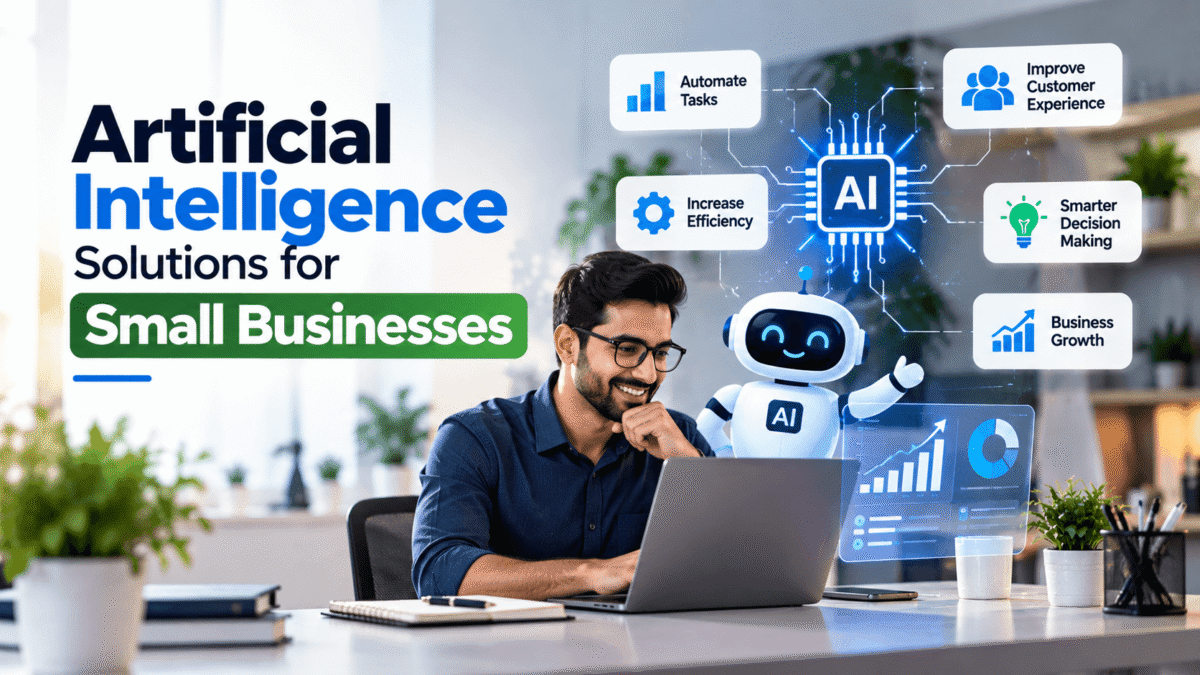
Artificial intelligence is no longer limited to large corporations with extensive technology budgets and dedicated data science teams. Today, Artificial Intelligence Solutions for Small Businesses are becoming increasingly accessible, helping smaller organizations automate routine work, understand customers, improve decision-making, reduce operational costs, and compete more effectively in digital markets.
For a small business, adopting AI does not necessarily mean completely transforming existing systems or investing in complex infrastructure. The most effective approach is often to identify specific business challenges and introduce AI where it can deliver measurable value. From customer support and marketing automation to sales forecasting and document processing, artificial intelligence can support several areas of day-to-day operations.
As AI technologies continue to evolve, small businesses have an opportunity to adopt practical solutions that improve productivity without compromising their existing workflows. The key is understanding where AI can make a genuine difference and selecting solutions that align with business objectives.
What Are Artificial Intelligence Solutions for Small Businesses?
Artificial Intelligence Solutions for Small Businesses are AI-powered technologies, applications, and customized systems designed to address the operational and strategic needs of smaller organizations.
These solutions can analyze information, recognize patterns, generate content, automate repetitive activities, communicate with customers, and assist employees with complex tasks.
Unlike traditional software that typically follows predefined rules, AI systems can process large amounts of information and generate insights or responses based on patterns in the available data.
For example, an AI-enabled customer support system can understand frequently asked questions and provide immediate responses. An AI-powered marketing platform can analyze customer behavior and help businesses personalize campaigns. Similarly, AI can assist with forecasting demand by identifying patterns in historical sales data.
The objective is not simply to use AI because it is a popular technology. Instead, businesses should use artificial intelligence to solve specific problems, improve efficiency, and create better customer and employee experiences.
Why Small Businesses Are Adopting Artificial Intelligence
Small businesses often operate with limited resources. Employees may be responsible for multiple functions, while business owners frequently manage operations, sales, customer relationships, finance, and marketing simultaneously.
This makes efficiency particularly important.
Artificial intelligence can help small businesses reduce the amount of time spent on repetitive processes while allowing employees to focus on activities that require creativity, communication, judgment, and strategic thinking.
Several factors are contributing to the growing adoption of AI among smaller organizations.
Reducing Repetitive Work
Many business processes involve repetitive activities such as data entry, appointment scheduling, email responses, report preparation, invoice processing, and customer follow-ups.
AI can automate or assist with these activities, reducing manual effort and allowing employees to spend more time on higher-value responsibilities.
Improving Customer Experience
Customers increasingly expect fast responses and convenient digital interactions. AI-powered chatbots, virtual assistants, recommendation systems, and automated communication tools can help businesses provide timely support.
For small organizations that cannot maintain large customer service teams, AI can provide additional support without requiring continuous human intervention.
Making Better Use of Business Data
Businesses generate information through sales transactions, websites, customer interactions, marketing campaigns, and internal operations.
However, collecting data does not automatically create value.
AI can help analyze this information, identify patterns, and turn large datasets into actionable insights. This can support better planning and more informed decision-making.
Increasing Operational Efficiency
AI can connect different workflows and reduce unnecessary manual processes. When repetitive activities are automated, businesses can often complete tasks faster and with greater consistency.
This can be particularly valuable for organizations where a small team needs to manage a growing workload.
Key Artificial Intelligence Solutions for Small Businesses
AI can be applied across almost every business function. However, businesses should prioritize solutions based on their actual requirements rather than implementing AI everywhere simultaneously.
Here are several practical applications of artificial intelligence for small businesses.
AI-Powered Customer Support
Customer support is one of the most practical areas for AI adoption.
AI-powered conversational systems can answer common customer questions, provide product information, guide visitors through websites, and direct complex inquiries to human employees.
A properly designed AI support system can operate outside traditional business hours, helping customers receive immediate responses.
For example, a service-based business could use AI to answer questions about services, pricing structures, availability, and appointment procedures.
However, AI should not replace human support in every situation. Complex complaints, sensitive issues, and situations requiring professional judgment should still be transferred to appropriate employees.
The most effective model combines automated assistance with human expertise.
AI for Marketing Automation
Marketing requires continuous effort, including content planning, audience analysis, campaign optimization, email communication, and performance monitoring.
Artificial intelligence can assist with many of these activities.
AI marketing tools can help businesses analyze customer behavior, identify audience segments, generate content ideas, personalize communications, and evaluate campaign performance.
For example, an AI system can analyze previous campaign results and identify patterns in customer engagement. Marketing teams can then use those insights to improve future campaigns.
AI can also help create initial drafts for emails, advertisements, social media content, and website copy. Human review remains important to maintain brand consistency, accuracy, and originality.
AI for Sales and Lead Management
Sales teams often spend considerable time qualifying leads, updating customer records, sending follow-up messages, and analyzing sales pipelines.
AI can automate or assist with these processes.
AI-powered sales systems can evaluate customer interactions, identify potentially valuable leads, recommend follow-up actions, and help sales teams prioritize opportunities.
For small businesses, this can be especially useful because sales employees can spend less time on administrative tasks and more time communicating with potential customers.
AI can also identify patterns in historical sales data that may help businesses understand which types of prospects are more likely to convert.
AI for Business Process Automation
Business process automation is another major application of AI.
Organizations can use intelligent automation for activities such as:
- Document processing
- Data classification
- Invoice handling
- Email management
- Appointment scheduling
- Customer onboarding
- Internal reporting
- Data extraction
- Workflow routing
AI-powered automation becomes particularly valuable when a business receives large quantities of unstructured information.
For example, an AI system can extract relevant information from documents and transfer it into a business application, reducing manual data entry.
AI for Data Analysis and Business Intelligence
Data-driven decision-making is often associated with large organizations, but small businesses can benefit from it as well.
AI can analyze sales figures, customer activity, website performance, inventory information, and other operational data.
Instead of manually reviewing spreadsheets, business owners can use AI-powered analytics systems to identify trends and anomalies.
For example, an AI system may identify:
- Changes in customer purchasing behavior
- Products with increasing demand
- Declining sales patterns
- Marketing channels generating stronger engagement
- Seasonal demand fluctuations
- Operational inefficiencies
These insights can help business owners make decisions based on evidence rather than assumptions.
AI for Content Creation
Content plays an important role in modern digital marketing.
Businesses need website content, blog articles, product descriptions, email campaigns, social media posts, advertisements, and other marketing materials.
AI can accelerate the content development process by generating initial ideas, outlines, drafts, summaries, and variations.
However, businesses should avoid publishing unreviewed AI-generated content.
Human expertise is necessary to verify factual accuracy, maintain brand voice, improve originality, and ensure that content genuinely helps the intended audience.
The best approach is to treat AI as a productivity tool rather than a complete replacement for content strategy.
AI for Inventory and Demand Forecasting
Inventory management can become complicated as a business grows.
Too much inventory can tie up capital, while insufficient inventory can result in missed sales and dissatisfied customers.
AI-based forecasting systems can analyze historical sales, seasonal patterns, purchasing behavior, and other relevant variables to estimate future demand.
This can help businesses make better inventory planning decisions.
For retailers, distributors, manufacturers, and product-based businesses, AI forecasting can become an important part of operational planning.
AI for Human Resources
Small businesses may not have large HR departments, but they still need to manage recruitment, employee communication, onboarding, documentation, and workforce planning.
AI can assist with administrative HR processes.
For example, AI can help organize resumes, schedule interviews, create onboarding documents, answer common employee questions, and summarize internal information.
However, businesses should be particularly careful when applying AI to employment decisions. Automated systems should not make sensitive decisions without appropriate human oversight, review, and compliance controls.
AI for Finance and Accounting
Financial administration involves many repetitive activities.
AI can assist with transaction categorization, document processing, invoice management, financial reporting, anomaly detection, and forecasting.
Automating these activities can reduce administrative workload and help businesses identify potential inconsistencies more quickly.
AI should complement financial professionals rather than replace appropriate accounting review, particularly for tax, compliance, and other decisions that require professional expertise.
Benefits of Artificial Intelligence Solutions for Small Businesses
The value of AI varies depending on the organization, but several potential benefits are common across industries.
Improved Productivity
AI can complete repetitive tasks quickly, allowing employees to focus on activities that require human judgment and creativity.
Lower Operational Workload
Automating routine processes can reduce the number of manual steps required to complete everyday business activities.
Faster Customer Response
AI-powered support tools can respond to common questions immediately, improving responsiveness and accessibility.
Better Decision-Making
AI analytics can identify patterns within business data that may be difficult to detect manually.
Scalable Operations
AI systems can help businesses manage increasing workloads without requiring every additional task to be handled manually.
More Personalized Customer Experiences
AI can analyze customer behavior and support more personalized communication, recommendations, and marketing experiences.
Improved Consistency
Automated workflows can help businesses perform repetitive processes consistently and reduce certain types of manual errors.
How to Choose the Right AI Solution for Your Small Business
Choosing an AI solution requires more than selecting the newest technology.
The right solution should address a genuine business requirement.
Start by identifying repetitive or time-consuming processes within your organization. Determine how much time employees spend on these activities and identify the consequences of delays or errors.
Next, evaluate whether AI can realistically improve the process.
A practical evaluation can include the following questions:
What Business Problem Are You Solving?
Start with the problem rather than the technology.
Instead of saying, “We need AI,” define the actual challenge.
For example:
“We spend several hours every day responding to repetitive customer questions.”
This provides a clear foundation for evaluating an AI customer support solution.
What Data Is Available?
AI systems depend on data. Businesses should understand what information they have, where it is stored, and whether it is accurate enough for the intended application.
Poor-quality data can limit the usefulness of AI-generated results.
What Is the Expected Business Impact?
Businesses should establish measurable objectives.
These could include:
- Reducing processing time
- Increasing qualified leads
- Improving response times
- Reducing administrative work
- Improving customer satisfaction
- Increasing conversion rates
- Reducing operational errors
Defining measurable outcomes makes it easier to determine whether an AI implementation is delivering value.
How Will Employees Use the Solution?
Technology adoption depends heavily on usability.
Employees should understand how the system works, when they should use it, and when human review is required.
An AI solution that employees find difficult to use may provide limited practical value.
Custom Artificial Intelligence Solutions vs. Ready-Made Tools
Small businesses can generally approach AI adoption in two ways.
The first option is to use existing AI-powered software that provides predefined features.
This can be suitable when the business has common requirements and wants to implement a solution quickly.
The second option is to develop a customized AI solution.
Custom AI development can be useful when a business has unique workflows, proprietary data, specialized requirements, or integration needs that standard software cannot adequately address.
For example, a business may need an AI system that connects its website, CRM, internal database, customer support system, and reporting infrastructure.
A customized solution can be designed around those specific requirements.
The appropriate approach depends on the business problem, available budget, technical requirements, data environment, and long-term objectives.
Integrating AI With Existing Business Systems
AI becomes more valuable when it can work with the systems a business already uses.
Instead of creating another isolated application, businesses can integrate AI with existing platforms such as:
- Customer relationship management systems
- E-commerce platforms
- Accounting software
- Enterprise applications
- Websites
- Marketing platforms
- Customer support systems
- Internal databases
Integration allows AI to access relevant information and return useful results within existing workflows.
For example, an AI customer service assistant can connect to a knowledge base and customer information system to provide more relevant responses.
Data Security and Privacy in AI Adoption
Security should be considered before implementing an AI system.
Businesses may process customer information, financial records, employee data, intellectual property, and other sensitive information.
Before adopting an AI solution, organizations should understand how data is collected, processed, stored, transferred, and protected.
Important considerations include:
- Data access controls
- Encryption
- Authentication
- Data retention
- Third-party integrations
- User permissions
- Regulatory requirements
- Human oversight
Businesses should avoid providing sensitive information to AI systems without understanding the applicable privacy and security controls.
Common Mistakes Small Businesses Should Avoid
AI implementation can produce significant benefits, but poor planning can create unnecessary costs and complexity.
Adopting AI Without a Clear Objective
Technology should support a business objective. Implementing AI simply because competitors are discussing it can lead to unnecessary investment.
Automating a Poorly Designed Process
Automation does not automatically fix inefficient workflows.
Businesses should first understand and improve the underlying process.
Ignoring Human Oversight
AI can generate incorrect, incomplete, or inappropriate outputs.
Human review should remain part of workflows where accuracy and judgment are important.
Using Poor-Quality Data
AI systems can only provide useful results when the underlying information is sufficiently accurate and relevant.
Expecting Immediate Transformation
AI implementation may require testing, integration, employee training, monitoring, and continuous improvement.
A phased approach is often more practical than attempting to automate an entire organization at once.
A Practical AI Adoption Strategy for Small Businesses
Small businesses can approach AI implementation through a structured process.
Step 1: Identify Repetitive Processes
Review daily operations and identify activities that consume significant employee time.
Step 2: Prioritize Business Impact
Determine which processes have the greatest potential to improve productivity, customer experience, revenue, or operational efficiency.
Step 3: Evaluate AI Feasibility
Determine whether AI is technically appropriate for the selected process.
Step 4: Start With a Focused Use Case
Rather than implementing multiple systems simultaneously, begin with one clearly defined application.
Step 5: Establish Performance Metrics
Measure results before and after implementation.
Step 6: Train Employees
Employees should understand how to use the system effectively and when human intervention is necessary.
Step 7: Monitor and Improve
AI solutions should be continuously evaluated. Business requirements, customer expectations, data, and technology can change over time.
The Future of Artificial Intelligence for Small Businesses
Artificial intelligence is becoming increasingly integrated into everyday business software.
As AI capabilities continue to develop, small businesses may gain access to more advanced automation, predictive analytics, conversational interfaces, intelligent search, personalized customer experiences, and workflow orchestration.
The most significant shift may not be the introduction of one particular AI tool. Instead, AI is increasingly becoming part of the infrastructure through which businesses operate.
Small businesses that establish strong data practices, efficient workflows, appropriate security controls, and clear technology objectives can create a stronger foundation for future AI adoption.
The future of AI for small businesses is therefore not simply about replacing manual work. It is about creating systems that allow people and technology to work together more effectively.
How Artificial Intelligence Can Create a Competitive Advantage
Competition in many industries depends on speed, customer experience, operational efficiency, and the ability to respond to changing market conditions.
AI can support each of these areas.
A business that responds to customer inquiries faster, understands customer behavior more effectively, automates repetitive operations, and uses data more intelligently can potentially improve its overall operational capabilities.
However, technology itself is not a competitive advantage unless it is implemented effectively.
The real value comes from combining AI with business knowledge, human expertise, quality data, and well-designed processes.
Why Professional AI Implementation Matters
Selecting and implementing an AI solution can become complicated when multiple systems, data sources, security requirements, and business processes are involved.
Professional AI implementation can help businesses identify suitable use cases, define technical requirements, integrate systems, establish workflows, and develop solutions around measurable objectives.
For organizations considering customized AI development, professional guidance can also help determine whether a ready-made platform, AI integration, automation workflow, or custom application is the appropriate approach.
The goal should always be to create practical technology that solves real business problems.
Get Started With Artificial Intelligence Solutions for Small Businesses
Artificial intelligence can provide small businesses with new opportunities to improve productivity, automate operations, understand customers, and make better use of data.
The most effective AI strategy is not necessarily the one with the most advanced technology. It is the strategy that connects technology with a clearly defined business objective.
Whether your organization needs intelligent automation, AI-powered customer support, data analysis, marketing assistance, workflow optimization, or a customized AI application, the first step is understanding where artificial intelligence can create measurable value.
If you are exploring how AI can support your business, discuss your requirements with our team and identify practical opportunities for implementation.
Build Your AI Strategy With the Right Technology Partner
The right AI solution should fit your business processes, technology environment, customer requirements, and long-term goals.
Start by identifying the processes that consume the most time, the areas where customers need faster support, and the business decisions that could benefit from better data analysis.
From there, AI can be introduced strategically and scaled as your business grows.
Ready to explore how AI can transform your business operations?
Artificial intelligence is evolving rapidly, but successful implementation starts with a clear business problem, a practical strategy, and technology designed around measurable outcomes.