

How SEO Helps Businesses Generate Organic Traffic
October 7, 2026
Artificial Intelligence Solutions for Small Businesses
October 9, 2026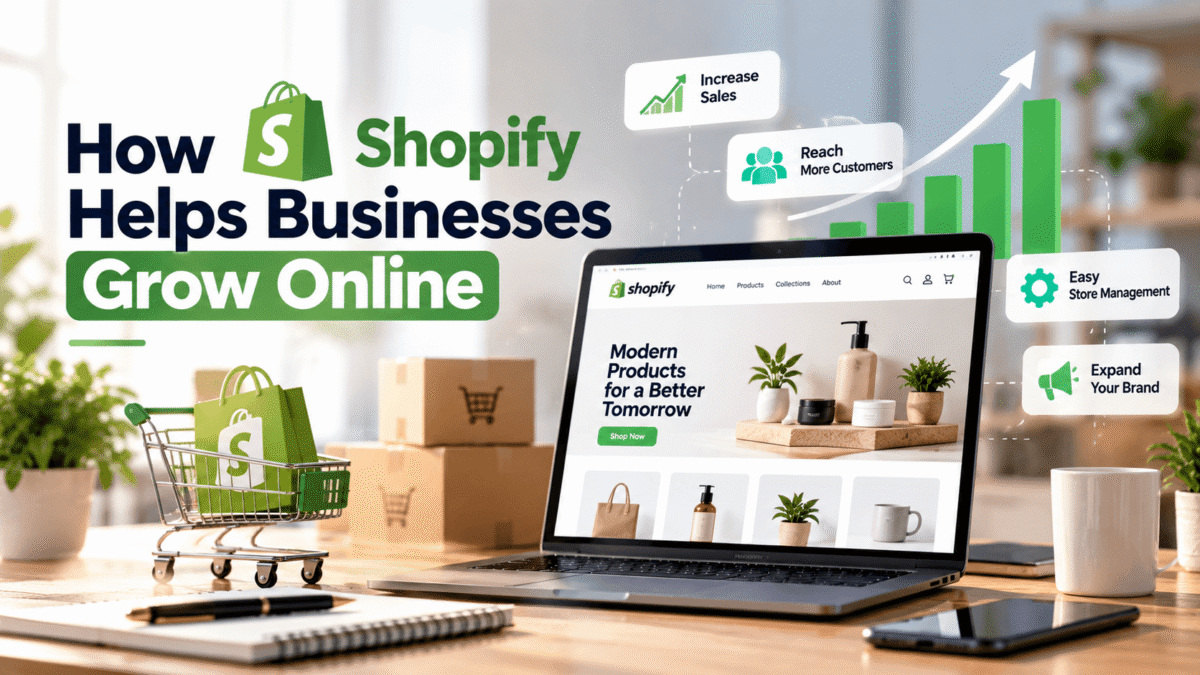
In today’s digital-first marketplace, having an online presence is no longer optional for businesses that want to expand their reach. Customers increasingly discover products online, compare alternatives, read reviews, and make purchasing decisions without visiting a physical store. For businesses looking to establish or strengthen their eCommerce presence, Shopify provides a flexible platform for building, managing, and growing an online store.
But how Shopify helps businesses grow online goes beyond simply creating a digital storefront. A well-planned Shopify store can help businesses improve customer experiences, streamline operations, support marketing activities, manage products efficiently, and create a foundation for long-term digital growth.
Whether you are launching a new online business, moving from traditional retail to eCommerce, or looking to improve an existing online store, Shopify can provide the tools required to build a scalable digital sales channel.
What Is Shopify and Why Is It Important for Online Businesses?
Shopify is an eCommerce platform that enables businesses to create and manage online stores. It provides functionality for product management, payments, inventory, order processing, customer management, storefront design, analytics, and more.
One of the key reasons businesses choose Shopify is its ability to bring many essential eCommerce functions together within one platform. Instead of developing every component of an online store from scratch, businesses can use Shopify as a foundation and customize the store according to their brand, products, customers, and business objectives.
For growing businesses, this can reduce technical complexity while allowing teams to concentrate on marketing, customer relationships, product development, and sales.
The real value of Shopify becomes clearer when considering the different ways an eCommerce platform contributes to business growth.
How Shopify Helps Businesses Grow Online
Shopify can support online business growth across multiple areas, from storefront development and mobile shopping to SEO, marketing, analytics, and operational management.
Here are some of the major ways Shopify can contribute to sustainable eCommerce growth.
1. Shopify Makes It Easier to Build an Online Store
One of the first challenges businesses face when entering eCommerce is building a professional online store.
A successful eCommerce website needs more than product images and a checkout button. It needs clear navigation, organized product categories, compelling product pages, responsive design, secure payment functionality, and a smooth purchasing process.
Shopify provides a structured foundation for creating these experiences.
Businesses can build storefronts around their brand identity, customize layouts, organize products, create collections, and develop pages that guide visitors toward purchasing decisions.
This makes Shopify particularly useful for businesses that want to establish an online sales channel without building an entire eCommerce infrastructure from the ground up.
A professionally designed Shopify store can also create greater confidence among customers. Consistent branding, intuitive navigation, high-quality product presentation, and a straightforward checkout experience can all contribute to a stronger perception of the business.
2. Shopify Supports a Better Customer Shopping Experience
Customer experience has a direct influence on online sales.
Visitors may leave an online store if they cannot find products quickly, struggle to understand product information, encounter confusing navigation, or experience unnecessary friction during checkout.
Shopify allows businesses to build storefronts that prioritize usability.
Important elements such as:
- Clear product categories
- Search functionality
- Product filtering
- Detailed product descriptions
- Product images and media
- Mobile-friendly layouts
- Customer account functionality
- Streamlined checkout
- Multiple payment options
can help create a more convenient shopping journey.
A better customer experience can encourage visitors to explore more products and potentially increase conversions.
For businesses operating in competitive markets, the quality of the online shopping experience can become an important differentiating factor.
3. Shopify Helps Businesses Reach Mobile Shoppers
Mobile devices play an important role in online shopping. Customers may discover products through search engines, social media, advertisements, email campaigns, or direct referrals using smartphones.
Therefore, a Shopify store needs to provide an effective mobile experience.
Responsive Shopify storefronts can adapt their layout to different screen sizes, allowing customers to browse products, read descriptions, view images, and complete purchases from mobile devices.
Mobile optimization is particularly important because a poor mobile experience can create unnecessary barriers between product discovery and purchase.
Businesses should pay attention to mobile navigation, page loading performance, button sizes, product image presentation, checkout usability, and overall readability.
When mobile users can move through the purchasing process comfortably, the store becomes accessible to a broader audience.
4. Shopify Provides a Strong Foundation for SEO
Search engine optimization is an important part of long-term eCommerce growth.
Businesses need customers to discover their products when they search for relevant terms online. Shopify provides several features that can support an effective SEO strategy.
Businesses can optimize elements such as:
- Page titles
- Meta descriptions
- Product descriptions
- Collection pages
- Image alt text
- URLs
- Internal links
- Blog content
- Structured content
However, simply using Shopify does not automatically guarantee high search rankings.
SEO still requires strategic keyword research, high-quality content, technical optimization, internal linking, relevant product information, strong page performance, and ongoing monitoring.
A Shopify store can serve as the technical foundation, while a well-planned SEO strategy helps increase its visibility in organic search.
For businesses targeting customers over the long term, combining Shopify with consistent SEO efforts can create an important source of organic traffic.
5. Shopify Makes Product Management More Organized
As a business grows, managing products manually can become increasingly complicated.
An eCommerce store may contain dozens, hundreds, or even thousands of products. Each product may have different images, descriptions, prices, variants, inventory quantities, and collections.
Shopify provides tools for organizing product information within a centralized system.
Businesses can manage:
- Product names
- Descriptions
- Prices
- Images
- Variants
- Inventory
- Collections
- Product availability
- Product organization
A structured product catalog makes it easier for businesses to maintain consistency across their storefront.
It can also make day-to-day eCommerce management more efficient as the number of products and orders increases.
6. Shopify Supports Business Scalability
One of the most important considerations when selecting an eCommerce platform is scalability.
A business may start with a small product catalog and a limited number of customers. Over time, it may expand into new product categories, markets, customer segments, or sales channels.
The eCommerce platform should be able to support that growth.
Shopify provides a foundation that businesses can build upon as their requirements evolve.
Companies can introduce additional functionality, improve their storefront, integrate business tools, expand product catalogs, and enhance their marketing strategy without necessarily rebuilding the entire online store from scratch.
This makes Shopify useful not only for launching an online business but also for supporting its ongoing development.
7. Shopify Simplifies Online Payment Management
A smooth payment experience is essential for converting customers.
Even when visitors are interested in a product, complicated or unreliable payment processes can result in abandoned purchases.
Shopify supports eCommerce payment functionality that can help businesses provide customers with convenient ways to complete transactions.
Depending on the business location and configuration, merchants can provide suitable payment options to customers while managing orders through the Shopify administration system.
Businesses should still carefully evaluate payment methods based on their target market, transaction costs, customer preferences, security requirements, and operational needs.
The goal is to make payment as straightforward as possible while maintaining a secure and trustworthy purchasing environment.
8. Shopify Helps Businesses Manage Orders Efficiently
As online sales increase, order management becomes increasingly important.
A growing business needs a reliable process for tracking purchases from the moment an order is placed through fulfillment and delivery.
Shopify provides centralized order management functionality that allows businesses to keep track of online orders and related information.
This can help businesses manage their daily operations more effectively.
A well-organized order process can reduce manual work, improve fulfillment accuracy, and provide customers with a more consistent purchasing experience.
Operational efficiency becomes increasingly valuable as order volumes grow.
9. Shopify Provides Useful Analytics and Business Insights
Business growth depends on making informed decisions.
An online store generates valuable data about customer behavior, product performance, sales activity, and traffic sources.
Shopify provides analytics and reporting capabilities that businesses can use to understand their eCommerce performance.
Depending on the available reports and integrations, businesses can analyze areas such as:
- Sales performance
- Order volume
- Product performance
- Customer behavior
- Traffic
- Conversion activity
- Average order value
- Store performance
These insights can help business owners identify patterns and make better decisions.
For example, if certain products consistently generate more sales, the business may decide to give those products greater visibility. If customers frequently leave during a particular stage of the purchasing journey, the business can investigate potential usability or checkout issues.
Data turns an online store from a simple sales channel into a measurable business asset.
10. Shopify Supports Content Marketing
eCommerce growth is not only about product pages.
Content marketing can help businesses attract potential customers earlier in the buying journey.
A Shopify store can incorporate content such as:
- Blog articles
- Buying guides
- Product education
- Industry insights
- Tutorials
- FAQs
- Comparison content
- Product-use ideas
This type of content can target informational search queries and help businesses establish relevance around their products and industry.
For example, a business selling interior products could publish articles explaining design trends, material selection, maintenance advice, or buying considerations.
Useful content can attract organic traffic while also helping potential customers understand the products before making a purchase.
11. Shopify Can Support Social Media Marketing
Social media can play an important role in product discovery.
Customers may encounter a product through social content before they ever visit a company’s website.
Shopify can be integrated into broader digital marketing workflows, allowing businesses to connect their online store with relevant marketing and social commerce channels.
This can help create a more connected customer journey.
A customer might discover a product through social media, visit the Shopify store, review product information, add the product to their cart, and complete the purchase online.
Connecting marketing activity with the eCommerce store can make it easier for businesses to convert digital attention into measurable sales.
12. Shopify Helps Businesses Create a Consistent Brand Experience
Brand identity matters in eCommerce.
Customers should be able to recognize a business through its colors, typography, imagery, messaging, product presentation, and overall visual language.
Shopify allows businesses to customize storefront designs so they can create an online shopping environment that reflects their brand.
A strong branded store can communicate professionalism and consistency.
Instead of presenting products through a generic marketplace environment, businesses can create a dedicated digital destination where customers can learn about the company, explore products, understand the brand story, and make purchases.
This can be especially valuable for businesses that want to build long-term brand equity rather than compete only on price.
13. Shopify Can Help Improve Conversion Rates
Driving traffic to an online store is only one part of eCommerce growth.
Businesses also need to convert visitors into customers.
Conversion rate optimization focuses on improving the elements that influence purchasing decisions.
A Shopify store can be optimized through improvements to:
- Product page layouts
- Calls to action
- Product photography
- Product descriptions
- Reviews
- Navigation
- Search functionality
- Checkout experience
- Mobile usability
- Page speed
Small improvements can sometimes make a meaningful difference when applied consistently.
For example, clearer product information may reduce customer uncertainty. Better product photography may help customers understand the product more effectively. Simplified navigation may help visitors find relevant products faster.
Shopify provides the storefront infrastructure, while conversion optimization strategies help businesses improve the effectiveness of that storefront.
14. Shopify Supports Customer Retention
Acquiring new customers is important, but retaining existing customers is equally valuable for long-term growth.
A Shopify store can become a central platform for building ongoing customer relationships.
Businesses can use customer data and marketing integrations to develop strategies such as:
- Follow-up communication
- Product recommendations
- Promotional campaigns
- New product announcements
- Educational content
- Loyalty initiatives
- Repeat-purchase campaigns
The objective is to keep the brand relevant after the first purchase.
A customer who has already experienced a successful transaction may become more likely to purchase again when the business provides useful communication and a consistent experience.
15. Shopify Helps Businesses Expand Their Product Catalog
Businesses often evolve after entering eCommerce.
A company may initially sell a limited selection of products and later introduce complementary products, new variants, collections, or premium offerings.
Shopify’s product management capabilities allow businesses to organize expanding catalogs.
Businesses can create product collections and organize products according to categories, use cases, customer needs, styles, materials, or other relevant attributes.
This creates opportunities for cross-selling and product discovery.
For example, a customer purchasing one product may discover related products through carefully structured collections and recommendations.
16. Shopify Can Support Omnichannel Commerce
Modern customers often interact with brands across multiple channels.
They may discover a product through search engines, social media, email, advertisements, physical stores, or referrals.
Businesses therefore increasingly need to think beyond a single sales channel.
Shopify can act as an eCommerce foundation within a broader omnichannel strategy.
Businesses can connect online selling with other customer touchpoints and create a more unified commerce experience.
The objective is to make the brand accessible wherever customers choose to interact with it while keeping product and order management organized.
17. Shopify Reduces Some Technical Complexity
Building a custom eCommerce platform requires significant technical resources.
Businesses may need to manage hosting, security, payment infrastructure, product systems, checkout functionality, integrations, maintenance, and updates.
Shopify handles many core platform-level responsibilities, allowing businesses to focus more of their resources on their products, customers, marketing, and growth strategy.
This does not eliminate the need for technical expertise. Professional design, development, performance optimization, SEO, integrations, and ongoing maintenance can still be important.
However, Shopify can provide a more structured foundation than building every component independently.
18. Shopify Allows Businesses to Integrate Additional Tools
Different businesses have different operational requirements.
A growing business may need email marketing, accounting, customer relationship management, analytics, inventory management, customer support, shipping, marketing automation, or other functionality.
Shopify supports integrations and apps that can extend the functionality of an online store.
This flexibility allows businesses to build an eCommerce ecosystem around their specific requirements.
The important consideration is to avoid installing unnecessary tools simply because they are available.
Every additional integration should have a clear purpose and should contribute to business efficiency, customer experience, revenue generation, or another measurable objective.
19. Shopify Supports International Online Growth
The internet allows businesses to reach customers beyond their local markets.
For businesses with suitable products, logistics, and market positioning, international eCommerce can create opportunities for geographic expansion.
Shopify can provide a foundation for businesses looking to build online sales across different markets.
International expansion requires more than translating a website. Businesses should consider currencies, taxation, shipping, product regulations, payment preferences, customer support, localization, and regional SEO.
When these factors are addressed strategically, an eCommerce platform can support a business as it moves from a local customer base toward broader markets.
20. Shopify Gives Businesses a Foundation for Continuous Optimization
Online stores should not be treated as finished projects.
Customer behavior changes. Search trends change. Competitors introduce new experiences. Products evolve. Marketing channels develop.
A successful eCommerce business therefore needs continuous optimization.
Shopify provides a platform that businesses can continue refining over time.
Businesses can test different layouts, improve product pages, optimize navigation, create new content, introduce additional products, analyze performance, and refine marketing campaigns.
This creates a continuous improvement cycle:
Analyze → Optimize → Test → Measure → Improve
Over time, these improvements can help create a more effective digital sales channel.
Why Professional Shopify Development Matters
Although Shopify makes eCommerce development more accessible, creating a successful online store still requires strategic planning.
A basic store and a high-performing eCommerce website are not necessarily the same thing.
Professional Shopify development can help businesses address areas such as:
- Custom storefront design
- Responsive development
- Theme customization
- Conversion optimization
- Technical SEO
- Product structure
- Navigation architecture
- Third-party integrations
- Performance optimization
- Custom functionality
- Analytics implementation
The objective should be to create a store that supports specific business goals rather than simply launching a website with products.
Businesses should begin by defining their target audience, product positioning, customer journey, conversion goals, and long-term growth objectives.
The Shopify store can then be developed around those requirements.
Shopify SEO: Turning Store Traffic Into Long-Term Growth
SEO deserves particular attention because organic search can provide sustainable visibility.
A Shopify SEO strategy should include both technical and content-related elements.
Important areas include:
Keyword Research
Businesses should identify keywords that potential customers actually use when searching for products, solutions, and information.
Product Page Optimization
Product pages should provide clear, useful, original information while naturally incorporating relevant search terms.
Collection Page Optimization
Collection pages can target broader commercial keywords and help customers discover groups of related products.
Internal Linking
Internal links help users navigate between related content and products while creating a logical site structure for search engines.
Image Optimization
Product images should be appropriately compressed and accompanied by descriptive alt text where relevant.
Content Marketing
Blogs, guides, FAQs, and educational content can target informational searches and support the broader SEO strategy.
Technical Performance
Page speed, mobile usability, crawlability, structured data, and overall technical health can influence the effectiveness of an SEO strategy.
SEO should therefore be treated as an ongoing process rather than a one-time setup task.
Shopify and Conversion-Focused Web Design
A visually attractive website is valuable, but design should also support business objectives.
Every major element of a Shopify store should have a purpose.
The navigation should help customers find products.
Product photography should communicate quality and details.
Descriptions should answer customer questions.
Calls to action should make the next step obvious.
The checkout should minimize unnecessary friction.
The design should also communicate trust.
Professional branding, transparent product information, clear policies, secure payment functionality, customer reviews, and accessible support information can all contribute to customer confidence.
A conversion-focused Shopify website combines visual design, usability, content, technology, and customer psychology into one cohesive experience.
How Shopify Helps Small and Growing Businesses
Shopify can be particularly useful for small and growing businesses that need to establish an online presence while managing limited resources.
Instead of investing in a highly complex custom commerce infrastructure at the beginning, businesses can establish a structured eCommerce foundation and expand it as their requirements grow.
This allows businesses to start with essential functionality and progressively introduce more advanced features.
Growth can happen through several stages:
Stage 1: Establish
Build the online store, organize products, define branding, and establish the customer journey.
Stage 2: Attract
Use SEO, content marketing, social media, advertising, and other channels to generate qualified traffic.
Stage 3: Convert
Optimize product pages, navigation, checkout, and calls to action.
Stage 4: Retain
Develop customer relationships and encourage repeat purchases.
Stage 5: Scale
Expand product offerings, markets, channels, integrations, and marketing activities.
This approach allows businesses to treat Shopify as an evolving business platform rather than simply a website.
Common Mistakes to Avoid When Building a Shopify Store
While Shopify offers many capabilities, businesses can still make strategic mistakes.
Creating a Store Without a Clear Target Audience
A store should be designed around the people it intends to serve.
Understanding customer needs, preferences, problems, and purchasing behavior should influence product presentation and website structure.
Using Generic Product Descriptions
Copied or overly generic descriptions may fail to communicate product value.
Businesses should create original, informative content that answers customer questions.
Ignoring Mobile Users
A store that works well on desktop but performs poorly on smartphones can lose potential customers.
Mobile usability should be considered from the beginning.
Installing Too Many Apps
More functionality does not always mean a better store.
Unnecessary apps can increase complexity and potentially affect performance.
Businesses should install tools based on actual requirements.
Focusing Only on Traffic
Getting visitors is not enough.
Businesses should monitor whether visitors are engaging with products, adding items to carts, completing purchases, and returning later.
Neglecting SEO
Launching a Shopify store without an SEO strategy can limit its discoverability.
SEO should be incorporated into the website structure and content from the beginning.
Measuring Shopify Growth
Businesses should define measurable indicators to understand whether their eCommerce strategy is working.
Useful metrics may include:
- Organic traffic
- Conversion rate
- Revenue
- Average order value
- Customer acquisition cost
- Cart abandonment rate
- Repeat purchase rate
- Product performance
- Customer lifetime value
- Returning visitor percentage
The right metrics depend on the business model.
A new store may initially focus on traffic and conversion activity, while a mature store may focus more heavily on customer retention, lifetime value, profitability, and repeat purchases.
The key is to connect website analytics with actual business objectives.
The Future of Shopify Growth
eCommerce will continue to evolve as customer expectations, technology, and digital marketing change.
Businesses will increasingly need online stores that are fast, mobile-friendly, personalized, accessible, and easy to navigate.
Successful Shopify strategies will therefore involve more than selecting a theme and uploading products.
They will require continuous attention to:
- User experience
- Search visibility
- Content
- Performance
- Data
- Personalization
- Customer retention
- Conversion optimization
- Omnichannel marketing
Businesses that treat their Shopify store as a continuously evolving digital asset can respond more effectively to changing customer expectations.
Final Thoughts on How Shopify Helps Businesses Grow Online
Understanding how Shopify helps businesses grow online requires looking beyond the technical process of creating an online store.
Shopify can provide the foundation businesses need to establish an eCommerce presence, organize products, manage orders, accept payments, analyze performance, support marketing, improve customer experiences, and scale their digital operations.
However, the platform itself is only one part of the equation.
Long-term eCommerce growth depends on the combination of technology, strategy, branding, SEO, content, customer experience, marketing, analytics, and continuous optimization.
A Shopify store should therefore be developed around the business’s actual objectives and customer journey.
Whether your goal is to launch a new online store, redesign an existing Shopify website, improve search visibility, increase conversions, or build a scalable eCommerce ecosystem, having the right strategy can make the difference between simply having an online store and building a productive digital sales channel.
Build a Shopify Store Designed for Growth
Ready to turn your eCommerce idea into a professional, scalable online store? Our team can help you plan, design, develop, optimize, and improve your Shopify presence around your business goals.
Talk to our team about your Shopify project and take the next step toward building an online store designed for sustainable growth.