
Digital Catalogue vs Printed Catalogue: Which Is Better?
October 28, 2026
Corporate Film vs Promotional Video: What’s the Difference?
November 2, 2026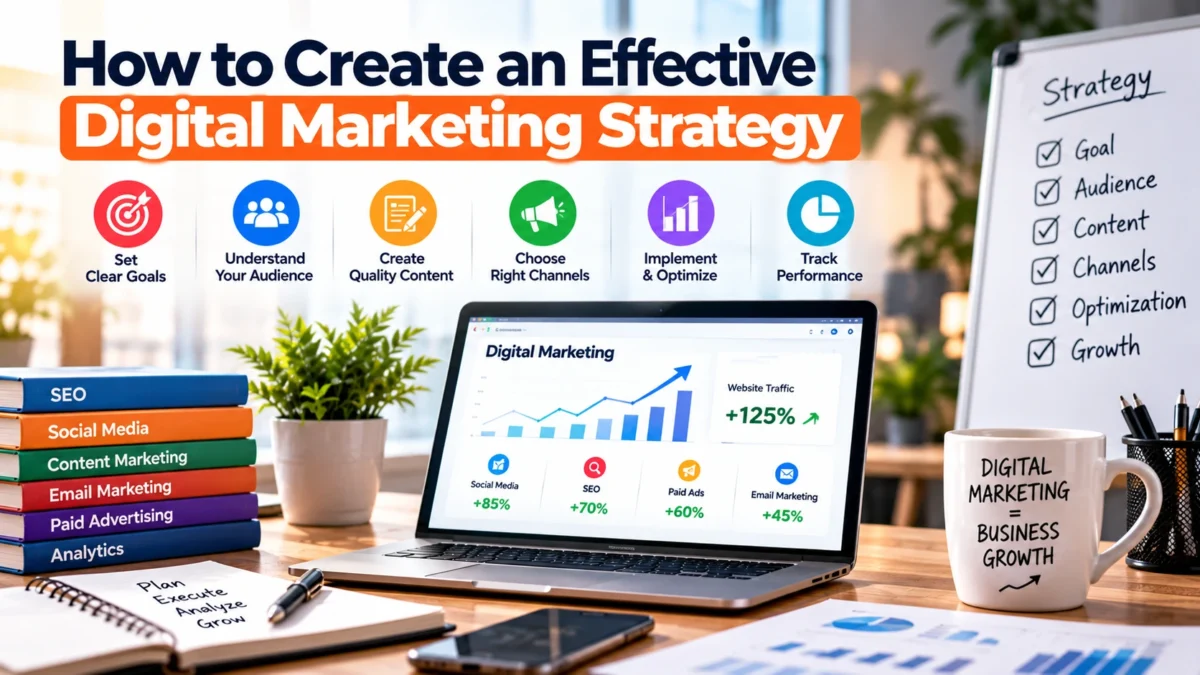
Digital marketing has become an essential part of how businesses build visibility, attract customers, generate leads, and increase revenue. However, simply having a website, posting on social media, or running paid advertisements does not automatically create successful digital marketing results. Businesses need a clear, measurable, and adaptable strategy that connects marketing activities with specific business objectives.
Learning How to Create an Effective Digital Marketing Strategy involves understanding your audience, defining measurable goals, researching competitors, selecting the right digital channels, developing valuable content, managing advertising campaigns, measuring performance, and continuously optimizing your approach.
A strong digital marketing strategy provides direction to every online marketing activity. Instead of investing time and money into disconnected campaigns, businesses can create a coordinated system where search engine optimization, content marketing, social media, email marketing, paid advertising, and conversion optimization work toward common objectives.
This guide explains how to develop an effective digital marketing strategy from the ground up and how businesses can create a sustainable framework for long-term online growth.
What Is a Digital Marketing Strategy?
A digital marketing strategy is a structured plan that explains how a business will use digital channels and marketing technologies to achieve its business and marketing goals.
These channels may include:
- Search engines
- Websites
- Social media platforms
- Email marketing
- Content marketing
- Paid advertising
- Video marketing
- Online marketplaces
- Mobile marketing
- Marketing automation
A strategy determines which channels should be used, who the business wants to reach, what message should be communicated, what content should be created, how campaigns should be measured, and how marketing resources should be allocated.
An effective strategy is not simply a list of marketing activities. It is a framework that connects business goals, customer needs, marketing channels, content, budgets, and measurable outcomes.
For example, a business trying to increase qualified leads may prioritize SEO, landing pages, educational content, search advertising, and conversion optimization. A business focused on brand awareness may place greater emphasis on social media, video content, display advertising, and thought leadership.
The right strategy depends on the business model, target audience, industry, available resources, and desired outcomes.
Why Is a Digital Marketing Strategy Important?
Without a clearly defined strategy, digital marketing can become reactive and inconsistent. Businesses may publish content without a purpose, run advertising campaigns without measurable objectives, or spend money on channels that do not effectively reach their customers.
A strategic approach provides several important benefits.
Creates Clear Marketing Direction
A digital marketing strategy establishes priorities. Instead of trying every available marketing channel, businesses can identify the channels most relevant to their audience and objectives.
Improves Resource Allocation
Marketing budgets, employees, technology, and time are limited. A strategy helps businesses allocate resources toward activities with the greatest potential business impact.
Builds Audience Understanding
Effective digital marketing begins with knowing the customer. Research helps businesses understand customer needs, motivations, objections, search behavior, and purchasing decisions.
Makes Marketing Measurable
A strategy establishes key performance indicators that allow businesses to evaluate whether campaigns are producing meaningful results.
Supports Long-Term Growth
Individual campaigns may generate short-term results, but a comprehensive strategy creates marketing assets such as organic search visibility, content libraries, customer databases, brand recognition, and conversion systems.
How to Create an Effective Digital Marketing Strategy
Creating a successful strategy requires a systematic approach. The following steps provide a practical framework that businesses can adapt to their objectives and industry.
1. Define Your Business and Marketing Goals
The first step in creating a digital marketing strategy is determining what the business wants to accomplish.
Marketing goals should support broader business objectives rather than exist independently.
Common digital marketing goals include:
- Increasing website traffic
- Generating qualified leads
- Increasing online sales
- Improving conversion rates
- Increasing brand awareness
- Growing an email subscriber base
- Increasing customer retention
- Improving customer engagement
- Expanding into new markets
- Reducing customer acquisition costs
Avoid vague objectives such as “get more traffic” or “increase social media engagement.”
Instead, establish measurable goals.
For example:
Increase organic website traffic by 30% within six months.
Or:
Generate 100 qualified leads per month through organic search and paid advertising.
Clear objectives make it easier to select channels, establish budgets, and measure progress.
2. Use SMART Marketing Goals
One useful framework for setting marketing objectives is the SMART methodology.
Goals should be:
- Specific
- Measurable
- Achievable
- Relevant
- Time-bound
For example, “increase website traffic” is not sufficiently specific.
A stronger objective could be:
Increase qualified organic traffic to service pages by 25% over the next six months.
This objective provides a measurable target and a defined timeframe.
SMART goals also help marketing teams determine whether their strategy is working. If performance falls below expectations, the team can identify the gap and adjust campaigns accordingly.
3. Identify and Understand Your Target Audience
Understanding your target audience is one of the most important parts of digital marketing strategy development.
Your audience determines what you communicate, where you communicate it, and how you position your products or services.
Research factors such as:
- Age
- Location
- Profession
- Industry
- Income level
- Interests
- Purchasing behavior
- Digital habits
- Pain points
- Common objections
- Buying motivations
- Search behavior
- Preferred communication channels
Businesses should go beyond basic demographic information.
For example, knowing that your target audience consists of business owners is useful, but understanding their actual problems is more valuable.
What challenges are they trying to solve?
What information do they search for?
What prevents them from purchasing?
What factors influence their decision?
The answers can directly influence your content strategy, website messaging, advertisements, and offers.
4. Create Detailed Buyer Personas
Buyer personas turn audience research into practical customer profiles.
A buyer persona represents a specific segment of your ideal customer and can include:
- Background
- Business or professional role
- Goals
- Challenges
- Pain points
- Buying triggers
- Objections
- Preferred content
- Search behavior
- Purchasing preferences
For example, a B2B service provider might create a persona representing a marketing manager who needs reliable lead generation but has limited internal resources.
This persona can influence content topics, landing page messaging, advertising campaigns, and lead nurturing sequences.
However, personas should be based on real research whenever possible rather than assumptions.
5. Conduct Market and Competitor Research
Competitor research helps businesses understand the digital environment in which they operate.
Analyze competitors’:
- Website structure
- Service positioning
- Content topics
- Search visibility
- Social media activity
- Advertising messages
- Landing pages
- Calls to action
- Customer reviews
- Content formats
- Conversion opportunities
The objective is not to copy competitors.
Instead, identify gaps and opportunities.
For example, competitors may focus heavily on basic educational content while customers are looking for detailed implementation guides, comparisons, case studies, calculators, or practical resources.
Those gaps can become opportunities for differentiation.
6. Perform Keyword Research
Search engine optimization should be integrated into the digital marketing strategy from the beginning.
Keyword research helps identify what potential customers are searching for online.
Keywords can be categorized into several groups.
Informational Keywords
These searches indicate that the user is looking for information.
Examples include:
- What is digital marketing?
- How does SEO work?
- How to create a marketing strategy
Commercial Keywords
These searches indicate that the user is researching potential solutions.
Examples include:
- Best digital marketing services
- SEO agency for small business
- Digital marketing packages
Transactional Keywords
These searches indicate stronger purchase intent.
Examples include:
- Hire digital marketing agency
- Digital marketing consultant
- SEO services near me
A balanced SEO strategy should target different stages of the customer journey.
7. Build a Strong Website Foundation
Your website is often the central asset of a digital marketing strategy.
Paid advertising, SEO, social media, email marketing, and content campaigns frequently direct users toward website pages.
Therefore, the website should provide a strong user experience.
Important considerations include:
- Mobile responsiveness
- Fast loading speed
- Clear navigation
- Logical page structure
- Strong messaging
- Search-friendly content
- Clear calls to action
- Secure browsing
- Accessible design
- Optimized landing pages
Each important page should have a clear purpose.
A service page should explain the service and encourage an appropriate next step. A product page should communicate value and facilitate purchase. A blog article should educate readers and guide them toward relevant resources.
8. Develop a Content Marketing Strategy
Content marketing is an important component of a comprehensive digital marketing strategy.
Instead of producing content randomly, businesses should develop content around audience needs and business objectives.
Content can include:
- Blog articles
- Guides
- Case studies
- Videos
- Infographics
- Ebooks
- Whitepapers
- Webinars
- Frequently asked questions
- Social media posts
- Email newsletters
A useful content strategy should answer three questions:
Who is the content for?
What problem does it solve?
What business objective does it support?
For example, an educational blog can attract organic traffic, build authority, answer customer questions, and introduce readers to relevant products or services.
9. Create Content for Every Stage of the Customer Journey
Customers do not always purchase immediately after discovering a business.
The customer journey generally includes several stages.
Awareness
At this stage, users are discovering a problem or learning about a topic.
Content should educate and attract attention.
Consideration
Users are evaluating possible solutions.
Content such as comparisons, detailed guides, case studies, and service explanations can help.
Decision
Users are ready to take action.
Strong landing pages, testimonials, product information, pricing details, demonstrations, and clear calls to action can support conversion.
Retention
After the purchase, businesses can use email marketing, educational resources, customer support, and personalized communication to strengthen the relationship.
A complete digital marketing strategy should address each stage rather than focusing exclusively on acquisition.
10. Develop a Search Engine Optimization Strategy
SEO can provide long-term organic visibility when implemented strategically.
A comprehensive SEO strategy should include:
- Keyword research
- Search intent analysis
- Technical SEO
- On-page optimization
- Content development
- Internal linking
- Image optimization
- Site architecture
- Local SEO where relevant
- Authority development
- Performance monitoring
SEO should not be treated as simply adding keywords to pages.
Search engines increasingly evaluate the usefulness, relevance, quality, and overall experience provided by content.
Businesses should therefore prioritize genuinely useful information that satisfies the user’s search intent.
11. Build a Social Media Marketing Strategy
Social media can help businesses increase visibility, communicate with audiences, distribute content, and build relationships.
However, businesses do not necessarily need to maintain an active presence on every platform.
Choose platforms based on:
- Target audience
- Content format
- Industry
- Marketing objectives
- Available resources
- Audience engagement
A social media strategy should define:
- Content themes
- Posting frequency
- Visual style
- Brand voice
- Engagement approach
- Community management
- Performance metrics
Consistency is generally more valuable than publishing large amounts of disconnected content.
12. Use Paid Advertising Strategically
Paid advertising can provide immediate visibility and help businesses reach specific audience segments.
Common forms include:
- Search advertising
- Display advertising
- Social advertising
- Video advertising
- Remarketing
- Shopping campaigns
Paid campaigns should have clearly defined objectives.
Possible objectives include:
- Website traffic
- Lead generation
- Sales
- App installations
- Brand awareness
- Remarketing
Each campaign should direct users toward a relevant landing page and include appropriate tracking.
Do not evaluate paid advertising only by impressions or clicks. Businesses should also analyze metrics such as qualified leads, conversion rate, cost per acquisition, revenue, and return on advertising spend.
13. Create Conversion-Focused Landing Pages
Driving traffic to a website is only one part of digital marketing.
Businesses also need to convert visitors into leads or customers.
Landing pages should generally contain:
- A clear headline
- Relevant supporting information
- Benefits
- Trust elements
- Appropriate visuals
- A strong call to action
- A simple conversion process
Avoid overwhelming visitors with unnecessary information.
The landing page should align closely with the advertisement, search query, email, or content that brought the visitor there.
This alignment can improve relevance and reduce friction.
14. Develop an Email Marketing Strategy
Email marketing provides businesses with a direct communication channel.
A strong email strategy can support:
- Lead nurturing
- Customer onboarding
- Product education
- Promotions
- Customer retention
- Content distribution
- Re-engagement
Instead of sending identical messages to every subscriber, businesses can segment audiences according to interests, behavior, customer stage, or previous interactions.
Useful email sequences may include welcome emails, educational campaigns, abandoned-cart messages, onboarding sequences, and re-engagement campaigns.
15. Establish a Strong Brand Message
Digital marketing channels may differ, but the brand experience should remain consistent.
Your messaging should communicate:
- Who you are
- What you offer
- Who you serve
- What problem you solve
- Why customers should consider your solution
Consistency should extend across:
- Website
- Social media
- Advertising
- Content
- Landing pages
A consistent message makes the brand easier to recognize and understand.
16. Create a Marketing Funnel
A digital marketing funnel helps businesses understand how users move from awareness to conversion.
A basic funnel can include:
Awareness → Interest → Consideration → Conversion → Retention
Different marketing channels can support different stages.
For example:
SEO and social media can attract new audiences.
Educational content can develop interest.
Case studies and service pages can support consideration.
Landing pages and sales processes can facilitate conversion.
Email marketing and customer support can support retention.
Understanding this relationship helps businesses create a more coordinated strategy.
17. Set a Digital Marketing Budget
An effective strategy must account for available resources.
Budget categories may include:
- Advertising
- SEO
- Content production
- Website development
- Marketing software
- Design
- Video production
- Analytics
- Email marketing
- Agency or consultant services
Instead of distributing the budget equally across every channel, businesses should prioritize channels based on objectives, audience behavior, historical performance, and available resources.
Budget allocation should also remain flexible.
If one channel consistently generates qualified business results while another produces weak outcomes, future investment can be adjusted accordingly.
18. Define Key Performance Indicators
Key performance indicators, or KPIs, help businesses determine whether digital marketing activities are producing meaningful results.
Potential KPIs include:
- Website sessions
- Organic traffic
- Keyword visibility
- Engagement rate
- Leads
- Qualified leads
- Conversion rate
- Cost per lead
- Customer acquisition cost
- Revenue
- Return on investment
- Email engagement
- Customer retention
The correct KPI depends on the campaign objective.
For example, brand awareness campaigns may focus on reach and engagement, while lead-generation campaigns should place greater emphasis on qualified leads and cost per acquisition.
19. Implement Analytics and Tracking
Without reliable data, marketing decisions become difficult.
Businesses should establish tracking before launching major campaigns.
Important tracking systems may include:
- Website analytics
- Search performance monitoring
- Conversion tracking
- Advertising platform tracking
- CRM integration
- Call tracking
- Email analytics
- UTM parameters
Tracking should connect marketing activity to business outcomes whenever possible.
For example, instead of simply measuring how many visitors came from an advertising campaign, businesses should determine how many visitors became qualified leads or customers.
20. Test and Optimize Your Strategy
Digital marketing is not a one-time activity.
Campaigns should be continuously tested and improved.
Businesses can test:
- Headlines
- Calls to action
- Landing page layouts
- Ad messaging
- Content formats
- Email subject lines
- Audience segments
- Offers
- Creative assets
A/B testing can help determine which versions perform better under controlled conditions.
However, testing should be based on a clear hypothesis rather than random changes.
For example:
Hypothesis: A shorter lead form will increase completed submissions because users encounter less friction.
The test can then compare conversion performance between the original and revised forms.
21. Create a Digital Marketing Calendar
A marketing calendar helps coordinate campaigns across channels.
A monthly calendar can include:
- Blog publishing
- Social media content
- Email campaigns
- Advertising campaigns
- Promotional campaigns
- Video content
- SEO updates
- Website improvements
The calendar should connect individual activities to broader objectives.
For example, if a business plans to promote a new service in a particular month, the marketing calendar might include a supporting blog article, social content, email campaign, search campaign, landing page, and remarketing campaign.
This creates a coordinated campaign rather than disconnected marketing activities.
22. Focus on Customer Experience
Digital marketing does not end when someone clicks an advertisement or submits a form.
The entire customer experience affects business results.
Consider what happens after:
- A customer fills out a form.
- Someone requests pricing.
- A user makes a purchase.
- A visitor subscribes to an email list.
- A customer contacts support.
Slow responses, complicated forms, confusing navigation, and inconsistent communication can reduce the effectiveness of otherwise strong marketing campaigns.
Marketing and customer experience should therefore work together.
23. Use Automation Where Appropriate
Marketing automation can reduce repetitive manual tasks and improve communication.
Automation can support:
- Email sequences
- Lead nurturing
- Customer onboarding
- Appointment reminders
- Follow-up communication
- Audience segmentation
- Reporting
- Lead notifications
Automation should enhance customer communication rather than replace genuine interaction.
The objective is to deliver relevant communication at appropriate stages of the customer journey.
24. Review Your Digital Marketing Strategy Regularly
A digital marketing strategy should evolve as customer behavior, market conditions, search trends, technology, and business objectives change.
Conduct regular reviews of:
- Campaign performance
- Website traffic
- Conversion rates
- SEO performance
- Content performance
- Advertising costs
- Lead quality
- Customer acquisition costs
- Revenue contribution
Monthly reviews can identify tactical improvements, while quarterly or semiannual strategy reviews can help determine whether the overall direction remains appropriate.
Common Digital Marketing Strategy Mistakes
Even businesses with active digital marketing programs can experience poor results because of strategic mistakes.
Marketing Without Clear Objectives
Without defined goals, it becomes difficult to determine whether campaigns are successful.
Targeting Everyone
Trying to appeal to everyone often produces generic messaging.
Focusing Only on Traffic
High website traffic does not necessarily mean high-quality leads or revenue.
Ignoring Conversion Optimization
Attracting visitors without creating an effective conversion experience can waste marketing investment.
Publishing Content Without Strategy
Content should serve a defined audience need and business objective.
Using Too Many Channels
Managing every available channel can spread resources too thin.
Ignoring Data
Marketing decisions should be supported by measurable evidence wherever possible.
Failing to Adapt
A strategy that worked previously may require modification as audiences and market conditions change.
How to Measure the Success of a Digital Marketing Strategy
Success should be evaluated according to business objectives.
For lead generation, businesses may monitor:
- Qualified leads
- Cost per lead
- Conversion rate
- Lead-to-customer rate
- Customer acquisition cost
For ecommerce, important metrics may include:
- Sales
- Conversion rate
- Average order value
- Customer acquisition cost
- Revenue per visitor
- Repeat purchases
For SEO, businesses may monitor:
- Organic traffic
- Search visibility
- Keyword rankings
- Organic conversions
- Indexed pages
- Click-through rates
For content marketing, useful measurements can include:
- Organic traffic
- Engagement
- Time spent on content
- Content-assisted conversions
- Leads generated
- Returning visitors
The key is to connect marketing metrics with meaningful business outcomes.
How Long Does It Take to See Digital Marketing Results?
The timeframe varies according to the strategy, industry, competition, budget, existing online presence, and selected channels.
Paid advertising can generate traffic and leads relatively quickly when campaigns are properly configured.
SEO and content marketing generally require more time because organic visibility develops progressively.
Brand building and customer retention can also take time to produce measurable results.
Businesses should therefore avoid judging an entire strategy based on a very short period.
Instead, establish realistic milestones and evaluate performance over appropriate timeframes.
How to Build a Sustainable Digital Marketing Strategy
Long-term digital marketing success requires consistency.
Businesses should focus on building marketing assets that become more valuable over time.
These assets can include:
- High-quality website content
- Organic search visibility
- Email databases
- Customer relationships
- Brand recognition
- Useful educational resources
- Conversion-focused landing pages
- Customer data
- Marketing processes
A sustainable strategy balances short-term acquisition with long-term growth.
Paid campaigns may help generate immediate opportunities, while SEO, content, email marketing, and customer retention can contribute to longer-term value.
A Practical Digital Marketing Strategy Framework
A simple framework can help businesses organize their strategy:
1. Business Objectives
Define what the business wants to achieve.
2. Target Audience
Identify who the business needs to reach.
3. Market Research
Understand competitors, customer behavior, and market opportunities.
4. Digital Channels
Select channels based on audience behavior and objectives.
5. Content Strategy
Create useful content for different customer journey stages.
6. Conversion Strategy
Build landing pages and experiences designed to generate meaningful actions.
7. Measurement
Establish KPIs, analytics, and conversion tracking.
8. Optimization
Review data, test campaigns, and continuously improve performance.
This framework provides a foundation that can be adapted for startups, established businesses, ecommerce brands, B2B organizations, local businesses, and service providers.
Final Thoughts on How to Create an Effective Digital Marketing Strategy
Understanding How to Create an Effective Digital Marketing Strategy requires more than selecting a few online channels and publishing content regularly. Effective digital marketing depends on alignment between business objectives, audience needs, messaging, technology, content, distribution, conversion, and measurement.
The most important principle is to build a strategy around the customer and the desired business outcome.
Start by defining measurable goals. Research your audience. Understand the competitive environment. Select appropriate channels. Build useful content. Optimize your website and landing pages. Track meaningful metrics. Test your campaigns and continuously improve them.
Digital marketing is an ongoing process rather than a one-time project. Businesses that consistently analyze performance and adapt their strategy can create stronger digital visibility, better customer experiences, and more sustainable growth.
If you need professional guidance to develop a digital marketing strategy tailored to your business goals, audience, and growth objectives, contact our team to discuss your digital marketing requirements and explore how a structured approach can strengthen your online presence.
Frequently Asked Questions About Digital Marketing Strategy
What is the first step in creating a digital marketing strategy?
The first step is to define clear business and marketing objectives. Once the objectives are established, you can identify your target audience, select appropriate channels, develop content, and determine how success will be measured.
What are the main components of a digital marketing strategy?
Major components can include SEO, content marketing, social media marketing, paid advertising, email marketing, website optimization, conversion optimization, analytics, and customer retention.
How do I choose the right digital marketing channels?
Choose channels based on your target audience, business objectives, available resources, customer journey, and historical performance. Not every business needs to use every digital channel.
Why is SEO important for digital marketing?
SEO can help businesses attract relevant organic traffic from search engines. A strong SEO strategy can improve online visibility and provide a sustainable source of website visitors and potential customers.
How often should a digital marketing strategy be reviewed?
Marketing performance should be monitored regularly, while the broader strategy can be reviewed monthly, quarterly, or according to the business’s planning cycle. Major changes in market conditions or business objectives may require an earlier review.
Can small businesses use digital marketing effectively?
Yes. Small businesses can use focused digital marketing strategies to reach specific audiences. Concentrating resources on a few relevant channels can be more practical than attempting to manage every available platform.
What makes a digital marketing strategy effective?
An effective strategy connects measurable business objectives with audience research, relevant digital channels, useful content, conversion opportunities, reliable tracking, and continuous optimization.