
Brand Identity vs Brand Image: What’s the Difference?
October 26, 2026
How to Create an Effective Digital Marketing Strategy
October 30, 2026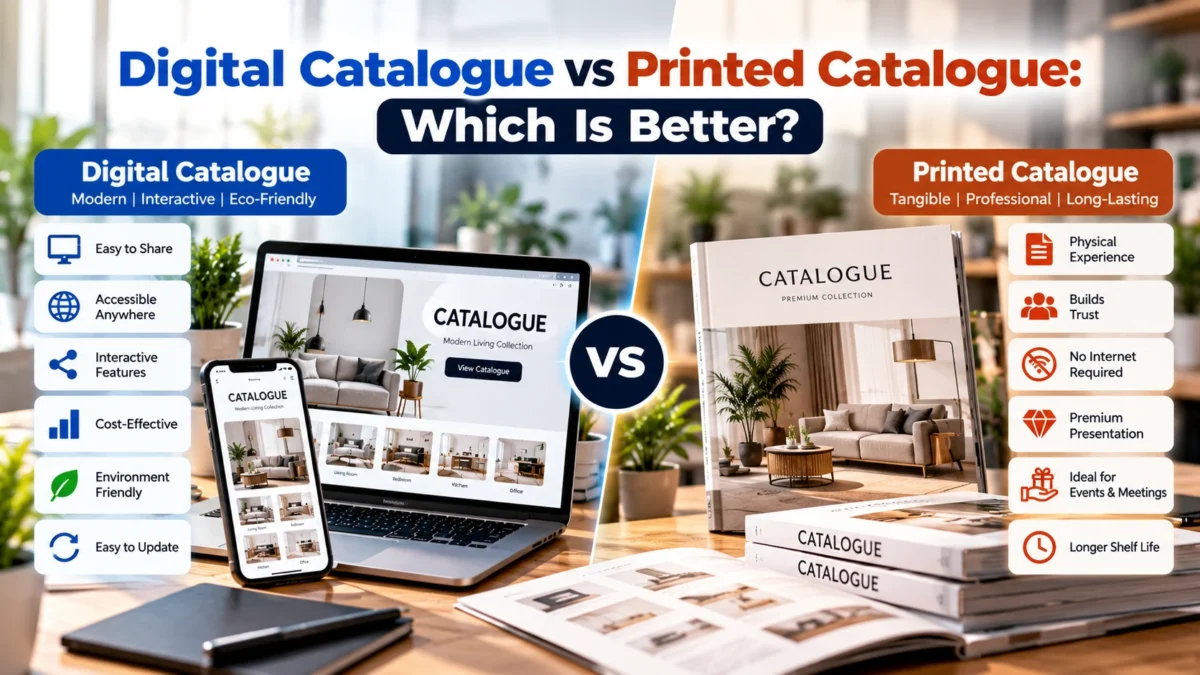
When businesses need to showcase their products or services, a catalogue remains one of the most effective marketing and sales tools. However, the way catalogues are created and distributed has changed significantly. Businesses today can choose between a digital catalogue that customers can access online and a printed catalogue that provides a physical browsing experience.
This creates an important question: Digital Catalogue vs Printed Catalogue: Which Is Better?
The answer depends on several factors, including your target audience, industry, sales process, budget, distribution strategy, customer preferences, and marketing objectives. A digital catalogue can provide convenience, instant access, interactive features, and easy updates, while a printed catalogue can deliver a tangible brand experience and work effectively in face-to-face sales environments.
For businesses looking to improve product presentation and customer communication, understanding the differences between digital and printed catalogues is essential. Rather than choosing a format simply because it is popular, businesses should evaluate which option aligns with their customers and sales journey.
In this guide, we explore digital catalogue vs printed catalogue, their advantages and disadvantages, costs, usability, SEO opportunities, customer experience, sustainability, and the situations where each format can be more suitable.
What Is a Digital Catalogue?
A digital catalogue is an electronic version of a product or service catalogue that customers can view using a computer, smartphone, tablet, or other internet-connected device.
Digital catalogues can be delivered in several formats. They may be downloadable PDF documents, interactive online catalogues, web-based product catalogues, or digital brochures integrated into a company’s website.
Unlike traditional catalogues, digital versions can include interactive elements such as clickable product links, videos, animations, enquiry buttons, downloadable specifications, image galleries, and direct links to product pages.
A well-designed digital catalogue can therefore function as more than a simple collection of product images. It can become an important part of a company’s digital sales and marketing ecosystem.
For example, a product catalogue can allow users to:
- Browse product categories
- View high-resolution product images
- Read specifications
- Download technical information
- Submit enquiries
- Visit individual product pages
- Contact the sales team
- Watch product videos
- Access pricing or quotation information
- Share products with other decision-makers
This makes digital catalogues particularly useful for businesses that regularly update their products or serve customers across different locations.
What Is a Printed Catalogue?
A printed catalogue is a physical marketing document containing information about a company’s products, services, collections, or offerings.
Printed catalogues have traditionally been used across industries such as manufacturing, interior products, fashion, furniture, building materials, electronics, hospitality, and wholesale distribution.
A printed catalogue may contain product photography, descriptions, technical specifications, product codes, dimensions, finishes, colour options, applications, company information, and contact details.
The biggest advantage of a printed catalogue is its physical presence.
A salesperson can hand a catalogue to a customer during a meeting, showroom visit, exhibition, dealer meeting, or business presentation. Customers can browse the catalogue without requiring an internet connection or digital device.
Printed catalogues can also create a strong physical representation of a brand. Paper quality, typography, photography, binding, layout, and finishing can all influence how customers perceive the company.
Digital Catalogue vs Printed Catalogue: Key Differences
The biggest difference between digital and printed catalogues is how customers access and interact with the information.
A digital catalogue exists electronically and can potentially reach customers anywhere. A printed catalogue exists physically and requires production, storage, transportation, and distribution.
Here are some of the major differences.
| Factor | Digital Catalogue | Printed Catalogue |
|---|---|---|
| Accessibility | Available through digital devices | Requires physical copy |
| Distribution | Instant online distribution | Physical distribution required |
| Updates | Easy to update | Requires reprinting |
| Production cost | Generally lower for repeated updates | Printing and finishing costs |
| Interactivity | Supports links, videos and buttons | Mostly static |
| Internet dependency | Often required | Not required |
| Physical experience | Limited | Strong |
| Sharing | Easy through links or files | Requires physical handover |
| Storage | Digital storage | Physical storage |
| Sustainability | Reduces paper usage | Requires paper and printing |
| Personal interaction | Mostly digital | Strong during direct sales |
| Longevity | Easy to maintain digitally | Physical copy can remain useful |
Neither format is universally better. Each solves different business and customer needs.
Advantages of a Digital Catalogue
Digital catalogues have become increasingly important because customers now expect information to be available quickly and conveniently.
Easy Global Distribution
One of the biggest benefits of a digital catalogue is distribution.
A company can send a catalogue to customers through email, messaging platforms, websites, QR codes, social media, or sales communication.
A single digital catalogue can potentially reach customers across multiple cities, states, or countries without requiring physical shipping.
For businesses serving dealers, distributors, architects, designers, retailers, or international buyers, this can significantly simplify product communication.
Easy to Update
Product information frequently changes.
New collections are introduced, discontinued products are removed, specifications are updated, and product photography may change.
Updating a printed catalogue requires redesigning, printing, and distributing a new edition.
A digital catalogue can be updated much more efficiently.
Businesses can replace outdated information, add new products, modify specifications, and update contact details without producing thousands of new physical copies.
Interactive Product Experience
Digital catalogues can provide an interactive browsing experience.
Instead of displaying only static information, a digital catalogue can connect customers to additional resources.
For example, a product entry can include:
- View Product
- Download Specification
- Request a Quote
- Explore Collection
- Watch Video
- Contact Sales
This creates a direct connection between product discovery and customer action.
Better Integration With Digital Marketing
A digital catalogue can be connected with a company’s broader online presence.
For example, a catalogue can direct visitors to relevant landing pages, product pages, enquiry forms, downloadable resources, and contact pages.
Businesses can also distribute catalogue links through email campaigns and other digital marketing channels.
This makes the catalogue part of the overall customer journey instead of being an isolated marketing document.
Convenient for Customers
Customers can access digital catalogues from their smartphones, tablets, or computers.
They do not need to carry a physical catalogue.
A buyer attending a meeting can open the catalogue instantly and search for a particular product or collection.
For businesses dealing with large product ranges, this convenience can make product discovery considerably easier.
Lower Long-Term Distribution Requirements
Once a digital catalogue has been created, distribution can be repeated without printing additional copies.
This can be particularly useful for companies with large sales networks.
Instead of sending boxes of catalogues to multiple locations, a company can distribute a digital link or file.
Disadvantages of a Digital Catalogue
Digital catalogues also have limitations.
Device Dependency
Customers need a smartphone, tablet, computer, or another digital device to access the catalogue.
Depending on the format, they may also need an internet connection.
Screen Fatigue
Large product catalogues can be difficult to browse on small screens if they are poorly designed.
A PDF that works well on a desktop may not provide the same experience on a smartphone.
Responsive design and mobile-friendly layouts are therefore important.
Less Physical Brand Experience
A digital catalogue cannot replicate the physical experience of premium paper, texture, binding, or printed photography.
For brands where tactile presentation plays an important role, this can be a limitation.
Poor Design Can Reduce Engagement
Simply converting a printed catalogue into a PDF does not automatically create a good digital catalogue.
Large files, confusing navigation, tiny text, excessive pages, and weak mobile optimization can make digital catalogues frustrating.
The digital format needs to be designed specifically for digital consumption.
Advantages of a Printed Catalogue
Despite the growth of digital marketing, printed catalogues continue to have value.
Strong Physical Presence
A printed catalogue creates something tangible that customers can hold and browse.
This can be particularly useful during sales meetings, showroom visits, exhibitions, dealer meetings, and business presentations.
Effective for Face-to-Face Sales
Sales representatives can use printed catalogues as a structured presentation tool.
Instead of relying entirely on a phone or laptop, the salesperson can physically point to products, compare pages, discuss specifications, and make notes.
This can make the sales conversation more interactive.
Premium Brand Experience
High-quality printing can communicate a sense of professionalism.
Paper thickness, photography, typography, colour reproduction, cover design, binding, and finishing can all contribute to the overall brand experience.
For premium products, a carefully designed catalogue can become an important physical brand asset.
Works Without Internet Access
Printed catalogues do not require Wi-Fi, mobile data, batteries, or a screen.
Customers can browse them anywhere.
This can be useful in locations where internet connectivity is inconsistent or where customers prefer physical documentation.
Useful at Exhibitions and Events
Printed catalogues can be effective at trade exhibitions, conferences, showrooms, dealer meetings, and business events.
Visitors can take a catalogue with them after the event, allowing the brand to remain physically present after the initial interaction.
Disadvantages of a Printed Catalogue
Printing Costs
Printing requires spending on paper, ink, production, finishing, binding, packaging, and transportation.
Large catalogues can become expensive, particularly when produced in high quantities.
Difficult to Update
Once a catalogue is printed, the information cannot be changed.
If a product is discontinued or a specification changes, existing copies may contain outdated information.
Storage Requirements
Large quantities of printed catalogues require physical storage.
Businesses also need to manage inventory and distribution.
Physical Distribution
Printed catalogues need to be transported to sales teams, dealers, customers, showrooms, or events.
This makes distribution slower and more resource-intensive than sharing a digital file.
Limited Tracking
A printed catalogue does not automatically provide information about which pages customers viewed or which products generated the most interest.
Digital catalogues can potentially be connected with analytics systems, depending on how they are implemented.
Digital Catalogue vs Printed Catalogue for Business Marketing
When comparing digital catalogue vs printed catalogue, businesses should consider their complete marketing strategy rather than looking only at production costs.
A digital catalogue works particularly well when the company wants:
- Wider distribution
- Fast updates
- Interactive product information
- Easy sharing
- Website integration
- Digital lead generation
- Reduced printing requirements
- Convenient mobile access
A printed catalogue may be more appropriate when the company wants:
- Physical product presentation
- Face-to-face sales support
- Premium tactile branding
- Exhibition distribution
- Showroom use
- Dealer meetings
- Offline product browsing
The most suitable choice depends on the business model.
Digital Catalogue vs Printed Catalogue: Which Is More Cost-Effective?
Cost is one of the most important considerations.
A printed catalogue has direct production costs. These can include design, paper, printing, finishing, binding, packaging, shipping, and storage.
Digital catalogues generally reduce many of these recurring physical expenses.
However, digital does not mean free.
A professionally designed digital catalogue may require investment in:
- Graphic design
- UX planning
- Copywriting
- Product photography
- Development
- Interactive features
- Website integration
- Content management
- Digital distribution
The correct comparison should therefore consider the total cost of ownership rather than only the initial production cost.
For businesses that frequently change their product range, the ability to update digital content may create significant operational advantages.
Which Catalogue Is Better for SEO?
If search engine visibility is a major goal, digital catalogues can offer more opportunities than traditional printed catalogues.
However, an important distinction must be made between a simple PDF and an SEO-optimized web catalogue.
Search engines can discover and index certain digital documents, but a website-based catalogue can provide more opportunities for structured content, page-level optimization, internal linking, metadata, image optimization, and user engagement.
Businesses can create individual product or collection pages containing:
- SEO-friendly titles
- Descriptive content
- Optimized images
- Product specifications
- Internal links
- Relevant keywords
- Frequently asked questions
- Enquiry forms
This can make the catalogue part of a broader SEO strategy.
For businesses investing in organic search visibility, a web-based digital catalogue can therefore provide significant advantages over a purely printed catalogue.
Digital Catalogue vs Printed Catalogue for Customer Experience
Customer experience should be one of the primary factors when deciding between formats.
Digital catalogues provide speed and convenience.
Customers can search, click, zoom, share, and access additional information.
Printed catalogues provide physical interaction.
Customers can flip through pages, make notes, compare products physically, and retain the catalogue for future reference.
The best experience depends on the customer’s situation.
A customer browsing products on a smartphone may prefer digital content. A buyer sitting in a showroom with a sales representative may appreciate a printed catalogue.
Understanding the customer journey is therefore more important than following a single format.
Which Catalogue Is Better for Product-Based Businesses?
Product-based businesses often have large collections and regularly introduce new products.
For such businesses, digital catalogues can simplify product management and distribution.
Consider a company with hundreds of products distributed through dealers and sales representatives.
Printing a new catalogue every time the product range changes can become inefficient.
A digital catalogue can be updated and redistributed much faster.
However, printed catalogues can still be valuable during sales meetings and physical product presentations.
This is why many product-focused businesses can benefit from using both formats strategically.
Digital Catalogue vs Printed Catalogue for B2B Businesses
B2B customers often require detailed product information before making purchasing decisions.
They may need specifications, dimensions, technical documentation, product codes, certifications, application information, and collection details.
Digital catalogues can make this information easier to distribute.
A sales representative can send the catalogue immediately after a meeting.
The customer can then share it internally with procurement teams, architects, designers, management, or other decision-makers.
Printed catalogues can complement this process during meetings and presentations.
Therefore, B2B businesses should consider how catalogue content fits into their complete sales funnel.
Should You Choose a Digital Catalogue or Printed Catalogue?
Instead of asking whether digital catalogues or printed catalogues are universally better, businesses should ask which format is better for a specific use case.
Choose a digital catalogue when your priority is:
- Online accessibility
- International distribution
- Fast updates
- Product sharing
- Digital lead generation
- Website integration
- Interactive content
- Reduced physical distribution
Choose a printed catalogue when your priority is:
- Physical presentations
- Showroom sales
- Exhibitions
- Dealer meetings
- Premium tactile branding
- Offline browsing
- Face-to-face selling
If your business has diverse customer groups, using both formats may provide greater flexibility.
Why a Hybrid Catalogue Strategy Can Work
A hybrid approach combines digital convenience with physical brand experience.
For example, a company can maintain a comprehensive digital catalogue while printing a carefully selected version for sales meetings and exhibitions.
The printed catalogue can focus on important collections or flagship products, while the digital version contains the complete and regularly updated product range.
QR codes can connect physical catalogues to digital product pages.
This creates a bridge between offline and online marketing.
A customer browsing a printed product page can scan a QR code and immediately access additional specifications, images, videos, or enquiry forms.
This approach makes the physical catalogue more useful without abandoning the benefits of digital communication.
How to Create an Effective Digital Catalogue
A successful digital catalogue should not simply replicate a printed document.
Start with a clear information architecture.
Organize products into logical categories and collections.
Use high-quality product photography and consistent visual presentation.
Make navigation intuitive.
Use readable typography and sufficient spacing.
Include clickable calls to action where appropriate.
Optimize the catalogue for mobile devices.
Keep file sizes manageable when using downloadable documents.
If possible, connect product entries to relevant website pages.
Most importantly, keep product information accurate and current.
How to Create an Effective Printed Catalogue
A printed catalogue requires careful planning because changes after production can be expensive.
Begin with a clear page structure.
Use consistent product photography, typography, colour systems, and spacing.
Make specifications easy to locate.
Avoid overcrowding pages with excessive information.
Select paper and finishing based on the brand positioning and intended audience.
Before mass printing, carefully proofread product codes, dimensions, descriptions, contact details, and other important information.
A printed catalogue should function as both a sales tool and a physical representation of the brand.
The Role of Catalogue Design in Brand Perception
Whether digital or printed, catalogue design has a direct impact on how customers perceive a business.
A catalogue should communicate more than product information.
It should reflect the company’s visual identity, positioning, quality standards, and personality.
Important design elements include:
- Typography
- Colour palette
- Photography
- Layout
- Product hierarchy
- White space
- Icons
- Information structure
- Brand consistency
A poorly designed catalogue can make high-quality products appear less professional.
A well-structured catalogue can make product information easier to understand while strengthening brand recognition.
Digital Catalogue vs Printed Catalogue: Final Comparison
The debate around Digital Catalogue vs Printed Catalogue: Which Is Better? does not have one universal answer.
Digital catalogues provide accessibility, flexibility, easy distribution, interactive features, and simpler updates. They are especially useful for businesses with frequently changing product ranges and customers located across multiple markets.
Printed catalogues provide tangibility, physical engagement, strong presentation value, and offline accessibility. They remain useful for showrooms, exhibitions, dealer meetings, and face-to-face sales.
The right decision should be based on the company’s customers, product range, sales process, distribution model, budget, and marketing objectives.
For many businesses, the most practical strategy is not to choose one format exclusively.
A digital-first catalogue supported by strategically produced printed catalogues can provide the benefits of both approaches.
Conclusion: Digital Catalogue vs Printed Catalogue: Which Is Better?
So, Digital Catalogue vs Printed Catalogue: Which Is Better?
The answer depends on what your business needs the catalogue to accomplish.
If you need rapid distribution, easy updates, digital accessibility, interactive content, and integration with online marketing, a digital catalogue can be highly effective.
If you need a physical sales tool for meetings, showrooms, exhibitions, or premium product presentations, a printed catalogue can remain valuable.
For businesses operating across multiple customer touchpoints, combining both formats can create a more flexible catalogue strategy.
The most important factor is not simply whether the catalogue is digital or printed. It is whether the catalogue presents your products clearly, communicates your brand professionally, provides useful information, and makes it easy for customers to take the next step.
If you are planning a professionally designed catalogue or want to improve how your products are presented online, you can contact our team to discuss your catalogue design and digital marketing requirements.
Frequently Asked Questions About Digital Catalogue vs Printed Catalogue
Is a digital catalogue better than a printed catalogue?
A digital catalogue can be more convenient for online distribution, frequent updates, interactive content, and wider accessibility. A printed catalogue can be more effective for physical presentations, exhibitions, showrooms, and face-to-face sales.
Are digital catalogues cheaper than printed catalogues?
Digital catalogues can reduce recurring printing, storage, and distribution expenses. However, professional design, development, content creation, and maintenance still involve costs.
Can a digital catalogue help with SEO?
A digital catalogue can support SEO when it is integrated with an optimized website. Individual product and collection pages can provide opportunities for keyword targeting, internal linking, optimized images, and useful search-focused content.
Should a business use both digital and printed catalogues?
Yes. A hybrid strategy can be useful when a business serves customers through both online and offline channels. Digital catalogues can support online discovery and distribution, while printed catalogues can support physical sales interactions.
How often should a digital catalogue be updated?
A digital catalogue should be updated whenever important product information changes. New products, discontinued products, specifications, pricing, contact details, and product images should be reviewed regularly.
What should a professional product catalogue include?
A professional catalogue can include product names, product codes, descriptions, specifications, dimensions, images, applications, collections, technical information, company details, and clear calls to action.
What is the best format for a digital catalogue?
The best format depends on the purpose. A downloadable PDF can work well for sharing, while a web-based catalogue can provide stronger navigation, SEO opportunities, analytics, interactive features, and direct connections to product pages.