
Digital Marketing Trends Businesses Should Know
November 23, 2026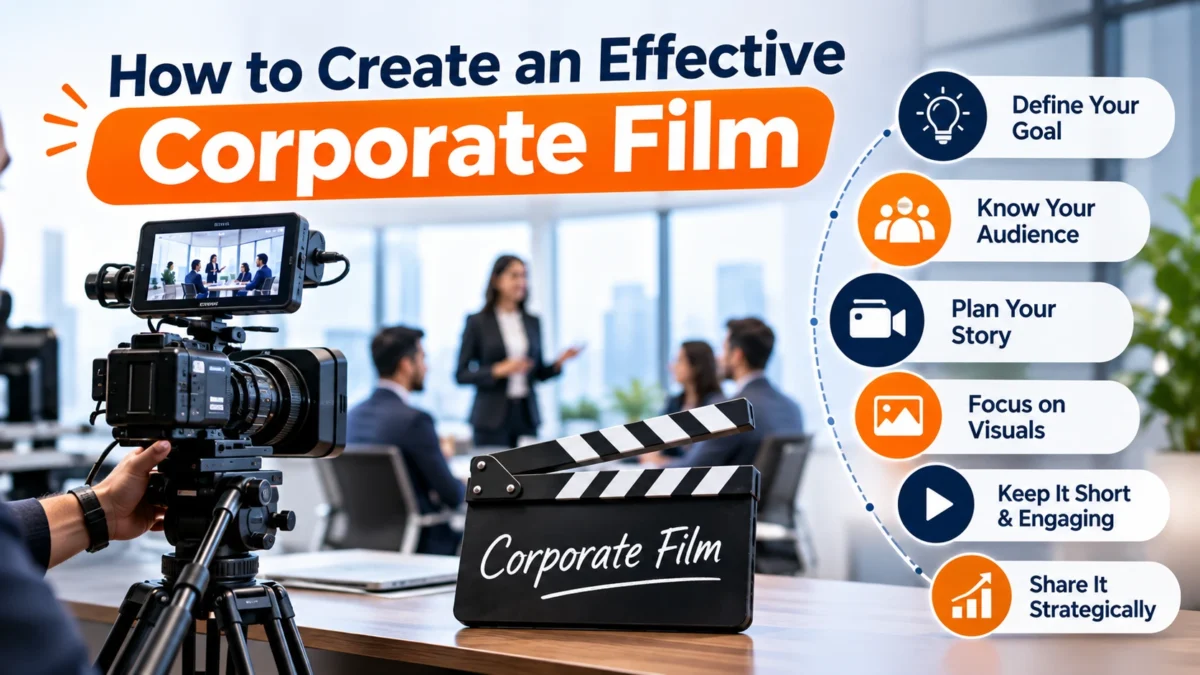
A corporate film is more than a collection of professional footage, office shots, employee interviews, and product visuals. When planned and produced correctly, it becomes a powerful communication tool that can explain your brand, establish credibility, showcase your capabilities, connect with your audience, and support your business goals.
For businesses operating in competitive markets, video has become an important part of brand communication. Customers, investors, employees, partners, and other stakeholders increasingly expect organizations to communicate their purpose and value through engaging visual experiences. A well-produced corporate film can bring together your company’s story, people, products, culture, expertise, and vision in a format that is easier to understand and remember.
However, creating an effective corporate film requires more than simply hiring a production team and recording footage. The process involves strategy, research, storytelling, scripting, visual planning, production, editing, sound design, branding, and distribution.
If you are wondering how to create an effective corporate film, this guide explains the complete process, from defining your objective to distributing the finished film and measuring its performance.
What Is a Corporate Film?
A corporate film is a professionally produced video created to communicate information about a business, organization, product, service, people, culture, or vision.
Unlike a conventional advertisement that may focus primarily on selling a specific product or offer, a corporate film generally takes a broader approach. It can communicate who a company is, what it does, why it exists, how it operates, and what makes its approach valuable.
Corporate films can be created for different purposes, including:
- Company introductions
- Brand storytelling
- Corporate communication
- Product and service presentations
- Manufacturing and facility showcases
- Recruitment and employer branding
- Investor communication
- Customer education
- Corporate events
- Internal communication
- Annual business presentations
- Sustainability and social responsibility communication
- Business-to-business marketing
The format can also vary considerably. A corporate film may be documentary-style, interview-driven, cinematic, animated, product-focused, culture-oriented, or built around a strong brand narrative.
The most important factor is not the format itself. It is whether the film communicates the right message to the right audience in a compelling and credible way.
Why an Effective Corporate Film Matters
A strong corporate film can communicate information that would otherwise require lengthy presentations, brochures, meetings, or website pages.
Video combines visuals, dialogue, music, motion, typography, storytelling, and sound into a single communication experience. This allows companies to demonstrate their environment, people, processes, products, and personality rather than simply describing them.
A corporate film can also help create consistency across different communication channels. The same core story can be adapted for a website, social media, presentations, exhibitions, recruitment campaigns, sales meetings, and internal communication.
The value of a corporate film becomes particularly clear when a company has a complex story to explain. Manufacturing companies, technology businesses, professional service organizations, infrastructure companies, exporters, and large organizations may have sophisticated processes that are difficult to communicate through static content alone.
A well-planned film can simplify that complexity without making the business appear simplistic.
Define the Purpose of Your Corporate Film
The first step in learning how to create an effective corporate film is defining exactly why the film needs to exist.
A common mistake is beginning production with a vague objective such as “We need a company video.” That is not enough to guide creative decisions.
Instead, define a specific communication objective.
Ask:
- What should the audience understand after watching the film?
- What should they remember?
- What action should they take?
- Who is the primary audience?
- Where will the film be shown?
- What business problem should the film solve?
- How will success be measured?
For example, a manufacturing company may want to demonstrate production capabilities to international buyers. A technology company may want to explain a complicated solution to potential customers. An organization hiring specialized professionals may want to communicate its workplace culture.
Each objective requires a different narrative approach.
A useful objective should connect communication with a measurable business or marketing outcome.
Identify Your Target Audience
A corporate film cannot be effective if it attempts to communicate equally with everyone.
Before writing the script, identify the primary audience.
Your audience could include:
- Existing customers
- Potential customers
- Business partners
- Investors
- Employees
- Prospective employees
- Distributors
- International buyers
- Industry professionals
- Government or institutional stakeholders
Understanding the audience influences everything from language and tone to visuals and storytelling.
For example, a film created for technical decision-makers may require more evidence, process information, specifications, and expert interviews. A recruitment film may focus more heavily on people, culture, career development, workplace experiences, and employee stories.
Audience research ensures that the film is not simply talking about the company but communicating something relevant to the people watching it.
Build a Clear Corporate Film Strategy
Once the objective and audience are established, create a strategic framework for the film.
A strong corporate film strategy should define:
Core message: What is the single most important idea the audience should remember?
Supporting messages: What additional information strengthens the main message?
Audience insight: What does the audience care about, need, question, or expect?
Brand personality: Should the film feel innovative, premium, human, technical, authoritative, energetic, or approachable?
Desired action: What should viewers do after watching?
Distribution channels: Where will the film be published or presented?
This strategy acts as a filter throughout production. Whenever an idea, shot, interview, animation, or section of the script is considered, it can be evaluated against the central objective.
Create a Strong Corporate Film Concept
The concept transforms the strategy into a creative direction.
A corporate film should have a central idea rather than simply presenting disconnected information.
For example, instead of creating a film that says:
“We were established in 2005. We have several facilities. We have experienced employees. We provide multiple products.”
The concept could focus on:
“Every product begins with an idea, and every idea becomes possible through people, technology, and precision.”
The second approach provides a narrative foundation. Company information can then be incorporated naturally into the story.
A strong concept gives the film an identity and helps differentiate it from generic corporate videos.
Develop the Corporate Film Story
Storytelling is one of the most important elements of corporate video production.
Even a highly professional film can become difficult to watch if it simply presents facts one after another.
A useful corporate film structure can follow this progression:
Opening: Capture Attention
The first few seconds should establish curiosity or relevance.
Instead of immediately beginning with a long company introduction, consider opening with:
- A strong visual
- A compelling statement
- A customer challenge
- A human moment
- An intriguing question
- A powerful environmental sequence
- A concise statement of purpose
The opening establishes why the viewer should continue watching.
Context: Establish the Challenge
Introduce the market, customer need, problem, opportunity, or idea that gives the company story meaning.
This prevents the film from becoming entirely company-centric.
Story: Introduce the Organization
Once the context is established, introduce how the organization responds to the challenge.
This is where company history, capabilities, people, processes, technology, and expertise can enter the narrative.
Evidence: Demonstrate the Difference
Show rather than simply tell.
Use manufacturing footage, product demonstrations, interviews, facilities, data, customer experiences, technology, processes, certifications, or real-world applications where appropriate.
Human Connection: Show the People
Organizations are ultimately built by people.
Employees, founders, engineers, designers, technicians, leaders, customers, and partners can provide authenticity and emotional depth.
Conclusion: Communicate the Future
End by reinforcing the company’s purpose, ambition, vision, or next chapter.
The conclusion should leave the audience with a clear impression rather than simply ending when the footage runs out.
Write a Professional Corporate Film Script
The script transforms the concept into a structured communication piece.
A professional script should define what the audience hears and sees.
Consider developing two connected components:
Voiceover or dialogue: What is being said?
Visual direction: What is happening on screen while the message is communicated?
The strongest corporate scripts avoid excessive corporate jargon.
Words such as “synergy,” “excellence,” “commitment,” “innovation,” and “solutions” can be useful, but they become ineffective when repeatedly used without evidence.
Instead of saying:
“We deliver innovative solutions with uncompromising quality.”
Show the engineering process, design team, production environment, testing process, and final application that demonstrate innovation and quality.
The principle is simple: use the script to explain, and use visuals to prove.
Keep the Corporate Film Focused
One of the biggest challenges in corporate filmmaking is trying to include everything.
Companies naturally want to mention:
- Their history
- Every product
- Every department
- Every facility
- Every achievement
- Every certification
- Every market
- Every service
- Every employee benefit
Trying to include everything can weaken the film.
A corporate film should prioritize information based on the audience and objective.
If a detail does not contribute to the central story, consider moving it to another communication asset such as the website, brochure, presentation, or product video.
A focused film is generally easier to understand and remember.
Plan the Visual Language
The visual style should support the company’s brand identity.
Before production begins, define the visual direction.
This may include:
- Camera movement
- Composition
- Lighting
- Color treatment
- Lens selection
- Framing
- Motion graphics
- Typography
- Transitions
- Animation style
- Product presentation
- Interview setup
For a premium corporate brand, controlled camera movement, sophisticated lighting, clean compositions, and restrained motion graphics may be appropriate.
For a technology-focused organization, dynamic movement, interface animation, data visualization, and modern environments may communicate the brand more effectively.
The visual language should feel intentional rather than being determined randomly during production.
Create a Detailed Corporate Film Storyboard
A storyboard provides a visual blueprint before filming begins.
It does not always need to be a highly detailed illustration. Depending on the project, it can consist of frames, references, shot descriptions, camera directions, and visual notes.
A storyboard can define:
- Opening sequence
- Establishing shots
- Interview frames
- Product shots
- Facility footage
- Employee interactions
- Process sequences
- Motion graphics
- Transitions
- Closing sequence
This reduces uncertainty during production and helps the creative, production, and client teams work from the same visual plan.
Prepare a Corporate Film Shot List
The shot list converts the storyboard into practical production requirements.
A comprehensive shot list may include:
- Wide establishing shots
- Medium environmental shots
- Close-up details
- Product footage
- Machinery and process footage
- Employee interactions
- Leadership interviews
- Customer interactions
- Office environments
- Facility exteriors
- Logistics and operations
- Detail shots for transitions
- Branding elements
Plan multiple variations of important scenes.
For example, if a production process is essential to the story, capture wide, medium, and close-up shots. This provides flexibility during editing and prevents the final film from feeling visually repetitive.
Choose the Right Interview Approach
Interviews can provide credibility and human depth to a corporate film.
However, poorly conducted interviews can make a film feel like a corporate presentation.
Instead of asking executives to repeat promotional statements, use questions that encourage meaningful responses.
Useful questions may include:
- What problem does the organization exist to solve?
- What changed in the industry that influenced your approach?
- What does quality mean within your organization?
- What makes your process different?
- How do employees contribute to the company’s work?
- What has the organization learned over time?
- Where is the organization heading next?
Strong interviews often produce more natural and memorable content.
The interviewer should also understand that the best response may not be the first response. Follow-up questions can reveal stories, examples, and specific details that create a stronger narrative.
Use Authentic Corporate Film Footage
Authenticity is essential.
Whenever possible, show the real environment, real employees, real processes, and real products.
Stock footage can sometimes support a film, particularly for establishing context or abstract concepts, but excessive stock footage can make the corporate film feel generic.
If the organization’s manufacturing facility is impressive, show it.
If the engineering team solves complex problems, show the process.
If the company culture is collaborative, capture authentic interactions.
The objective is to make the audience feel that they are seeing the organization rather than watching a collection of generic business visuals.
Focus on Cinematography and Lighting
Professional cinematography can significantly influence how a company is perceived.
Lighting should be planned according to the environment, subject, and desired mood.
Interview lighting should create a flattering and controlled image while maintaining a natural appearance. Product footage may require more precise lighting to reveal texture, form, materials, and details.
Facility footage may benefit from a combination of natural and controlled lighting.
Camera movement should also have purpose. Movement can communicate energy, scale, precision, or sophistication, but excessive movement can distract from the message.
Good cinematography is not simply about making footage look attractive. It is about using visual decisions to strengthen communication.
Pay Attention to Sound Design
Sound is often underestimated in corporate video production.
A film can have beautiful visuals but still feel unprofessional if the dialogue is unclear or the audio environment is distracting.
Prioritize:
- Clean dialogue recording
- Appropriate microphones
- Room tone
- Background ambience
- Music
- Sound effects
- Audio transitions
- Voiceover quality
- Final audio mixing
Music should support the narrative rather than overpower it.
Different sections may require different levels of intensity. A reflective opening might use restrained sound design, while a manufacturing sequence could benefit from rhythmic industrial ambience.
Effective sound design makes visual storytelling more immersive.
Use Motion Graphics Strategically
Motion graphics can help explain information that is difficult to communicate through live footage.
They can be used for:
- Statistics
- Timelines
- Maps
- Product specifications
- Process diagrams
- Geographic presence
- Technical concepts
- Data visualization
- Titles and lower thirds
- Brand messages
However, graphics should not become decoration without purpose.
Every animation should help the viewer understand something faster or more clearly.
Maintain Consistent Branding
A corporate film should feel like an extension of the company’s brand.
Maintain consistency across:
- Logo usage
- Brand colors
- Typography
- Graphic elements
- Photography style
- Voice and messaging
- Music selection
- Animation
- Tone
The film should complement the organization’s website, presentation materials, social media presence, and other brand communication.
Consistency improves recognition and makes the entire brand experience feel more professional.
Edit the Corporate Film for Attention
Editing determines how all the individual elements become a coherent story.
A strong editor considers:
- Narrative progression
- Pacing
- Shot duration
- Dialogue
- Visual continuity
- Music
- Sound effects
- Graphics
- Emotional rhythm
- Audience attention
Avoid keeping footage simply because it was expensive to produce.
The edit should serve the story.
If a shot is beautiful but does not support the narrative, it may need to be removed.
The same principle applies to dialogue. A long statement may contain valuable information, but if the same point can be communicated more clearly in a shorter sequence, editing should prioritize clarity.
Create Different Versions for Different Channels
A single corporate film does not necessarily have to be distributed in only one format.
Consider creating versions for:
- Corporate website
- YouTube
- Sales presentations
- Trade exhibitions
- Recruitment platforms
- Internal communication
- Investor presentations
The master film can provide the foundation, while shorter edits can target specific audiences and platforms.
Vertical, square, and widescreen versions may also be useful depending on distribution requirements.
Planning these requirements before production can prevent unnecessary rework.
Optimize Your Corporate Film for SEO
If the corporate film will be published online, SEO should be considered as part of the distribution strategy.
Optimize the supporting page with a relevant primary keyword such as How to Create an Effective Corporate Film, where appropriate.
Additional optimization can include:
- SEO-friendly page title
- Descriptive URL
- Relevant headings
- Natural keyword usage
- Optimized video title
- Video description
- Transcript
- Captions
- Relevant supporting copy
- Descriptive thumbnail
- Internal links
- Structured data where appropriate
Do not force keywords into the script or page unnaturally.
Search optimization should support user experience rather than compromise readability.
Add Captions and Transcripts
Captions improve accessibility and allow audiences to understand the film even when audio is unavailable.
A transcript also creates valuable text content that search engines can understand.
For interview-heavy corporate films, transcripts can help turn video content into supporting website content, articles, social posts, or sales materials.
This means one production project can generate multiple content assets.
Distribute Your Corporate Film Strategically
Producing the film is only one part of the process.
A great corporate film can underperform if it is not distributed effectively.
Start with the channels most relevant to the audience.
For example, a B2B corporate film may work particularly well on the company website, professional social platforms, sales presentations, email campaigns, and industry events.
A recruitment-focused film may be distributed through careers pages, recruitment campaigns, social channels, and job listings.
The distribution strategy should reflect the original objective.
Measure Corporate Film Performance
The final step in understanding how to create an effective corporate film is measuring what happened after publication.
Useful performance indicators can include:
- Video views
- Average watch time
- Completion rate
- Engagement rate
- Click-through rate
- Website traffic
- Lead generation
- Enquiries
- Recruitment applications
- Sales conversations
- Content shares
- Audience retention
The right metrics depend on the objective.
If the goal is awareness, reach and viewing behavior may be important.
If the goal is lead generation, enquiries and conversions may matter more.
If the goal is recruitment, applications and candidate engagement may provide stronger indicators.
Measurement allows future video projects to become more strategic.
Common Corporate Film Mistakes to Avoid
Several mistakes can reduce the effectiveness of an otherwise well-produced corporate film.
Making the Film Entirely About the Company
A corporate film should communicate the company’s value from the audience’s perspective.
Using Too Much Corporate Jargon
Complex language can make the message harder to understand.
Trying to Include Everything
More information does not automatically create a better film.
Using Generic Stock Footage Excessively
Authentic footage generally provides stronger brand differentiation.
Ignoring Audio Quality
Poor sound can immediately reduce perceived production quality.
Creating an Unfocused Script
Without a central message, the film can feel like a collection of unrelated sections.
Making the Film Too Long
Length should be determined by the story and audience, not by the amount of footage available.
Forgetting Distribution
A film needs a clear plan for reaching its intended audience.
Focusing Only on Visuals
Beautiful visuals are valuable, but they cannot compensate for weak strategy and storytelling.
A Practical Corporate Film Production Workflow
A professional workflow can be organized into three major phases.
Pre-Production
This phase establishes the foundation.
Key activities include:
- Defining objectives
- Audience research
- Creative strategy
- Concept development
- Scriptwriting
- Storyboarding
- Location planning
- Interview preparation
- Crew planning
- Equipment planning
- Scheduling
- Shot list development
Strong pre-production reduces avoidable problems during filming.
Production
Production is where the planned story becomes footage.
This may include:
- Interviews
- Corporate environments
- Product footage
- Facility footage
- Employee interactions
- Process demonstrations
- Drone footage where appropriate
- Cinematic B-roll
- Voiceover recording
- Photography
The production team should capture enough visual variety to provide flexibility during post-production.
Post-Production
Post-production brings everything together.
It generally includes:
- Footage organization
- Editing
- Color correction
- Color grading
- Sound editing
- Sound design
- Music
- Voiceover
- Motion graphics
- Titles
- Captions
- Final mastering
The final stage should also include quality control across different devices and platforms.
How to Make a Corporate Film More Memorable
Memorability usually comes from a combination of clarity, emotion, specificity, and strong visual storytelling.
Instead of relying only on company claims, communicate through experiences and evidence.
Show the people behind the organization.
Show the process.
Show the details.
Show the challenges.
Show the outcomes.
Use specific stories rather than generic statements whenever possible.
A memorable corporate film does not necessarily need a dramatic storyline. It needs a meaningful one.
The audience should leave with a clear answer to three questions:
Who are you?
Why does your work matter?
Why should the audience care?
The Role of Emotion in Corporate Storytelling
Corporate communication does not need to be purely informational.
Emotion helps audiences connect information with memory.
That emotion can come from many sources:
- A founder’s story
- An employee’s experience
- A customer challenge
- A manufacturing process
- A breakthrough
- A community initiative
- A company’s journey
- A vision for the future
The objective is not to manufacture emotion artificially. It is to identify genuine human elements within the organization and present them honestly.
Authentic emotion tends to be more persuasive than exaggerated corporate messaging.
How Professional Corporate Film Production Creates Business Value
An effective corporate film can become a long-term business asset.
The same core production can support multiple communication requirements.
For example, a master corporate film can provide material for:
- Website content
- Social media clips
- Sales presentations
- Recruitment campaigns
- Exhibition screens
- Investor communication
- Email campaigns
- Product introductions
- Company profiles
This makes strategic planning especially important.
When production is designed with content reuse in mind, a single project can generate a library of high-quality visual assets.
Choosing a Corporate Film Production Partner
When selecting a production partner, look beyond camera equipment and visual style.
Evaluate whether the team understands:
- Brand strategy
- Storytelling
- Corporate communication
- Audience psychology
- Script development
- Cinematography
- Sound
- Post-production
- Motion graphics
- Digital distribution
Review relevant work and consider whether the production partner can understand your business rather than simply reproduce a visual style.
A good production process should begin with questions about your organization, audience, objectives, and communication challenges.
The final film should feel specifically created for your business.
Final Checklist for an Effective Corporate Film
Before publishing your corporate film, review the following:
- Is the primary objective clear?
- Is the target audience clearly defined?
- Does the opening capture attention?
- Is there one central message?
- Does the story have a logical structure?
- Are company claims supported by visuals or evidence?
- Are interviews natural and relevant?
- Is the footage authentic?
- Is the sound clear?
- Is the branding consistent?
- Are motion graphics purposeful?
- Is the pacing appropriate?
- Are captions available?
- Is the film optimized for its distribution channels?
- Are shorter versions required?
- Is there a clear call to action?
- Are performance metrics defined?
If the answer to these questions is yes, the film has a much stronger foundation for success.
Conclusion: Create a Corporate Film With Purpose
Learning how to create an effective corporate film is ultimately about understanding that professional video production begins long before the camera starts recording.
The strongest corporate films are built on a clear objective, defined audience, strong concept, purposeful storytelling, authentic visuals, professional production, thoughtful editing, and strategic distribution.
A corporate film should not simply tell people what your organization does. It should help them understand your value, experience your brand, recognize your people, and remember your message.
When strategy and creativity work together, corporate video can become much more than a company introduction. It can become a long-term communication asset that supports marketing, sales, recruitment, branding, stakeholder communication, and business development.
If you are planning a corporate film and want to turn your company’s story into a professional visual experience, you can connect with our team to discuss your corporate film project. A clear conversation about your objectives, audience, story, and distribution requirements is the right place to begin.
Start Creating Your Corporate Film
Your organization already has a story. The next step is turning that story into a visual experience that communicates clearly and leaves a lasting impression.
Whether you need a brand film, company profile, manufacturing film, recruitment video, product-focused corporate film, or a broader visual communication strategy, the process should begin with purpose.
Talk to our team about your corporate film requirements and explore how your business story can be developed into a focused, engaging, and strategically effective corporate film.