
Corporate Film Production: A Complete Guide
October 2, 2026
Product Photography: A Complete Guide for Businesses
October 5, 2026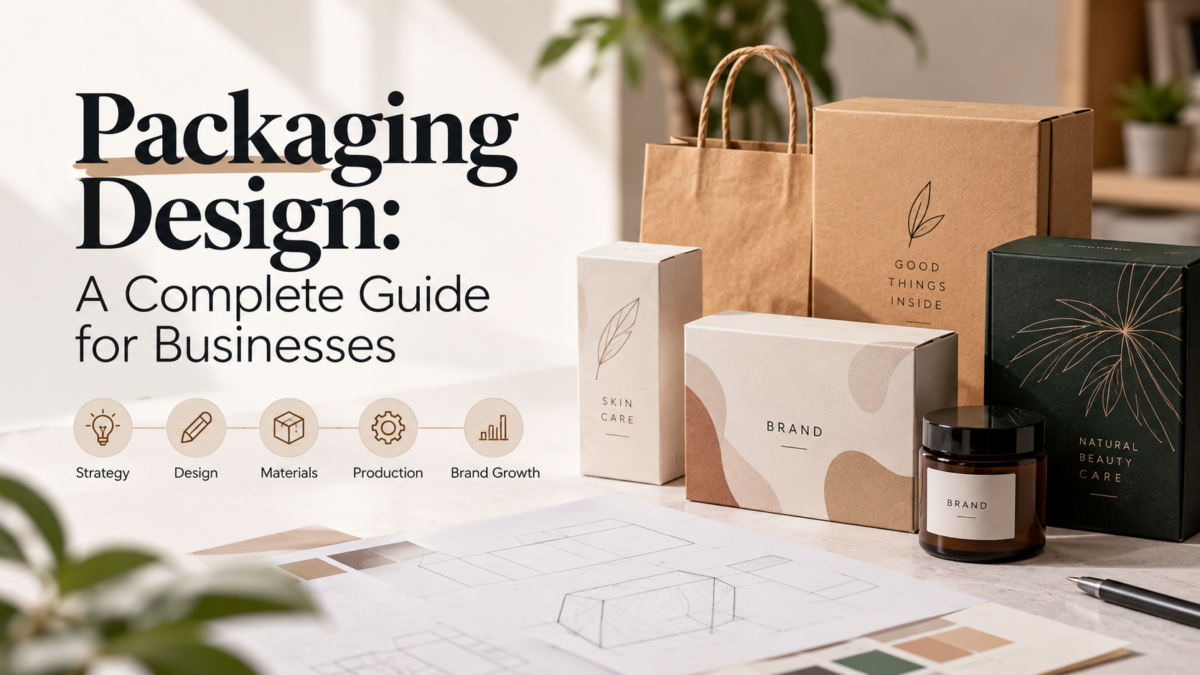
Packaging is more than a protective layer around a product. It is one of the first physical experiences a customer has with a brand. Before a customer reads a product description, tests the product, or learns about its features, packaging can influence how the product is perceived.
A well-planned Packaging Design: A Complete Guide for Businesses approach combines branding, visual communication, functionality, customer psychology, production requirements, and sustainability. The right packaging can help a product stand out on shelves, communicate its value, create recognition, and strengthen the overall customer experience.
For businesses entering a competitive market, packaging should therefore be treated as a strategic brand asset rather than simply a container.
This guide explains the fundamentals of packaging design, the design process, important elements, types of packaging, common mistakes, current considerations, and practical strategies businesses can use to create packaging that is both attractive and effective.
What Is Packaging Design?
Packaging design is the process of planning and creating the visual and functional presentation of a product’s packaging. It involves decisions about structure, materials, typography, colors, graphics, imagery, information hierarchy, finishing, and usability.
Effective packaging design needs to perform several jobs simultaneously. It should protect the product, provide relevant information, communicate the brand, appeal to the intended audience, and make the product easy to recognize.
Packaging can include:
- Primary packaging that directly contains the product
- Secondary packaging that groups or protects primary packaging
- Tertiary packaging used for transportation and distribution
- Labels, sleeves, cartons, boxes, pouches, bottles, jars, and containers
- Inserts, instruction cards, seals, and other supporting materials
The design requirements differ depending on the product, industry, distribution model, target audience, and sales environment.
For example, packaging for a premium cosmetic product may prioritize tactile finishes and sophisticated typography, while food packaging may place greater emphasis on product visibility, nutritional information, freshness, and regulatory requirements.
Why Packaging Design Matters for Businesses
Packaging can influence how customers understand a product before they interact with it. A thoughtful design creates a connection between the product and the brand’s positioning.
Packaging Creates the First Brand Impression
Customers often encounter packaging before they experience the actual product. The colors, typography, imagery, materials, and structure immediately communicate visual signals.
Premium packaging can create a sense of sophistication. Minimal packaging can communicate simplicity. Bright colors and expressive illustrations can create an energetic personality.
The objective is not simply to make packaging attractive. It is to make the visual presentation appropriate for the brand and its audience.
Packaging Helps Products Stand Out
Retail environments can contain dozens or hundreds of competing products. Online marketplaces also present customers with multiple visual choices.
Distinctive packaging can improve recognition and help a product attract attention.
Strong packaging usually has a clear visual hierarchy. Customers should quickly understand:
- What the product is
- What brand it belongs to
- Why it is relevant
- What makes it different
- How it should be used
If everything receives equal visual emphasis, the packaging can become difficult to understand.
Packaging Strengthens Brand Recognition
Consistent packaging creates repeated visual exposure.
When a business maintains recognizable colors, typography, graphic elements, imagery, and structural characteristics across products, customers can identify the brand more easily.
This is particularly important when businesses have multiple products or product variations.
A packaging system should therefore be scalable rather than designed as a collection of unrelated individual packages.
Packaging Influences Perceived Product Value
Packaging contributes to perceived value.
Customers can form assumptions about product quality based on the materials, construction, typography, finishing, photography, and overall attention to detail.
However, premium packaging does not necessarily mean expensive packaging. Strategic design can create a premium perception through proportion, typography, restrained color usage, material selection, and strong visual hierarchy.
Key Elements of Effective Packaging Design
A successful packaging project requires several design elements to work together.
Brand Identity in Packaging Design
Brand identity provides the foundation for packaging.
Important brand elements include:
- Logo
- Brand colors
- Typography
- Photography style
- Illustration style
- Graphic patterns
- Iconography
- Tone of voice
- Brand positioning
Packaging should reinforce these elements instead of creating a disconnected visual identity.
For businesses with an established brand, packaging should feel like a natural extension of the broader identity.
For new brands, packaging can become one of the primary ways the identity is introduced to customers.
Packaging Typography
Typography plays a major role in packaging communication.
The typeface should reflect the personality of the product while remaining readable at the physical size at which customers will encounter it.
Packaging typography should establish a clear hierarchy between:
- Brand name
- Product name
- Product category
- Key benefits
- Supporting information
- Instructions
- Legal or regulatory information
Decorative fonts may work well for specific brand elements, but important product information should prioritize readability.
Typography should also account for viewing distance. Text that looks attractive on a computer screen may become difficult to read when printed on a small package.
Color Selection for Packaging
Color is one of the fastest visual signals customers perceive.
Different color combinations can communicate different brand associations, but color should always be considered in the context of the target audience and product category.
When selecting packaging colors, businesses should consider:
- Brand identity
- Product positioning
- Competitor environment
- Target audience
- Printing limitations
- Material characteristics
- Cultural considerations
- Product variants
A packaging system can use a consistent core color palette while introducing secondary colors to distinguish different products.
Packaging Imagery and Graphics
Photography, illustrations, patterns, icons, and graphic elements can explain or reinforce the product proposition.
For example, food packaging may use product photography to communicate taste and ingredients, while technical products may rely more heavily on diagrams, icons, and concise information.
Imagery should have a clear purpose.
Overusing visual elements can make packaging look crowded. On the other hand, insufficient visual information may make the package appear generic.
The strongest designs establish a balance between visual appeal and communication.
Packaging Structure and Shape
Packaging design is not limited to graphics.
The physical structure can significantly influence the customer experience.
Factors include:
- Opening mechanism
- Product protection
- Storage
- Transportation
- Stackability
- Portability
- Ergonomics
- Display orientation
- Reusability
A structurally interesting package can create differentiation, but functionality should remain the priority.
A beautiful package that is difficult to open, store, transport, or use can negatively affect the customer experience.
Choosing the Right Packaging Materials
Material selection affects appearance, durability, cost, sustainability, and production.
Common packaging materials include:
- Paper
- Cardboard
- Corrugated board
- Glass
- Metal
- Flexible films
- Plastics
- Bio-based materials
- Composite materials
The appropriate material depends on the product and distribution requirements.
For fragile products, protection may be the primary concern. For lightweight consumer goods, reducing material volume may be more important.
Businesses should evaluate materials not only from a visual perspective but also from manufacturing, logistics, durability, and end-of-life considerations.
Sustainable Packaging Design
Sustainability has become an important consideration in packaging decisions.
Businesses are increasingly evaluating how packaging materials are sourced, manufactured, transported, used, and disposed of.
Sustainable packaging strategies may include:
- Reducing unnecessary material
- Optimizing package dimensions
- Using recyclable materials where appropriate
- Designing reusable packaging
- Reducing excessive secondary packaging
- Selecting responsibly sourced materials
- Improving packaging-to-product ratios
However, sustainability claims should be accurate and supported by the actual characteristics of the packaging.
A package should not be presented as environmentally responsible simply because it uses a natural-looking color palette or sustainability-related graphics.
Understanding Your Target Audience
Good packaging design starts with understanding the customer.
Before designing the package, businesses should identify:
- Who will purchase the product?
- Where will the product be purchased?
- What problem does it solve?
- What does the customer value?
- What price segment does the product occupy?
- What visual styles appeal to the audience?
- What information does the customer need before purchasing?
A package designed for children will require a different visual language from packaging designed for professional buyers.
Likewise, premium consumers may respond differently to packaging than customers primarily focused on affordability and convenience.
Audience research helps prevent subjective design decisions from dominating the project.
Packaging Design and Consumer Psychology
Packaging can influence attention, expectations, and product perception.
Visual hierarchy determines what customers notice first. Color can influence emotional associations. Typography can affect perceived personality. Material and finishing can contribute to tactile impressions.
These factors work together.
For example, a restrained color palette combined with generous spacing, refined typography, and high-quality material may communicate a premium positioning.
Meanwhile, bold colors, large typography, and energetic graphics may create a more expressive personality.
The goal is not to manipulate customers. The goal is to communicate the product’s positioning clearly and consistently.
Types of Packaging Design
Different products require different packaging approaches.
Product Box Design
Boxes are widely used across retail categories.
They provide significant surface area for branding and product information while also offering structural protection.
Box design requires attention to:
- Front-panel hierarchy
- Side-panel information
- Back-panel content
- Folding structure
- Die lines
- Printing
- Finishing
- Shelf presentation
Bottle and Container Packaging
Bottle and container design combines structural and graphic considerations.
The label must fit the available surface while remaining readable around curves or irregular shapes.
The relationship between the container, cap, label, and overall silhouette can also become an important part of brand recognition.
Pouch Packaging
Flexible pouches can be lightweight and practical for various products.
Their design needs to consider sealing areas, printing boundaries, product visibility, handling, and shelf presentation.
Label Design
Labels can function as the primary visual communication system when the packaging structure itself is relatively simple.
A strong label should communicate the brand and product information without creating unnecessary visual complexity.
The Packaging Design Process
A professional packaging project typically moves through several stages.
Step 1: Research and Discovery
The first stage is understanding the business, product, customer, market, and competition.
Research should examine:
- Brand positioning
- Product characteristics
- Target customers
- Pricing
- Sales channels
- Competitor packaging
- Regulatory requirements
- Manufacturing constraints
This stage establishes the strategic foundation for design.
Step 2: Define the Packaging Strategy
Once research is complete, the business should establish a clear packaging direction.
This can include decisions about:
- Brand personality
- Visual positioning
- Material direction
- Color strategy
- Information hierarchy
- Structural requirements
- Sustainability objectives
A clear strategy prevents the design process from becoming purely aesthetic.
Step 3: Develop Design Concepts
Designers can then develop multiple creative directions.
Each concept should explore a distinct approach while remaining connected to the brand strategy.
Concept development may include:
- Moodboards
- Typography exploration
- Color systems
- Graphic directions
- Packaging mockups
- Structural ideas
The strongest concept is not necessarily the most visually complicated. It is the one that communicates the intended positioning most effectively.
Step 4: Refine the Selected Direction
After a direction is selected, the design moves into refinement.
This stage focuses on:
- Typography
- Spacing
- Visual hierarchy
- Graphic consistency
- Color accuracy
- Information organization
- Structural details
- Print feasibility
Small adjustments can significantly improve the final package.
Step 5: Create Packaging Artwork
Once the design is approved, production-ready artwork is prepared.
The artwork needs to account for technical requirements such as:
- Bleed
- Trim
- Safe areas
- Color modes
- Resolution
- Fonts
- Die lines
- Print finishes
- Barcode placement
Technical accuracy is essential because even a strong concept can fail during production if artwork is incorrectly prepared.
Step 6: Prototype and Test
A prototype allows businesses to evaluate the package in physical form.
Testing can reveal issues that are difficult to identify on screen.
Businesses should evaluate:
- Actual size
- Readability
- Opening experience
- Structural strength
- Material appearance
- Color reproduction
- Product fit
- Shelf visibility
- Handling
Physical testing is especially important for new packaging structures.
Step 7: Production and Quality Control
After approval, the package moves into production.
Quality control should verify that the final output matches the approved specifications.
Important factors include print quality, color consistency, cutting, folding, finishing, material quality, and structural integrity.
Common Packaging Design Mistakes
Even attractive packaging can fail strategically.
Too Much Information
Trying to place every possible message on the front of the package can create clutter.
Prioritize the information customers need first.
Poor Information Hierarchy
If the product name, brand name, benefits, and supporting information all compete for attention, customers may struggle to understand the package.
Hierarchy should guide the eye naturally.
Ignoring the Retail Environment
Packaging should be evaluated in the environment where customers will encounter it.
A design that looks excellent individually may become difficult to notice when surrounded by competing products.
Designing Only for the Screen
Packaging is a physical object.
Screen-based presentations cannot fully communicate material texture, scale, folding, printing characteristics, or tactile finishing.
Prototypes are therefore valuable.
Inconsistent Product Variations
When a business has multiple products, packaging should establish a recognizable system.
Each variation can have its own identifier while maintaining a consistent brand architecture.
Overlooking Production Constraints
A concept that cannot be manufactured efficiently may create unnecessary costs and production problems.
Design decisions should be discussed with packaging manufacturers early enough to identify technical limitations.
How to Create a Consistent Packaging System
Businesses with multiple products should think beyond individual packages.
A packaging system defines common rules for:
- Logo placement
- Typography
- Color
- Product naming
- Information hierarchy
- Imagery
- Icons
- Product differentiation
For example, a product family can maintain the same overall layout while using different accent colors or illustrations to distinguish individual variants.
This creates both consistency and flexibility.
Packaging Design for E-Commerce
E-commerce introduces additional packaging considerations.
Customers often first encounter the product through a digital image before receiving the physical package.
Therefore, packaging should remain recognizable in online product photography.
Shipping also introduces additional requirements.
Packaging may need to withstand:
- Handling
- Compression
- Vibration
- Moisture
- Transportation
- Storage
Businesses should consider both the presentation package and the shipping experience.
The moment a customer opens the delivery is also part of the brand experience.
Packaging Design and Unboxing Experience
The unboxing experience can strengthen the relationship between customers and brands.
A thoughtful experience may include:
- Easy opening
- Organized product placement
- Protective inserts
- Clear instructions
- Branded internal elements
- Reusable components
- Appropriate presentation
The objective should be to make the experience useful and memorable without adding unnecessary material or complexity.
How Much Does Packaging Design Cost?
Packaging design costs vary significantly depending on the project.
Factors that can influence the budget include:
- Number of products
- Structural complexity
- Number of design concepts
- Material requirements
- Illustration or photography requirements
- Number of packaging formats
- Prototype requirements
- Production specifications
- Regulatory requirements
- Revision rounds
A simple label design and a complete packaging system require very different levels of work.
Businesses should therefore define the scope before comparing design costs.
How to Measure Packaging Design Success
Packaging should be evaluated using measurable business and customer outcomes.
Possible indicators include:
- Product recognition
- Customer feedback
- Purchase conversion
- Repeat purchase behavior
- Retail visibility
- Packaging damage rates
- Returns related to packaging
- Production efficiency
- Material usage
- Customer satisfaction
Businesses can also conduct customer testing before a full production launch.
Questions can focus on whether customers understand the product, notice the brand, identify the key benefit, and perceive the intended positioning.
The Role of Packaging Design in Brand Strategy
Packaging should not operate independently from branding.
A successful packaging system should connect with the brand’s website, advertising, social media, retail presence, and other customer touchpoints.
When customers repeatedly encounter the same visual language, brand recognition becomes stronger.
This makes packaging an important component of a broader brand identity system.
How Businesses Can Improve Their Packaging Design
Businesses reviewing existing packaging can begin with a practical audit.
Ask:
- Is the product immediately identifiable?
- Is the brand clearly visible?
- Can customers understand the primary benefit quickly?
- Is the typography readable?
- Does the design reflect the product’s price positioning?
- Does the package stand out in its selling environment?
- Is the structure practical?
- Does the packaging work across product variations?
- Are sustainability claims accurate?
- Can the package be manufactured efficiently?
The answers can reveal opportunities for improvement before a complete redesign begins.
Why Professional Packaging Design Matters
Packaging combines multiple disciplines.
A successful project may require brand strategy, graphic design, structural thinking, typography, production knowledge, print preparation, material understanding, and customer research.
Professional packaging design helps bring these considerations together.
Instead of designing only for visual appearance, a strategic approach considers the complete journey from manufacturing to purchase, use, storage, and disposal.
Packaging Design: A Complete Guide for Businesses — Final Thoughts
Packaging is a physical expression of a brand.
From the material and structure to typography, color, imagery, information hierarchy, and finishing, every decision contributes to how customers experience the product.
The most effective packaging design balances brand identity, functionality, customer expectations, production requirements, and business objectives.
Whether you are launching a new product, entering a new market, expanding a product range, or updating an existing identity, packaging deserves strategic attention.
A strong package does more than contain a product. It helps customers recognize it, understand it, remember it, and experience the brand consistently.
If your business is planning a new packaging project or looking to improve an existing product presentation, you can explore professional packaging design services and discuss your project with the team.
Start Your Packaging Design Project
Your packaging is an opportunity to turn a physical product into a recognizable brand experience.
From initial strategy and concept development to final artwork and production preparation, every stage can be planned around your product, audience, and business objectives.
Ready to develop packaging that communicates your brand clearly and professionally?