How Logo Design Fits Into Brand Identity
November 6, 2026
Shopify vs Other E-Commerce Platforms: What Should You Choose?
November 11, 2026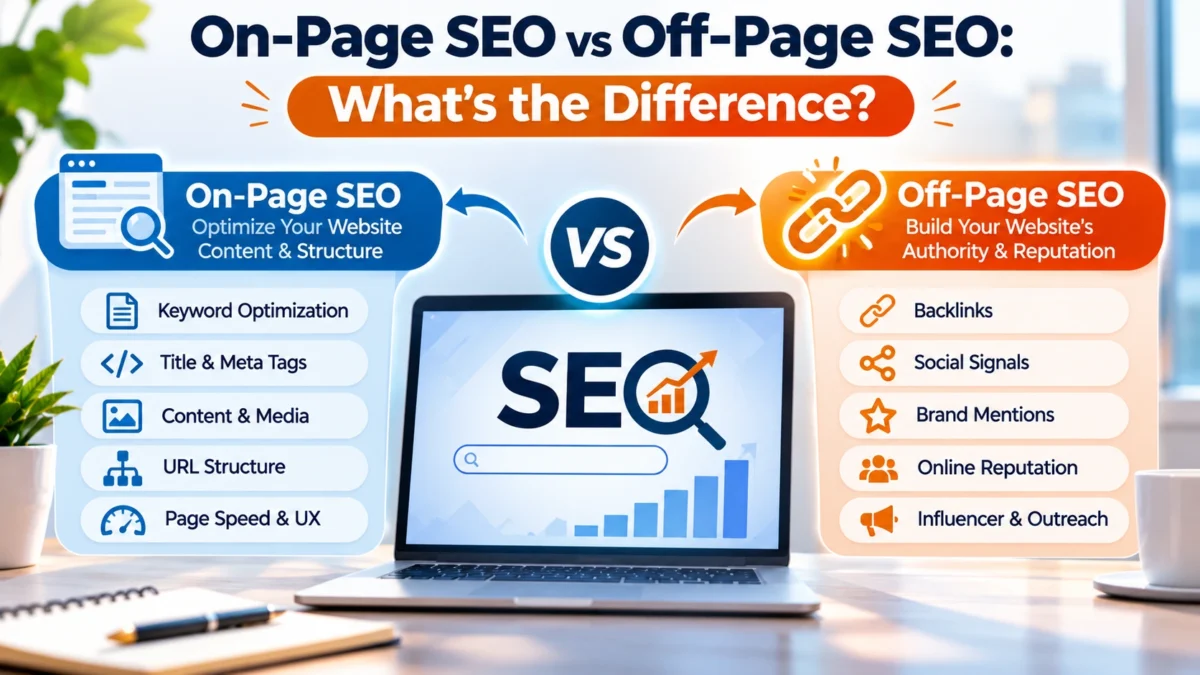
Search engine optimization (SEO) is one of the most important strategies for improving a website’s visibility in organic search results. However, SEO is not a single activity. It involves multiple techniques that work together to help search engines understand, evaluate, and rank a website.
Two of the most important areas of SEO are on-page SEO and off-page SEO.
If you are wondering, “On-Page SEO vs Off-Page SEO: What’s the Difference?”, the simplest explanation is that on-page SEO focuses on optimizing elements within your website, while off-page SEO focuses on activities outside your website that can strengthen its authority, reputation, and credibility.
Both approaches are important, but they serve different purposes. A technically sound website with well-optimized content may still struggle to compete if it has little authority. Similarly, a website with many external links may not perform well if its content, structure, or technical foundation is poorly optimized.
Understanding the difference between these two SEO approaches can help businesses develop a more balanced and effective search strategy.
What Is On-Page SEO?
On-page SEO refers to the optimization of elements that exist directly on your website. The goal is to make individual pages more useful to visitors and easier for search engines to understand.
On-page optimization covers much more than simply adding keywords to an article. It includes content quality, keyword placement, page titles, headings, URLs, internal links, images, user experience, and several other elements that influence how a page is interpreted and experienced.
A well-optimized page should clearly communicate:
- What the page is about
- Which search queries it addresses
- Who the content is intended for
- What information the visitor can find
- How the page relates to other pages on the website
- Why the content is useful or trustworthy
On-page SEO gives you considerable control because most of the optimization happens within your own website.
What Is Off-Page SEO?
Off-page SEO refers to activities performed outside your website that can influence its authority, reputation, and visibility in search engines.
The most commonly discussed component of off-page SEO is link building. When reputable and relevant websites link to your content, those links can contribute to your website’s authority and help search engines understand that your content has value.
However, off-page SEO is broader than backlinks.
It can include:
- Earning backlinks from relevant websites
- Digital PR
- Brand mentions
- Content promotion
- Industry publications
- Business citations
- Relationship-based outreach
- Community participation
- Reputation-building activities
- Relevant partnerships
- Unlinked brand mentions
The central idea is to establish credibility beyond your own website.
On-Page SEO vs Off-Page SEO: What’s the Difference?
The key difference between on-page SEO and off-page SEO is where optimization takes place and what it is primarily intended to accomplish.
On-page SEO focuses on improving your website itself. It helps search engines understand your content and helps users find useful information quickly.
Off-page SEO focuses on building signals outside your website. It helps establish authority, credibility, and recognition within your industry or online ecosystem.
Think of your website as a business location.
On-page SEO is similar to organizing the store, displaying products clearly, providing useful information, improving navigation, and making the customer experience convenient.
Off-page SEO is more like building a reputation through recommendations, industry recognition, partnerships, and positive references from other reputable sources.
Both are connected, but they are not interchangeable.
Why On-Page SEO Matters
On-page SEO creates the foundation for organic search performance.
Search engines need to understand the content and purpose of your pages before they can determine where those pages may be relevant in search results. Clear content structure and optimization can make that process easier.
Better Search Engine Understanding
Search engines analyze numerous elements when interpreting a webpage. Relevant titles, headings, content, structured information, internal links, and other signals help establish topical context.
For example, if a page targets the topic of technical SEO, the content should clearly explain technical SEO concepts rather than simply repeating the phrase “technical SEO.”
Semantic relevance and comprehensive coverage are important because modern search engines evaluate content in context.
Improved User Experience
SEO and user experience are closely connected.
A page that loads efficiently, has clear headings, provides useful information, and allows visitors to find what they need can create a better experience.
Good on-page optimization should therefore benefit both search engines and human readers.
Better Keyword Relevance
Keywords help connect search queries with relevant content.
However, effective keyword optimization is not about repeating a keyword as many times as possible. Excessive repetition can make content unnatural and may reduce its usefulness.
Instead, keywords should be incorporated naturally into:
- Page titles
- Main headings
- Supporting headings
- Introduction
- Body content
- Image descriptions where appropriate
- URLs when relevant
- Internal links
- Metadata
Related terminology and semantic concepts should also be covered naturally.
Important On-Page SEO Elements
Several components contribute to an effective on-page SEO strategy.
SEO-Friendly Page Titles
The page title provides search engines and users with an important indication of what a page covers.
A strong title should be:
- Relevant to the page
- Specific
- Concise
- Naturally optimized
- Written for users rather than search engines alone
For example, instead of using a generic title such as “SEO Services,” a more descriptive title could communicate the specific service or intent addressed by the page.
Optimized Headings
Headings organize content into logical sections.
A strong heading structure makes long-form content easier to scan and helps readers quickly locate information.
For an article targeting the keyword On-Page SEO vs Off-Page SEO: What’s the Difference?, headings can naturally address topics such as the definition of each SEO approach, their differences, benefits, strategies, and how they work together.
High-Quality Content
Content remains one of the most important components of on-page SEO.
Useful content should answer the reader’s question thoroughly while avoiding unnecessary repetition.
Strong SEO content generally demonstrates:
- Topical relevance
- Accuracy
- Originality
- Clear explanations
- Appropriate depth
- Useful examples
- Logical organization
- A clear search intent match
Writing longer content does not automatically make it better. A 3,000-word article that repeats the same points is less valuable than a focused article that answers the reader’s questions comprehensively.
Internal Linking
Internal links connect pages within the same website.
They can help visitors discover related content and allow search engines to understand relationships between different pages.
For example, an article about on-page and off-page SEO could link to related pages covering technical SEO, SEO audits, keyword research, content strategy, or digital marketing services.
Internal linking should use descriptive anchor text that gives users a clear idea of what they will find after clicking.
Image Optimization
Images can improve content engagement, but they should also be optimized for performance and accessibility.
Useful image optimization practices include:
- Using descriptive filenames
- Compressing images
- Choosing appropriate formats
- Adding meaningful alternative text
- Avoiding unnecessarily large image files
Image optimization can contribute to a faster and more accessible website.
URL Structure
SEO-friendly URLs should be descriptive and easy to understand.
A clean URL can communicate the subject of the page without unnecessary parameters, numbers, or confusing structures.
For example, a URL based around a clearly defined topic is generally easier for users to understand than a URL containing an automatically generated string of characters.
Why Off-Page SEO Matters
On-page SEO establishes the foundation, while off-page SEO can help strengthen a website’s authority and reputation.
Search engines do not evaluate websites solely by examining what those websites say about themselves. External references can provide additional signals about credibility and relevance.
Building Website Authority
Authority develops over time through consistent content quality, external recognition, relevant backlinks, and a strong reputation.
A backlink from a relevant and trustworthy website can be more meaningful than a large number of low-quality links.
This is why modern off-page SEO should focus on quality and relevance rather than simply attempting to acquire as many backlinks as possible.
Earning Relevant Backlinks
Backlinks remain an important component of SEO.
However, not every backlink provides the same value.
A relevant editorial link from a website operating within your industry can be more useful than an unrelated link from a low-quality source.
Effective link acquisition can involve creating content that others naturally want to reference, building relationships with publishers, contributing valuable insights, and promoting genuinely useful resources.
Digital PR and Brand Visibility
Digital PR can support off-page SEO by increasing exposure to a business, website, product, or subject-matter expert.
When a company is mentioned by relevant publications or industry websites, those references can contribute to broader brand recognition.
Even when a mention does not contain a backlink, it can still contribute to overall visibility and brand awareness.
Brand Mentions
Search visibility is not exclusively about links.
Brand mentions across relevant online platforms can contribute to the broader presence of a business.
Consistent brand information and meaningful mentions can help establish recognition within a particular market or industry.
Important Off-Page SEO Strategies
A sustainable off-page SEO strategy should focus on earning genuine recognition instead of manipulating search signals.
Content-Led Link Building
Creating useful content is one of the most sustainable ways to attract backlinks.
Potential link-worthy resources include:
- Original research
- Industry statistics
- Detailed guides
- Case studies
- Original surveys
- Expert insights
- Comprehensive tutorials
- Data-driven reports
- Useful tools
- Educational resources
The stronger the resource, the greater its potential to be referenced by other websites.
Digital PR
Digital PR combines public relations principles with online visibility strategies.
A business can create newsworthy stories, research, expert commentary, or industry insights that publications may find valuable.
The objective should be to provide something genuinely useful to journalists, publishers, and audiences rather than creating artificial links.
Guest Contributions
Contributing valuable content to relevant publications can help establish expertise and reach new audiences.
The focus should be on providing genuine value rather than publishing low-quality articles solely to obtain backlinks.
Relevance is particularly important.
Business Citations
For businesses serving specific geographic markets, accurate business information across relevant directories and platforms can support local visibility.
Consistency matters.
Business name, address, phone number, website information, and other important details should be accurate wherever they are published.
Relationship-Based Outreach
Successful off-page SEO often depends on relationships.
Building connections with publishers, industry professionals, content creators, organizations, and relevant websites can create opportunities for genuine collaboration and coverage.
Outreach should be personalized and relevant instead of relying on mass-produced messages.
On-Page SEO vs Off-Page SEO: Key Differences
The difference becomes clearer when the two approaches are compared across several areas.
| Factor | On-Page SEO | Off-Page SEO |
|---|---|---|
| Primary focus | Website optimization | External authority and reputation |
| Location | Within your website | Outside your website |
| Main objective | Improve relevance and usability | Build credibility and authority |
| Common activities | Content, titles, headings, internal links | Backlinks, PR, mentions, outreach |
| Level of control | Generally high | Relatively lower |
| Time horizon | Can produce improvements after optimization and indexing | Usually requires consistent relationship and authority building |
| Main audience | Users and search engines | External websites, publishers, audiences, and search ecosystems |
| Measurement | Rankings, organic traffic, engagement, technical performance | Referring domains, backlinks, mentions, referral traffic, authority signals |
Neither category should be viewed independently.
How On-Page and Off-Page SEO Work Together
The most effective SEO strategies typically combine both approaches.
Imagine creating an excellent resource about a highly searched industry topic.
The on-page SEO process could involve researching search intent, creating comprehensive content, optimizing the title and headings, improving internal linking, optimizing images, and ensuring the page provides a strong user experience.
The off-page SEO process could then involve promoting that resource, reaching relevant publishers, earning editorial references, generating industry discussion, and building awareness around the content.
The two strategies reinforce each other.
If your website has excellent external authority but poor content, visitors may not find what they need.
If your website has excellent content but no external recognition, competing for highly competitive search terms can be difficult.
Is On-Page SEO More Important Than Off-Page SEO?
Rather than treating one as universally more important, it is more useful to understand the role each plays.
On-page SEO gives you control over your website’s content, structure, relevance, and experience.
Off-page SEO helps establish external credibility and authority.
The appropriate balance depends on the website’s current situation.
A newly launched website may need strong foundational optimization before investing heavily in authority-building campaigns.
An established website with technically sound pages and strong content may benefit from expanding its external visibility.
An SEO audit can help identify where the largest opportunities exist.
Common On-Page SEO Mistakes
Several mistakes can reduce the effectiveness of an on-page SEO strategy.
Keyword Stuffing
Repeating the same keyword excessively can make content difficult to read.
Keywords should be incorporated naturally and supported by related concepts.
Duplicate Content
Publishing substantially similar content across multiple URLs can create confusion about which page should rank.
A clear content architecture and appropriate canonicalization can help address these issues where necessary.
Weak Search Intent Alignment
A page may target the correct keyword but still fail to satisfy what users are actually looking for.
Understanding search intent is therefore essential.
Before creating content, determine whether users want:
- Information
- Instructions
- Comparisons
- Products
- Services
- Solutions
- Research
The content should match that intent.
Ignoring Internal Links
A page that is isolated from the rest of the website may be harder for visitors and search engines to discover.
Strategic internal linking can strengthen the site’s content architecture.
Common Off-Page SEO Mistakes
Off-page SEO also has several common pitfalls.
Buying Low-Quality Links
Large quantities of irrelevant or low-quality backlinks can create risks and rarely provide sustainable value.
The objective should be earning relevant, credible references rather than purchasing links indiscriminately.
Excessive Anchor Text Manipulation
Using the same exact-match anchor text repeatedly can appear unnatural.
A healthy backlink profile generally contains varied and contextually appropriate anchor text.
Irrelevant Guest Posting
Publishing articles on unrelated websites solely for backlinks is unlikely to provide meaningful long-term value.
Guest contributions should be relevant to the publication’s audience and provide genuine information.
Focusing Only on Backlinks
Off-page SEO is broader than link building.
Brand awareness, digital PR, industry relationships, mentions, referral traffic, and reputation can all contribute to a website’s external presence.
How to Create an Effective SEO Strategy
A practical SEO strategy should integrate both on-page and off-page activities.
Step 1: Identify Your Target Audience
Understand who you want to reach.
Determine their problems, questions, search behavior, expectations, and decision-making process.
Step 2: Conduct Keyword Research
Identify relevant keywords based on:
- Search intent
- Relevance
- Competition
- Business value
- Topic relationships
Do not build your strategy around search volume alone.
Step 3: Optimize Existing Pages
Review your current website and identify opportunities involving:
- Page titles
- Headings
- Content
- Internal links
- URLs
- Images
- Metadata
- Technical performance
- User experience
Step 4: Create Valuable Content
Build content around topics that genuinely matter to your audience.
Instead of producing large volumes of thin articles, develop comprehensive resources that address important questions.
Step 5: Strengthen Internal Linking
Connect related pages using meaningful anchor text.
Create logical topic clusters so users can move naturally from broad subjects to detailed information.
Step 6: Build External Authority
Promote your strongest resources through relevant outreach, digital PR, partnerships, industry contributions, and content promotion.
Focus on relevance and quality.
Step 7: Monitor Performance
SEO requires continuous analysis.
Monitor metrics such as:
- Organic traffic
- Search impressions
- Click-through rate
- Keyword visibility
- Conversions
- Backlinks
- Referring domains
- Engagement
- Indexed pages
Use these insights to refine your strategy.
How to Measure On-Page SEO Performance
On-page SEO performance can be evaluated through several indicators.
Organic traffic can show whether more users are discovering your pages through search engines.
Search impressions can indicate how frequently your pages appear in search results.
Click-through rate can help identify whether your titles and snippets encourage users to visit.
Engagement and conversion metrics can help determine whether the traffic reaching your pages is relevant.
Technical SEO metrics can also reveal issues affecting crawling, indexing, page experience, and website performance.
How to Measure Off-Page SEO Performance
Off-page SEO requires different measurements.
Useful indicators can include:
- Number of referring domains
- Quality and relevance of backlinks
- Referral traffic
- Brand mentions
- Digital PR coverage
- Organic visibility
- New industry relationships
- Authority development
Avoid judging an off-page campaign solely by the number of backlinks acquired.
A smaller number of highly relevant editorial links may provide more meaningful value than hundreds of unrelated links.
On-Page SEO vs Off-Page SEO for Local Businesses
Local businesses often need both approaches.
On-page optimization can help location-based pages communicate services, products, geographic relevance, contact information, and useful local content.
Off-page optimization can strengthen local visibility through accurate citations, relevant directories, local publications, community references, and industry relationships.
For example, a local service business can optimize its service pages while also building relationships with relevant local organizations and publications.
Consistency across online business information is particularly important for local SEO.
On-Page SEO vs Off-Page SEO for New Websites
New websites often face a different challenge because they have limited authority and little historical visibility.
The first priority should generally be establishing a strong website foundation.
This includes:
- Clear site architecture
- Search-intent-focused content
- Technical SEO
- Fast and accessible pages
- Internal linking
- Strong metadata
- Useful landing pages
Once the foundation is established, external authority-building can help expand the website’s reach.
On-Page SEO vs Off-Page SEO for Established Websites
Established websites may already have significant content and backlinks.
In such cases, simply producing more content may not be the most effective approach.
An audit can identify:
- Underperforming pages
- Content gaps
- Cannibalization
- Broken internal links
- Outdated content
- Weak backlinks
- Missing topic coverage
- Technical problems
- Pages with strong impressions but low click-through rates
Optimizing existing assets and strengthening authority around important topics can produce meaningful opportunities.
Does Social Media Count as Off-Page SEO?
Social media is commonly discussed alongside off-page SEO, but social signals should not be treated as a direct substitute for traditional SEO signals.
Social platforms can nevertheless support SEO indirectly.
For example, social distribution can increase content exposure. Increased exposure can lead to more people discovering a resource, which may result in mentions, citations, backlinks, or referral traffic.
Therefore, social media can support the broader digital marketing ecosystem even when the social activity itself is not a direct ranking mechanism.
Can You Do SEO Without Link Building?
Yes, but the competitive environment matters.
A website can gain organic visibility through strong content, search intent alignment, technical optimization, internal linking, and overall relevance.
However, in competitive search results, external authority can become increasingly important.
This is why a comprehensive strategy considers both website optimization and external reputation.
Which SEO Strategy Should You Start With?
The answer depends on your website’s current condition.
If your website has technical problems, weak content, poor navigation, or unclear search intent, addressing on-page foundations should come first.
If your website already has strong content and technical foundations but struggles to compete against established websites, developing external authority may become a larger priority.
In many cases, the best approach is not choosing between on-page and off-page SEO but developing both simultaneously at appropriate levels.
Final Thoughts on On-Page SEO vs Off-Page SEO
So, On-Page SEO vs Off-Page SEO: What’s the Difference?
On-page SEO focuses on improving the elements within your website, including content, headings, titles, internal links, URLs, images, and user experience.
Off-page SEO focuses on strengthening your website’s external reputation through relevant backlinks, digital PR, brand mentions, relationships, citations, and content promotion.
The two approaches have different functions, but they work toward the same broader objective: improving a website’s ability to attract relevant organic search traffic.
A successful SEO strategy should therefore start with a strong website foundation and then build external credibility through useful content and legitimate industry recognition.
SEO is not a one-time activity. Search behavior, competition, content expectations, and websites themselves continue to change. Regular audits, content improvements, technical maintenance, and authority-building efforts can help maintain long-term organic visibility.
If you want to understand where your website currently stands and identify opportunities for improving its organic search performance, you can contact our SEO team for professional guidance and a tailored SEO strategy.
Take the Next Step With a Structured SEO Strategy
Your website deserves an SEO strategy built around its audience, industry, competition, and business objectives—not a collection of disconnected tactics.
Whether you need on-page optimization, technical improvements, content strategy, internal linking, or off-page authority building, a structured approach can help turn SEO into a sustainable acquisition channel.
Ready to improve your website’s search visibility? Contact our team to discuss your SEO requirements.