

Promotional Video Production: A Complete Guide
October 6, 2026
How Shopify Helps Businesses Grow Online
October 8, 2026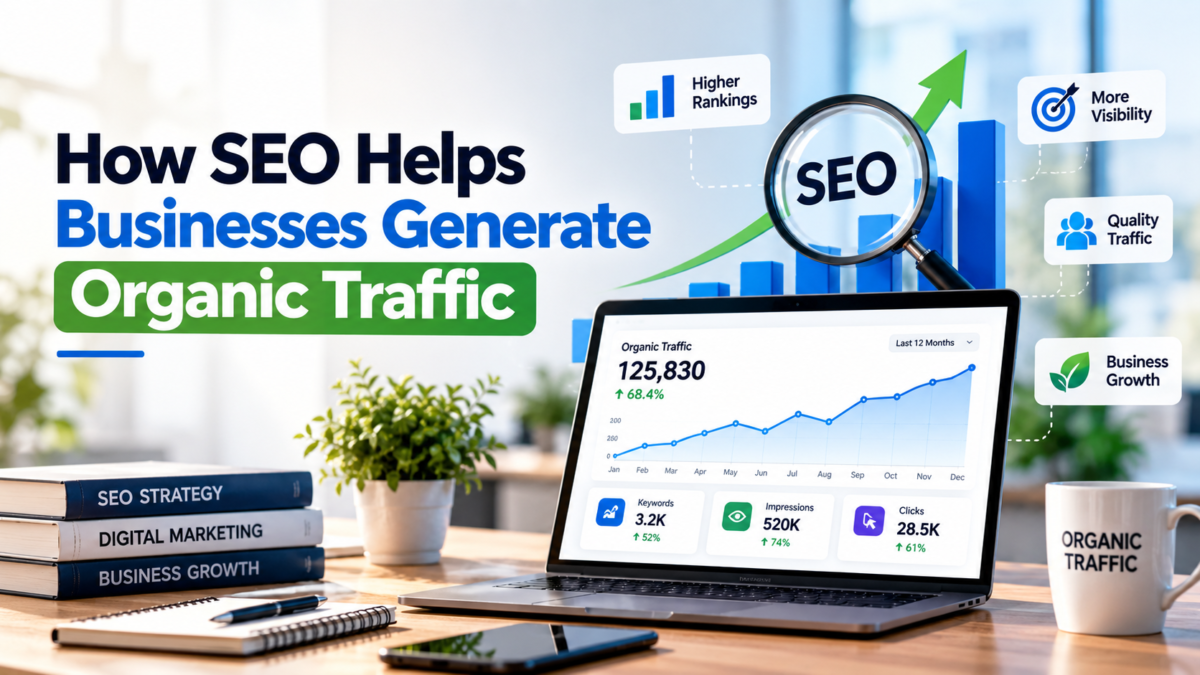
Search engines have become one of the most important ways customers discover businesses, products, services, and information online. Whether someone is searching for a local service, comparing solutions, researching a product, or looking for answers to a specific problem, search engines often represent the first step in their journey.
For businesses, appearing prominently in relevant search results can create a consistent source of website visitors without requiring payment for every individual click. This is where Search Engine Optimization (SEO) becomes valuable.
How SEO Helps Businesses Generate Organic Traffic is not simply about achieving higher rankings. Effective SEO helps businesses make their websites more discoverable, relevant, useful, technically accessible, and aligned with what their target audience is searching for.
Organic traffic refers to visitors who reach a website through unpaid search engine results. Unlike paid advertising, where traffic generally stops when the advertising budget is paused, SEO can continue generating visits when a website has established strong rankings and maintains its content and technical performance.
This guide explains how SEO generates organic traffic, why it matters for business growth, which factors influence organic visibility, and how businesses can build a sustainable SEO strategy.
What Is Organic Traffic?
Organic traffic is the traffic a website receives from unpaid search engine results.
For example, imagine a potential customer searches for:
- Digital marketing services
- Website development company
- SEO services for small businesses
- Best bathroom design ideas
- How to improve website visibility
- Local businesses near me
If a business website appears in the search results and the user clicks on it, that visitor is considered organic traffic.
Organic traffic is different from:
- Paid traffic: Visitors acquired through search advertisements or paid campaigns.
- Social traffic: Visitors coming from social media platforms.
- Referral traffic: Visitors arriving through links from other websites.
- Direct traffic: Visitors who directly enter a website address or use a bookmark.
- Email traffic: Visitors arriving through links in email campaigns.
SEO primarily focuses on increasing relevant organic traffic by improving a website’s ability to appear for valuable search queries.
How SEO Helps Businesses Generate Organic Traffic
The central purpose of SEO is to connect a business website with people actively searching for information, products, or services related to that business.
When SEO is implemented correctly, several activities work together to increase organic visibility.
These include:
- Keyword research
- Search intent analysis
- Content optimization
- Technical SEO
- On-page SEO
- Website architecture
- Internal linking
- Mobile optimization
- Page speed improvements
- Local SEO
- Link acquisition
- Content updates
- User experience improvements
Rather than relying on a single tactic, SEO creates a connected system that helps search engines understand a website and helps users find relevant information.
SEO Helps Businesses Reach People With Existing Search Intent
One of the biggest advantages of SEO is that it can reach people who are already searching for something.
Consider a user searching for “commercial interior design services.”
That person may already have a specific business requirement. If an interior design company has a well-optimized page targeting that search intent, the website may appear in the results and attract that potential customer.
This makes organic search different from many forms of interruption-based marketing.
Instead of placing a message in front of someone who may not currently need a service, SEO allows businesses to become visible when users are actively looking for relevant information or solutions.
The closer the content matches the user’s intent, the greater the opportunity to attract qualified visitors.
Keyword Research Builds the Foundation for Organic Traffic
Keyword research is one of the fundamental components of SEO.
A keyword is a word or phrase that users enter into search engines. Businesses can research keywords to understand what their target audience is searching for and how those searches relate to their products or services.
For example, a web development business might target keywords such as:
- Website development services
- Business website development
- E-commerce website development
- Custom website development
- Website development for small businesses
However, effective keyword research goes beyond finding popular phrases.
Businesses should also consider:
- Search intent
- Relevance
- Competition
- Commercial value
- Search volume
- Geographic relevance
- Long-tail opportunities
- Customer journey stage
A keyword strategy based only on search volume may attract visitors who are not actually interested in purchasing a product or service.
The objective should be to identify keywords that connect the business with its ideal audience.
Search Intent Makes SEO Traffic More Valuable
Search intent refers to the reason behind a user’s search.
Understanding intent helps businesses create content that answers the right question at the right stage of the customer journey.
Search intent commonly falls into several categories.
Informational Search Intent
Users want to learn something.
Examples include:
- What is technical SEO?
- How does SEO work?
- How to improve website speed
- What is organic traffic?
Educational content can help businesses attract users early in the buying journey.
Navigational Search Intent
Users are looking for a particular website, brand, or destination.
Examples include:
- Business website login
- Company contact page
- Brand product catalogue
Commercial Investigation
Users are researching options before making a decision.
Examples include:
- Best SEO services for businesses
- SEO agency pricing
- Website development services comparison
Transactional Search Intent
Users are ready to take an action.
Examples include:
- Hire SEO agency
- Buy ceramic tiles online
- Book website development consultation
Matching content with search intent increases the likelihood that organic visitors will find the information they actually need.
SEO-Optimized Content Attracts Consistent Search Visitors
Content is one of the most important components of organic search visibility.
A business can create content around questions, problems, products, services, and topics relevant to its target audience.
For example, an SEO agency could create resources covering:
- SEO fundamentals
- Keyword research
- Technical SEO
- Local SEO
- Content marketing
- Website optimization
- Search engine algorithms
- Organic traffic strategies
Each useful piece of content creates another opportunity for the website to appear in search results.
Over time, a well-developed content library can cover multiple topics and keyword variations.
This creates what is often called a content ecosystem, where different pages support different stages of the customer’s search journey.
On-Page SEO Improves Search Visibility
On-page SEO focuses on optimizing elements within a website.
Important on-page elements include:
- Page titles
- Headings
- Meta descriptions
- URLs
- Main content
- Image optimization
- Internal links
- Keyword placement
- Content structure
- Semantic relevance
For example, a page targeting “SEO services for small businesses” should clearly communicate that topic through its title, headings, content, URL, and supporting information.
However, SEO should not involve repeatedly inserting the same keyword into every paragraph.
Search engines increasingly evaluate the overall relevance and usefulness of content. Natural language, topical depth, clear organization, and satisfying user intent are therefore important components of modern SEO.
Technical SEO Helps Search Engines Access Your Website
Even excellent content can struggle to generate organic traffic if search engines cannot efficiently crawl, render, understand, or index a website.
Technical SEO addresses the infrastructure and technical characteristics of a website.
Important technical areas include:
- Crawlability
- Indexability
- XML sitemaps
- Robots.txt
- Canonical URLs
- HTTPS
- Mobile usability
- Website speed
- Core Web Vitals
- Structured data
- Redirects
- Broken links
- Duplicate content
- URL architecture
Technical SEO creates the foundation that allows content and other optimization efforts to perform effectively.
A technically healthy website gives search engines clearer access to its important pages.
Mobile SEO Expands Organic Reach
A large portion of online searches happen on mobile devices.
Therefore, a website needs to provide a strong experience across smartphones, tablets, laptops, and desktop computers.
Mobile SEO involves ensuring that:
- Pages adapt to different screen sizes.
- Text remains readable.
- Navigation is easy to use.
- Buttons are appropriately sized.
- Images do not create unnecessary layout problems.
- Pages load efficiently.
- Important content remains accessible.
A website that provides a poor mobile experience can lose opportunities to convert visitors even when it successfully attracts them through search.
Page Speed Can Influence the User Experience
Website speed is another important consideration for SEO and conversion performance.
When pages take too long to load, users may leave before interacting with the website.
Businesses can improve performance by reviewing:
- Image file sizes
- Image formats
- JavaScript
- CSS
- Server response time
- Browser caching
- Third-party scripts
- Unnecessary plugins
- Code efficiency
A faster website can provide a better experience for users and create a stronger technical foundation for organic search performance.
Internal Linking Helps Distribute SEO Value
Internal links connect one page of a website to another page on the same website.
For example, a blog discussing SEO strategy could link naturally to a relevant service page.
Internal linking can help:
- Users discover related information.
- Search engines understand website structure.
- Important pages receive additional internal signals.
- Visitors spend more time exploring relevant content.
- Businesses create clearer topical relationships.
Internal links should use descriptive anchor text that helps users understand what they will find after clicking.
For example, instead of using generic text such as “click here,” a business could use descriptive anchor text such as SEO services for growing businesses when appropriate.
Local SEO Helps Businesses Generate Nearby Traffic
Businesses serving specific geographic areas can use local SEO to increase visibility for location-based searches.
Examples include:
- Web design company in Ahmedabad
- Digital marketing agency in Gujarat
- Interior designers near me
- Tile showroom in Rajkot
- Dental clinic in a specific city
Local SEO can involve optimizing:
- Business profiles
- Location pages
- Contact information
- Local landing pages
- Customer reviews
- Local citations
- Website content
- Geographic keywords
For businesses dependent on local customers, local search visibility can be an important source of qualified organic traffic.
SEO Builds Visibility Across the Customer Journey
A strong SEO strategy does not only target people who are ready to buy.
It can attract users throughout different stages of the customer journey.
Someone may first search for:
“How much does website development cost?”
Later, they may search:
“Best features for a business website.”
Eventually, they may search:
“Website development services.”
A business that publishes useful content for each stage can remain visible throughout this journey.
This approach transforms SEO from a single-page ranking exercise into a broader customer acquisition strategy.
SEO Can Reduce Dependence on Paid Advertising
Paid advertising can provide immediate visibility, but it generally requires continuous investment.
SEO works differently.
Businesses invest resources into content, technical improvements, optimization, digital PR, and authority development. When successful, these efforts can continue attracting organic visitors without paying for every individual click.
This does not mean SEO makes paid advertising unnecessary.
Many businesses use both channels.
Paid campaigns can provide immediate visibility, while SEO can build longer-term organic search presence.
The two strategies can complement each other when managed according to business objectives.
High-Quality Content Creates More Ranking Opportunities
Every relevant page can potentially target a different set of search queries.
For example, a website offering digital services might publish separate resources about:
- SEO
- Website development
- E-commerce development
- Conversion optimization
- Technical SEO
- Local SEO
- Content marketing
Instead of forcing every topic onto a single page, businesses can build focused resources that provide comprehensive information about specific subjects.
This creates a larger search footprint.
However, quantity alone is not enough.
Publishing hundreds of low-value articles can create unnecessary content without producing meaningful organic growth.
The priority should be useful, original, relevant, and well-structured content.
Backlinks Can Strengthen Website Authority
A backlink is a link from another website to your website.
Search engines can use links as one of many signals when evaluating websites and pages.
Businesses can earn relevant backlinks through:
- Original research
- Useful resources
- Industry publications
- Digital PR
- Expert contributions
- Data-driven content
- Valuable guides
- Partnerships
- Relevant directories
The emphasis should be on relevance and quality rather than acquiring large quantities of low-quality links.
Unnatural link-building practices can create SEO risks, so businesses should prioritize legitimate authority-building strategies.
SEO Improves Brand Visibility
Organic search can contribute to brand awareness even when users do not immediately become customers.
A business that repeatedly appears for relevant searches can become more familiar to its target audience.
For example, a potential customer might discover a business through an educational blog post, return later through another search, and eventually visit a service page.
This repeated exposure can support the broader customer journey.
SEO therefore contributes not only to traffic generation but also to digital visibility.
Organic Traffic Can Support Lead Generation
Traffic itself is not the final objective for most businesses.
The real objective is usually to generate meaningful actions.
These may include:
- Contact form submissions
- Phone calls
- Consultation requests
- Product purchases
- Catalogue downloads
- Newsletter subscriptions
- Account registrations
- Quote requests
For this reason, SEO should be connected with conversion optimization.
A page can receive thousands of visitors but produce few leads if the content, messaging, navigation, and calls to action do not align with user intent.
SEO and Conversion Optimization Should Work Together
SEO brings relevant users to the website.
Conversion optimization helps turn those visitors into prospects or customers.
Important conversion elements include:
- Clear value propositions
- Strong calls to action
- Easy navigation
- Trust signals
- Relevant service information
- Testimonials
- Case studies
- Contact options
- Simple forms
- Product information
For example, an informational article can provide useful knowledge and then direct interested readers toward a relevant service page.
This creates a natural path from search → content → consideration → action.
How to Measure Organic Traffic Growth
Businesses need measurable SEO objectives.
Important SEO metrics can include:
Organic Sessions
Shows how many visits come through organic search.
Organic Users
Measures the number of users acquired through search.
Keyword Rankings
Shows how pages perform for targeted search terms.
Search Impressions
Indicates how often pages appear in search results.
Click-Through Rate
Measures the percentage of impressions that result in clicks.
Organic Conversions
Tracks leads, sales, enquiries, or other desired actions generated through organic search.
Engagement Metrics
These can help businesses understand how visitors interact with website content.
Landing Page Performance
Identifies which pages attract organic users and contribute to conversions.
Looking at multiple metrics provides a more complete picture than focusing on rankings alone.
Why SEO Is a Long-Term Business Strategy
SEO rarely delivers sustainable results through a single optimization campaign.
Search visibility can change as competitors publish new content, websites are updated, search algorithms evolve, and user behavior changes.
Businesses therefore need an ongoing process.
A long-term SEO program may include:
- Technical audits
- Keyword research
- Content planning
- Content production
- On-page optimization
- Internal linking
- Authority development
- Local optimization
- Performance monitoring
- Content updates
This continuous approach helps businesses maintain and expand their organic presence.
Common SEO Mistakes That Limit Organic Traffic
Businesses often struggle with SEO because of avoidable mistakes.
Targeting Only High-Volume Keywords
High-volume keywords can be competitive and may not always attract qualified visitors.
Long-tail and intent-focused keywords can provide valuable opportunities.
Publishing Content Without Search Intent
Content that does not answer the user’s actual question may struggle to perform.
Ignoring Technical SEO
Broken links, indexing problems, slow pages, and poor site architecture can limit organic visibility.
Keyword Stuffing
Repeating keywords unnaturally can reduce content quality and create a poor user experience.
Neglecting Internal Links
Important pages may remain difficult for users and search engines to discover.
Ignoring Existing Content
Older content can lose relevance over time. Updating useful pages can help maintain their value.
Focusing Only on Rankings
Rankings are important, but traffic quality and conversions are ultimately more closely connected to business outcomes.
How Businesses Can Build an Effective SEO Strategy
A practical SEO strategy can be developed through several stages.
Step 1: Define Business Goals
Start by determining what SEO should achieve.
Possible objectives include:
- Increasing qualified leads
- Generating e-commerce sales
- Increasing local enquiries
- Building brand visibility
- Growing website traffic
- Expanding into new markets
Step 2: Understand the Target Audience
Identify who the business wants to reach.
Understand their:
- Problems
- Questions
- Search behavior
- Buying motivations
- Locations
- Industry requirements
- Decision-making process
Step 3: Conduct Keyword Research
Identify relevant keywords across informational, commercial, and transactional intent.
Step 4: Audit the Website
Review technical SEO, content quality, internal links, website structure, mobile performance, and page speed.
Step 5: Create a Content Strategy
Develop content around topics that matter to the target audience.
Step 6: Optimize Existing Pages
Improve titles, headings, content, images, internal links, URLs, and conversion elements.
Step 7: Develop Authority
Earn relevant backlinks and establish the website as a useful source within its industry.
Step 8: Monitor Performance
Track organic traffic, search visibility, conversions, and page performance.
Step 9: Improve Continuously
SEO should be treated as an ongoing optimization process rather than a one-time project.
How Long Does SEO Take to Generate Organic Traffic?
SEO timelines vary significantly.
Results can depend on factors such as:
- Website age
- Existing authority
- Competition
- Industry
- Geographic market
- Technical condition
- Content quality
- Search demand
- Keyword difficulty
- Link profile
- Consistency of optimization
Some pages may begin receiving search visibility relatively quickly, while competitive keywords can require substantially more time and effort.
Businesses should therefore evaluate SEO using meaningful trends rather than expecting immediate results from isolated changes.
SEO Creates a Sustainable Organic Growth Framework
One of the most important benefits of SEO is its ability to create an interconnected digital growth framework.
A well-optimized website can attract users through:
- Service pages
- Product pages
- Blog articles
- Guides
- Location pages
- Resource pages
- FAQs
- Case studies
- Educational content
These assets can support one another through internal links and topical relevance.
Over time, a business can build a stronger organic search presence by continuously improving its website and publishing content that genuinely addresses audience needs.
Final Thoughts on How SEO Helps Businesses Generate Organic Traffic
Understanding How SEO Helps Businesses Generate Organic Traffic requires looking beyond rankings.
SEO connects businesses with people searching for relevant information, products, and services. Through keyword research, search intent analysis, technical optimization, useful content, internal linking, local SEO, authority development, and conversion optimization, businesses can build a stronger foundation for sustainable organic visibility.
The most effective SEO strategy is not simply about trying to rank for as many keywords as possible. It is about creating a website that search engines can understand and users can trust.
When SEO and business objectives work together, organic traffic can become more than a website metric. It can contribute to brand discovery, qualified leads, customer acquisition, and long-term digital growth.
Ready to Grow Your Organic Traffic?
A strong SEO strategy starts with understanding your website, audience, search landscape, and business goals. If you want to improve your search visibility and create a structured organic growth strategy, take the next step with a focused SEO consultation.
Connect with A Square Agency to discuss your SEO and digital growth requirements: https://asquare.agency/contact/