
Social Media Marketing for Startups
November 18, 2026
Digital Marketing Trends Businesses Should Know
November 23, 2026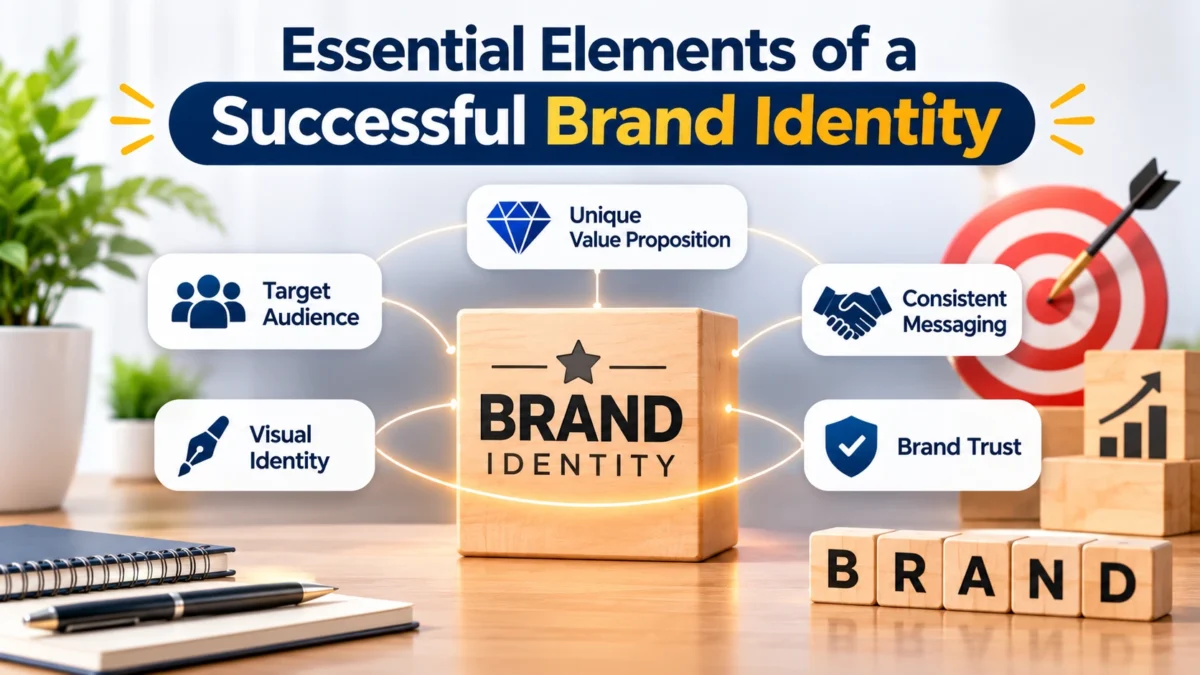
A strong brand identity is more than an attractive logo or a memorable color palette. It is the complete visual and verbal system that communicates who a business is, what it represents, and how it wants to be perceived by its audience. Every interaction a customer has with a business contributes to that perception, from a website and social media profile to product packaging, advertisements, presentations, and printed materials.
Understanding the Essential Elements of a Successful Brand Identity is therefore important for businesses that want to establish recognition, build credibility, and create consistent customer experiences. A carefully developed brand identity gives a business a recognizable personality and provides clear guidelines for communicating across different channels.
In competitive markets, businesses often offer similar products or services. A distinctive identity can help create meaningful differentiation by communicating a clear value proposition and establishing a recognizable presence. When visual design, messaging, typography, colors, imagery, and brand personality work together, the result is a cohesive identity that customers can recognize and remember.
This guide explores the Essential Elements of a Successful Brand Identity, explains why each component matters, and provides practical considerations for building a consistent and effective brand presence.
What Is Brand Identity?
Brand identity is the collection of visual, verbal, and strategic elements a business uses to present itself to its audience. It represents the intentional way an organization communicates its personality, values, positioning, and purpose.
Brand identity can include:
- Logo and logo variations
- Brand colors
- Typography
- Photography and imagery
- Graphic elements
- Brand voice
- Messaging
- Packaging
- Marketing materials
- Website design
- Social media presentation
- Brand guidelines
While branding and brand identity are closely related, they are not exactly the same. Branding is the broader process of shaping how a business is perceived, while brand identity consists of the elements created and controlled by the business to influence that perception.
A successful identity brings these components together into a consistent system rather than treating every marketing asset as an independent design project.
Why a Strong Brand Identity Matters
A strong brand identity can influence how customers recognize, understand, and remember a business. It establishes a visual and verbal foundation that can be applied across multiple customer touchpoints.
Builds Brand Recognition
Consistent use of colors, typography, logos, imagery, and design patterns helps customers identify a business more easily.
When the same visual language appears across a website, packaging, advertisements, social media, brochures, and other materials, customers gradually associate those elements with the business.
Recognition becomes particularly important when customers encounter a brand in crowded digital and physical environments.
Establishes Professional Credibility
Presentation influences perception. An inconsistent or poorly developed identity can make a business appear unorganized, while a coherent identity can communicate attention to detail and professionalism.
Professional brand identity design does not necessarily mean complicated design. Instead, it means that every component has a clear purpose and works together within an established system.
Creates Differentiation
A brand identity can help a business communicate what makes it distinct.
Differentiation may come from visual style, brand personality, messaging, positioning, or the way products and services are presented. A carefully defined identity helps businesses express those differences consistently.
Creates Consistency
Customers may interact with a business through several channels before making a purchase decision. They may visit its website, see a social media post, read an advertisement, receive an email, or encounter product packaging.
A consistent identity ensures that these interactions feel like part of the same brand experience.
Essential Elements of a Successful Brand Identity
The Essential Elements of a Successful Brand Identity work together as an integrated system. Each component contributes to recognition, communication, and consistency.
1. Clear Brand Strategy
A successful identity should begin with strategy rather than visual design.
Before creating a logo or selecting colors, a business should understand its purpose, audience, positioning, values, and competitive environment.
Important strategic questions include:
- What does the business offer?
- Who is the target audience?
- What customer problem does it solve?
- What makes the business different?
- What values should the brand communicate?
- How should customers perceive the business?
- What personality should the brand have?
These answers provide direction for every subsequent identity decision.
A clear strategy prevents design decisions from becoming purely subjective. Instead, colors, typography, imagery, messaging, and visual styles can be selected according to defined business objectives.
2. Memorable Logo Design
The logo is one of the most recognizable components of a brand identity, but it should not be considered the entire identity.
A strong logo should be distinctive, adaptable, legible, and appropriate for the business. It should work across different sizes and applications, from a website header to packaging, business cards, social media profiles, signage, and promotional materials.
A flexible logo system may include:
- Primary logo
- Secondary logo
- Symbol or icon
- Horizontal version
- Stacked version
- Monochrome version
- Light and dark variations
The objective is not to create the most complicated logo possible. A well-designed logo should communicate the brand clearly while remaining practical across different environments.
3. Strategic Brand Color Palette
Color is another fundamental component of brand identity.
People often recognize brands through recurring color combinations, making a consistent color system valuable for visual recognition.
A professional color palette generally includes:
- Primary brand colors
- Secondary colors
- Accent colors
- Neutral colors
- Background colors
Color selection should consider the brand personality, industry, target audience, accessibility, and intended emotional associations.
For example, a technology business may prefer a contemporary digital palette, while a luxury-oriented business may use restrained tones and refined neutrals. The important factor is that the palette supports the positioning of the brand.
Colors should also be assigned consistently. A brand guideline can specify which colors should be used for backgrounds, headings, buttons, illustrations, icons, packaging, and other applications.
4. Consistent Typography
Typography strongly influences how a brand communicates.
Different typefaces can create very different impressions. A geometric sans-serif can appear modern and structured, while a serif typeface may communicate tradition or sophistication.
A successful typography system normally establishes:
- Primary typeface
- Secondary typeface
- Heading styles
- Body text styles
- Caption styles
- Font weights
- Line spacing
- Letter spacing
- Digital and print usage
Typography should remain readable across platforms. A beautiful typeface is not effective if customers struggle to read website content or marketing materials.
The most successful systems balance personality with usability.
5. Distinctive Brand Voice
Brand identity is not limited to visual design. The way a business communicates through words is equally important.
Brand voice defines the personality behind written communication.
Depending on the positioning, a brand voice could be:
- Professional
- Friendly
- Confident
- Educational
- Conversational
- Sophisticated
- Approachable
- Innovative
The selected voice should remain consistent across website content, social media, advertisements, email communication, brochures, product descriptions, and other customer-facing materials.
A consistent voice helps customers understand what kind of organization they are interacting with.
6. Strong Brand Messaging
Brand messaging communicates the central ideas that customers should associate with the business.
A messaging framework may include:
- Brand statement
- Value proposition
- Mission
- Vision
- Brand promise
- Key benefits
- Supporting messages
- Tagline
Strong messaging should communicate meaningful value rather than relying exclusively on generic promotional language.
For example, instead of simply saying that a business provides “high-quality solutions,” its messaging can explain what quality means in practical terms and why that quality matters to customers.
Clear messaging makes the brand easier to understand.
7. Brand Personality
Brand personality gives human characteristics to a business.
Think of the brand as a person. How would it communicate? How would it behave? What qualities would people associate with it?
A brand could be:
- Bold
- Elegant
- Practical
- Innovative
- Energetic
- Reliable
- Minimal
- Traditional
- Creative
Defining personality helps guide visual and verbal decisions.
If a business wants to appear premium and sophisticated, its photography, typography, language, packaging, and website design should support that personality. If it wants to appear youthful and energetic, the visual system and communication style should reflect those characteristics instead.
8. Professional Photography and Imagery
Images can communicate information and emotion faster than written content.
A strong brand identity should establish a recognizable approach to photography and visual content.
This may include guidelines for:
- Photography style
- Lighting
- Composition
- Backgrounds
- Subject positioning
- Image treatment
- Illustration style
- Iconography
- Graphic elements
For example, a premium product brand may use clean compositions, controlled lighting, and carefully selected environments. A lifestyle-oriented brand may use more natural photography and human-centered compositions.
The objective is to ensure that images feel connected to the brand rather than appearing as unrelated stock visuals.
9. Graphic Design Elements
Supporting graphic elements help extend an identity beyond the logo.
These can include:
- Patterns
- Shapes
- Lines
- Icons
- Textures
- Illustrations
- Borders
- Frames
- Background treatments
These elements should have a consistent visual language.
When used effectively, they make marketing materials more recognizable without requiring the logo to appear everywhere.
10. Brand Guidelines
One of the most practical Essential Elements of a Successful Brand Identity is a comprehensive brand guideline.
Brand guidelines document how the identity should be used.
A brand guideline can include:
- Logo usage
- Minimum logo size
- Clear space requirements
- Incorrect logo examples
- Color codes
- Typography specifications
- Photography direction
- Iconography
- Graphic elements
- Brand voice
- Messaging principles
- Layout principles
- Digital applications
- Print applications
Brand guidelines are especially important as organizations grow. Multiple employees, designers, agencies, vendors, and marketing teams may create brand materials. A documented system helps ensure that everyone follows the same visual and communication standards.
11. Consistent Digital Presence
Modern brand identity must work effectively across digital platforms.
A website should reflect the same identity established through the brand strategy and visual system.
Important digital touchpoints include:
- Website
- Social media
- Email marketing
- Digital advertisements
- Landing pages
- Mobile interfaces
- Online catalogs
- E-commerce platforms
The logo, colors, typography, imagery, messaging, and user experience should feel connected across these channels.
Digital consistency is particularly important because customers may encounter a business online before interacting with it directly.
12. Packaging and Physical Touchpoints
For businesses selling physical products, packaging can become one of the most powerful expressions of brand identity.
Packaging should communicate the same visual language as the rest of the brand.
Elements may include:
- Product labels
- Boxes
- Bags
- Containers
- Product inserts
- Shipping materials
- Retail displays
A consistent packaging system can make products easier to recognize and can contribute to a more cohesive customer experience.
13. Brand Applications
A brand identity becomes meaningful when it is applied consistently.
Common applications include:
- Business cards
- Letterheads
- Presentations
- Brochures
- Catalogs
- Signage
- Uniforms
- Vehicles
- Packaging
- Websites
- Social media
- Advertisements
- Corporate documents
Each application should follow the same core identity while adapting appropriately to its format.
This is why a brand identity should be designed as a flexible system rather than a collection of individual graphics.
14. Brand Consistency Across Customer Touchpoints
Consistency is one of the most important principles of successful brand identity.
Customers should be able to move from a social media profile to a website, from the website to a product page, and from the product page to packaging without feeling like they have encountered different businesses.
Consistency does not mean that every design must look identical. Instead, the underlying visual and verbal principles should remain recognizable.
The same brand can use different layouts, imagery, and formats while maintaining consistent colors, typography, tone, imagery, and design principles.
15. Adaptability and Scalability
A successful brand identity should be designed for the future.
Businesses grow, launch new products, enter new markets, and adopt new communication channels. An identity that works only in one format may quickly become restrictive.
A scalable identity should work across:
- Small digital icons
- Large signage
- Websites
- Mobile screens
- Printed documents
- Packaging
- Presentations
- Advertising
- Video
- Social media
Responsive logo systems, flexible typography, defined color systems, and modular graphic elements can make brand identity easier to scale.
How to Build a Successful Brand Identity
Developing a brand identity should follow a structured process.
Step 1: Research the Market
Begin by understanding the industry, competitors, customers, cultural context, and market expectations.
Research helps identify opportunities for differentiation and prevents the identity from unintentionally looking too similar to existing brands.
Step 2: Define the Target Audience
A brand should be designed for the people it wants to reach.
Consider factors such as:
- Demographics
- Needs
- Purchasing behavior
- Expectations
- Preferences
- Pain points
- Motivations
Audience understanding influences both visual and verbal communication.
Step 3: Define Positioning
Brand positioning explains the space a business wants to occupy in the customer’s mind.
Positioning should identify the target audience, category, key value, differentiation, and supporting reasons to believe.
Step 4: Develop the Visual Direction
Once the strategic foundation is established, visual exploration can begin.
This stage may include moodboards, typography exploration, color studies, logo concepts, photography direction, and graphic language.
Step 5: Create the Identity System
The selected visual direction should then be developed into a complete identity system.
The system should define how individual components work together rather than focusing only on individual assets.
Step 6: Develop Brand Guidelines
Document the rules and recommendations so that the identity can be used consistently by internal teams and external partners.
Step 7: Apply the Identity
Implement the system across important customer touchpoints.
Start with high-priority applications such as the website, social media, packaging, sales materials, and advertising.
Step 8: Review and Refine
Brand identity should be reviewed periodically.
As markets, audiences, technology, and business objectives change, the identity may require controlled refinement.
A successful evolution preserves recognizable brand equity while improving relevance and usability.
Common Brand Identity Mistakes to Avoid
Understanding what not to do is just as important as understanding the Essential Elements of a Successful Brand Identity.
Designing Without Strategy
Starting with colors and logos before defining positioning can result in attractive but directionless design.
Using Too Many Fonts
An excessive number of typefaces can create visual inconsistency. A carefully selected typography system is generally easier to manage.
Inconsistent Colors
Using different shades of brand colors across materials can weaken recognition.
Changing the Logo Frequently
Frequent logo changes can make it difficult for customers to build recognition. Logo updates should have clear strategic reasons.
Ignoring Brand Voice
A visually consistent identity can still feel inconsistent if the written communication changes dramatically between platforms.
Relying on Trends
Design trends can be useful sources of inspiration, but an identity should not depend entirely on short-lived aesthetics.
Focusing Only on the Logo
A logo is important, but it is only one part of a complete brand identity.
Creating Rules That Are Too Complicated
Brand guidelines should provide clarity rather than create unnecessary restrictions. Teams should understand what to do and why it matters.
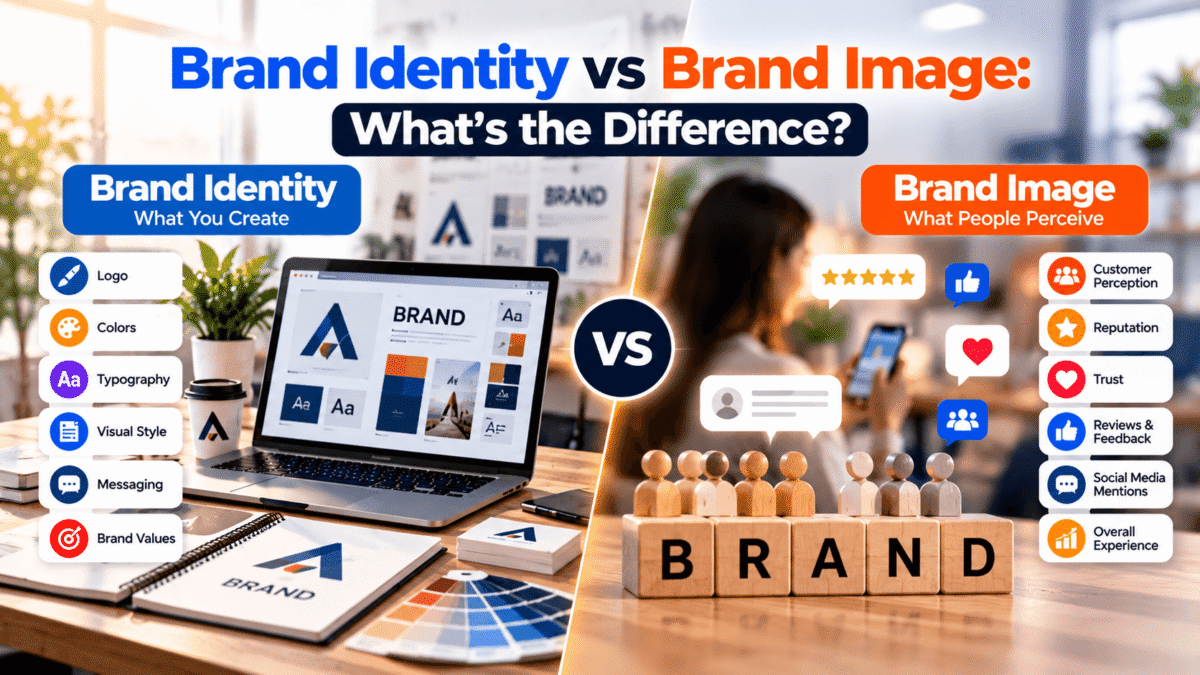
Brand Identity vs. Brand Image
Brand identity and brand image are connected but different concepts.
Brand identity represents how a business intentionally presents itself. Brand image represents how audiences actually perceive that business.
Businesses can control their identity, but they cannot completely control public perception.
This distinction makes consistency important. A clear identity gives customers repeated signals about what the business represents, while products, services, customer experiences, and communications contribute to the resulting brand image.
Measuring the Effectiveness of Brand Identity
Brand identity can be evaluated using both qualitative and quantitative indicators.
Businesses can examine:
- Brand recognition
- Direct traffic
- Engagement
- Customer feedback
- Conversion rates
- Customer retention
- Social media response
- Search behavior
- Brand recall
- Sales performance
Not every change in these metrics can be attributed exclusively to brand identity. Pricing, product quality, marketing campaigns, market conditions, customer service, and other factors can also influence results.
However, customer research and performance data can help identify whether the identity is communicating effectively and supporting broader business objectives.
How Brand Identity Supports Long-Term Growth
A well-defined identity creates a foundation that can support marketing and communication as a business expands.
Instead of creating a new visual direction for every campaign, teams can work from an established system.
This improves efficiency because designers and marketers already have defined rules for colors, typography, imagery, messaging, and layouts.
It also creates greater continuity. Customers encounter familiar visual and verbal signals even when the business introduces new products or enters new channels.
Over time, these repeated signals can contribute to stronger brand recognition.
The Role of Professional Brand Identity Design
Creating a complete identity requires a combination of strategy, design, communication, and implementation.
Professional brand identity design focuses not only on creating individual assets but also on developing a coherent system that can function across different applications.
A professional process typically considers:
- Business objectives
- Market positioning
- Audience expectations
- Visual differentiation
- Communication strategy
- Design consistency
- Digital usability
- Print applications
- Scalability
- Long-term implementation
The result should be practical as well as visually distinctive.
Future-Proofing Your Brand Identity
Brand identity should be prepared for changing customer behavior and communication technology.
Digital platforms continue to evolve, and businesses increasingly communicate through websites, mobile experiences, social media, video, interactive content, and emerging digital environments.
A future-ready identity should therefore be:
- Flexible
- Responsive
- Recognizable
- Accessible
- Scalable
- Consistent
- Easy to implement
It should have enough structure to maintain consistency while providing enough flexibility for future applications.
Conclusion
The Essential Elements of a Successful Brand Identity extend far beyond a logo. A strong identity combines strategy, visual design, typography, colors, messaging, personality, imagery, graphic elements, guidelines, and consistent implementation.
The most effective brand identities work as complete systems. Each component supports the others and contributes to a recognizable experience across websites, packaging, social media, advertising, presentations, and physical touchpoints.
For businesses building or refreshing their identity, the process should begin with understanding the audience, defining positioning, establishing a clear personality, and creating a strategic foundation. From there, visual and verbal elements can be developed into a flexible system that remains consistent across channels.
A well-planned brand identity does not simply make a business look professional. It provides a framework for communicating clearly, creating recognition, differentiating from competitors, and maintaining consistency as the organization grows.
If your business needs a structured approach to developing or improving its brand identity, professional guidance can help transform your ideas into a cohesive and practical brand system. Explore the next step through our Essential Elements of a Successful Brand Identity consultation and discuss how a strategic identity can support your business goals.