
Product Photography: A Complete Guide for Businesses
October 5, 2026
How SEO Helps Businesses Generate Organic Traffic
October 7, 2026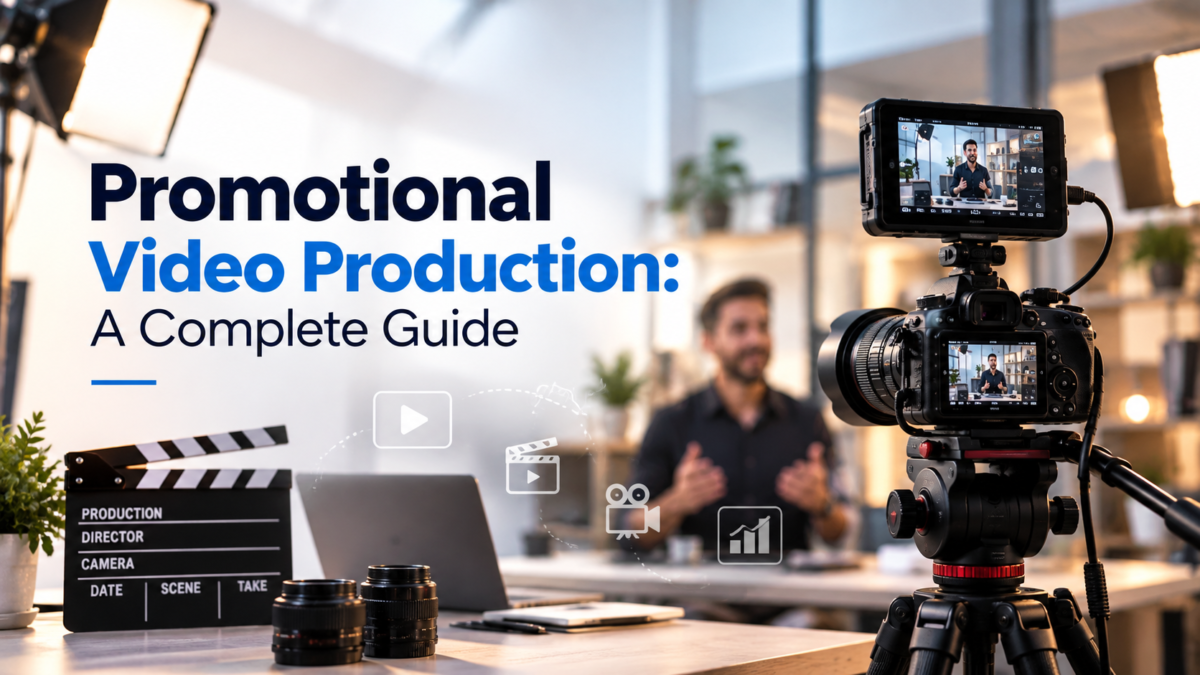
Promotional video production has become one of the most effective ways for businesses to communicate their value, introduce products, build brand awareness, and influence purchasing decisions. Unlike traditional advertising formats that rely heavily on written copy or static visuals, promotional videos combine storytelling, visuals, sound, motion, and emotion to deliver a memorable brand experience.
A well-produced promotional video can explain a product within minutes, demonstrate how a service works, introduce a new brand, support a marketing campaign, or encourage potential customers to take action. However, producing an effective video requires more than simply recording footage and adding music. It involves strategy, creative development, scripting, production planning, filming, editing, sound design, motion graphics, and distribution.
This guide explores Promotional Video Production: A Complete Guide to help businesses understand the complete process, from developing an initial concept to distributing the final video across relevant marketing channels.
What Is Promotional Video Production?
Promotional video production is the process of planning, creating, filming, editing, and distributing video content designed to promote a business, product, service, campaign, event, or brand.
The primary objective is to communicate a specific marketing message while encouraging the target audience to take a desired action. That action could include visiting a website, requesting a consultation, purchasing a product, downloading a resource, signing up for a service, or contacting a business.
Promotional videos can take many forms, including:
- Product promotional videos
- Service introduction videos
- Brand promotional videos
- Corporate promotional videos
- Product demonstration videos
- Social media promotional videos
- Event promotional videos
- Campaign videos
- Launch videos
- Explainer-style promotional videos
- Testimonial-driven promotional videos
- Digital advertising videos
The right format depends on the campaign objective, audience, brand identity, distribution platform, and available production resources.
Why Promotional Video Production Matters for Businesses
Modern audiences consume a significant amount of video content across websites, social media platforms, search engines, digital advertisements, and streaming services. This makes video an important communication format for businesses competing for attention online.
A professionally produced promotional video can communicate information quickly while creating a stronger emotional connection than many text-based formats.
Communicates Complex Ideas Clearly
Some products and services are difficult to explain using text alone. A promotional video can demonstrate a product, visualize a process, show a service in action, or use animation to simplify complicated concepts.
Instead of asking potential customers to read several paragraphs to understand an offering, businesses can use visuals, narration, demonstrations, and on-screen text to make the information easier to understand.
Builds Brand Recognition
Consistent promotional video content can reinforce a company’s visual identity. Elements such as colors, typography, photography style, animation, music, voice-over, and storytelling can work together to create recognizable brand communication.
Over time, this consistency can help audiences associate specific visual and emotional characteristics with the brand.
Supports Customer Decision-Making
Customers often want to understand what a product or service offers before making a decision. A promotional video can answer common questions, demonstrate benefits, showcase features, and establish credibility.
When the content addresses the audience’s actual concerns, it becomes a useful part of the customer journey rather than simply another advertisement.
Creates Multiple Marketing Opportunities
One professionally produced video can generate multiple pieces of content.
For example, a long-form promotional video can be adapted into:
- Short social media videos
- Website sections
- Paid advertising creatives
- Email marketing content
- Product pages
- Presentation material
- Sales resources
- YouTube content
- Vertical video clips
This makes promotional video production a potentially valuable component of a broader content marketing strategy.
Types of Promotional Videos
Choosing the right promotional video format is one of the earliest strategic decisions in the production process.
Product Promotional Videos
Product videos focus on a specific product and communicate its features, benefits, appearance, functionality, and applications.
These videos are particularly useful for products that benefit from visual demonstrations. Showing a product in use can provide context that product photography and written descriptions may not communicate as effectively.
Service Promotional Videos
Service businesses can use promotional videos to explain their process, expertise, customer experience, and value proposition.
For example, a professional service company can use a video to explain how its process works from initial consultation through project completion.
Corporate Promotional Videos
Corporate promotional videos communicate the identity, capabilities, culture, facilities, people, or achievements of an organization.
These videos can be used on corporate websites, presentations, recruitment campaigns, exhibitions, investor communications, and other business environments.
Brand Promotional Videos
Brand-focused promotional videos concentrate less on individual products and more on the company’s identity, purpose, positioning, and relationship with its audience.
The strongest brand videos usually communicate an idea or story rather than simply listing features.
Social Media Promotional Videos
Social media videos are generally designed for shorter attention spans and platform-specific viewing behaviors.
They may use fast pacing, strong opening visuals, captions, vertical framing, and concise messaging to capture attention quickly.
Promotional Explainer Videos
Explainer-style promotional videos combine education and marketing. They are useful when customers need additional context before understanding the value of a product or service.
Animation, motion graphics, screen recordings, product footage, and narration can all be used depending on the subject.
The Promotional Video Production Process
Successful promotional video production starts well before the camera is turned on. A structured production process helps ensure that creative decisions support the business objective.
1. Define the Marketing Objective
The first step is identifying what the video needs to accomplish.
A vague objective such as “make a promotional video” is not enough to guide production decisions.
Instead, define a measurable or clearly identifiable objective.
For example:
- Generate qualified leads
- Introduce a new product
- Increase product awareness
- Explain a service
- Support a product launch
- Drive website traffic
- Increase event registrations
- Strengthen brand perception
- Support a sales presentation
The objective influences the video’s message, structure, length, call to action, visual style, and distribution strategy.
2. Understand the Target Audience
A promotional video should be created for a specific audience rather than a general viewer.
Consider factors such as:
- Who is the audience?
- What problem are they experiencing?
- What motivates them?
- What objections might they have?
- What information do they need?
- Where do they consume video content?
- What action should they take after watching?
Understanding the audience helps determine the language, tone, pacing, visuals, storytelling approach, and level of technical detail.
3. Develop the Core Message
Every promotional video should communicate one central idea.
Trying to communicate too many unrelated messages can make a video confusing and reduce its impact.
A strong core message generally answers three questions:
What is being offered?
Why does it matter?
What should the viewer do next?
Supporting information can be incorporated around this central message without allowing secondary details to overpower the primary objective.
4. Create the Video Concept
The concept determines how the message will be presented.
A promotional video might use:
- Storytelling
- Product demonstration
- Customer journey
- Problem-and-solution structure
- Founder or expert presentation
- Lifestyle visuals
- Cinematic brand storytelling
- Animation
- Motion graphics
- Interview-based storytelling
The creative concept should reflect both the brand and the audience.
For example, a premium product may require a refined cinematic treatment, while a technology product may benefit from product demonstrations, interface animations, and concise explanations.
5. Write the Promotional Video Script
The script transforms the concept into a structured communication piece.
A typical promotional video script can include:
Opening Hook
The opening needs to establish relevance quickly.
This could be a question, statement, visual moment, customer problem, product reveal, or unexpected observation.
Problem or Need
Introduce the situation that the audience understands or experiences.
Solution
Present the product, service, or brand as the solution.
Benefits
Explain why the offering matters rather than simply listing features.
Proof
Where appropriate, include demonstrations, customer experiences, statistics, certifications, processes, or other credible evidence.
Call to Action
End with a clear next step.
The call to action should match the campaign objective. It could encourage viewers to visit a website, contact the company, request information, purchase a product, or learn more.
6. Create a Storyboard
A storyboard provides a visual interpretation of the script.
It can outline:
- Camera shots
- Product placement
- Scene transitions
- On-screen text
- Graphics
- Voice-over
- Camera movement
- Locations
- Visual effects
Storyboarding reduces uncertainty during production because the creative team has a clear visual roadmap before filming begins.
7. Plan the Production
Production planning covers the practical requirements of filming.
Important considerations include:
- Location
- Cast or presenters
- Crew
- Camera equipment
- Lighting
- Audio equipment
- Props
- Product samples
- Wardrobe
- Set design
- Shooting schedule
- Permits where applicable
- Backup plans
- Production budget
A detailed production plan helps reduce delays and unexpected costs.
8. Film the Video
Production is the stage where the planned concept becomes actual footage.
Professional filming involves more than operating a camera. Lighting, composition, camera movement, lens selection, audio quality, performance direction, and continuity all influence the final result.
For product-focused videos, special attention may be required for product surfaces, textures, materials, packaging, details, and demonstrations.
For corporate videos, interviews and environmental footage need to work together naturally.
For cinematic promotional campaigns, visual composition and controlled lighting can become important parts of the storytelling language.
9. Record Professional Audio
Audio is one of the most important aspects of promotional video production.
Poor sound can make otherwise high-quality footage feel unprofessional.
Depending on the project, audio production may include:
- Voice-over recording
- Interview audio
- Dialogue
- Ambient sound
- Sound effects
- Music
- Audio mixing
Clear speech, balanced sound levels, appropriate music, and purposeful sound effects contribute significantly to the viewing experience.
10. Edit the Promotional Video
Post-production transforms raw footage into the final story.
Editors typically work with:
- Video footage
- Voice-over
- Music
- Sound effects
- Graphics
- Animation
- Captions
- Color correction
- Transitions
Editing determines the pacing and rhythm of the promotional video.
The objective should not be to include every piece of footage captured during production. Instead, the editor should select the material that communicates the message most effectively.
11. Add Motion Graphics and Visual Effects
Motion graphics can make promotional content more informative and visually engaging.
They can be used for:
- Titles
- Product specifications
- Statistics
- Logos
- Icons
- Diagrams
- Transitions
- Animated typography
- Calls to action
- Product feature explanations
Visual effects should support communication rather than distract from the message.
12. Apply Color Correction and Grading
Color influences the visual identity and emotional tone of a video.
Color correction ensures consistency between shots, while color grading establishes the overall visual style.
For brand campaigns, the final look should complement the existing visual identity instead of creating an unrelated aesthetic.
13. Review and Refine
Before publishing, the video should go through a structured review process.
Check:
- Brand accuracy
- Spelling
- Logo usage
- Product information
- Voice-over accuracy
- Audio levels
- Visual continuity
- Captions
- Call-to-action information
- Contact details
- Technical quality
Multiple review stages can help identify issues before the video reaches the audience.
Promotional Video Production Budget
The cost of promotional video production varies considerably depending on the project’s scope.
Factors that can influence the budget include:
- Video duration
- Number of filming locations
- Production days
- Crew size
- Equipment requirements
- Actors or presenters
- Studio requirements
- Travel
- Set design
- Animation
- Visual effects
- Voice-over
- Music licensing
- Editing complexity
- Number of deliverables
A short social media promotional video and a cinematic brand campaign can have very different production requirements.
Instead of evaluating cost only by video duration, businesses should consider the complete production scope and expected marketing use.
How Long Should a Promotional Video Be?
There is no universal ideal length for every promotional video.
The appropriate duration depends on the audience, platform, subject matter, and campaign objective.
A short social media advertisement may need to communicate the message within seconds, while a product demonstration or corporate video may require several minutes.
The key principle is simple: use the amount of time required to communicate the message effectively without unnecessary content.
Every scene should contribute to the viewer’s understanding, interest, or next action.
Promotional Video SEO and Distribution
Creating a high-quality video is only one part of the marketing process. The content also needs to reach the intended audience.
Promotional videos can be distributed through:
- Company websites
- Landing pages
- Search engines
- Social media
- Video platforms
- Email campaigns
- Digital advertising
- Sales presentations
- Trade shows
- Event displays
For website publishing, businesses should consider relevant page titles, supporting text, video descriptions, transcripts, captions, structured content, thumbnail design, and page performance.
Search optimization should support the video rather than relying on the video alone to rank for competitive keywords.
Creating Platform-Specific Promotional Videos
A single master video can often be adapted into multiple formats.
For example, a campaign might require:
- 16:9 horizontal video for websites
- 9:16 vertical video for short-form platforms
- 1:1 square content for certain social placements
- Short cutdowns for advertising
- Captioned versions for silent viewing
- Different versions with platform-specific calls to action
Planning these requirements before production can reduce the need for expensive reshoots.
Common Promotional Video Production Mistakes
Even businesses with strong products can reduce the effectiveness of a promotional video through avoidable production mistakes.
Starting Without a Clear Objective
Without a defined goal, the video can become visually attractive but strategically ineffective.
Trying to Say Everything
A promotional video should prioritize the information that matters most to the audience.
Weak Opening
If the opening does not establish relevance, viewers may lose interest before the main message begins.
Focusing Only on Features
Features are useful, but audiences also need to understand the benefits and practical value.
Poor Audio
Low-quality audio can immediately reduce perceived production quality.
Excessive Visual Effects
Effects should enhance communication. Too many transitions, animations, or visual effects can distract from the message.
Ignoring Mobile Viewing
Many audiences encounter promotional videos on mobile devices. Text, framing, captions, and visual details should remain clear on smaller screens.
Missing Call to Action
A promotional video should guide the viewer toward an appropriate next step.
How to Make Promotional Videos More Effective
A successful promotional video combines strategy, creativity, production quality, and distribution.
Start With the Audience
Build the story around the audience’s needs rather than simply describing the business.
Show Instead of Only Telling
Whenever possible, demonstrate products, processes, results, environments, and experiences visually.
Keep the Message Focused
One strong message is generally easier to remember than several competing messages.
Maintain Brand Consistency
The visual style, tone, colors, typography, voice, and storytelling approach should align with the broader brand identity.
Design for Different Platforms
Consider distribution requirements before production begins so the final footage can be adapted efficiently.
Build a Strong CTA
The final action should be clear and relevant to the viewer’s position in the customer journey.
Measuring Promotional Video Performance
Promotional video performance should be evaluated against the original marketing objective.
Useful metrics may include:
- Video views
- Watch time
- Completion rate
- Engagement rate
- Click-through rate
- Website visits
- Lead generation
- Conversion rate
- Social interactions
- Cost per acquisition
- Sales influenced by the campaign
Not every video should be judged by the same metric.
For example, a brand awareness campaign may prioritize reach and completed views, while a lead-generation campaign may focus more heavily on qualified inquiries and conversions.
Promotional Video Production for Different Business Goals
Different marketing objectives require different creative approaches.
Product Launches
Product launch videos can introduce the product, establish its positioning, demonstrate key features, and create initial awareness.
Lead Generation
Lead-generation videos should communicate value clearly and finish with a compelling but relevant next step.
Brand Awareness
Brand videos can focus on identity, purpose, differentiation, and emotional storytelling.
Sales Enablement
Sales teams can use promotional videos to explain products, demonstrate solutions, answer common questions, and support presentations.
Event Marketing
Promotional videos can build anticipation before an event and extend its reach after the event through highlights, interviews, and recap content.
Choosing the Right Promotional Video Production Approach
The right production approach depends on the relationship between the message, audience, brand, budget, and distribution channel.
A simple product demonstration may not require an elaborate production environment. A major brand campaign may require detailed creative development, professional cinematography, extensive post-production, and multiple content versions.
The objective should always be to match production complexity with communication requirements.
High production value does not automatically make a video effective. Strategic clarity, relevant storytelling, strong execution, and audience understanding are equally important.
Why Professional Promotional Video Production Can Add Value
Professional production teams bring together multiple disciplines, including creative strategy, directing, cinematography, lighting, sound, editing, motion design, color grading, and post-production.
This integrated approach can help businesses transform a marketing message into a coherent visual experience.
Professional production can also help maintain consistency across multiple campaign assets, making it easier to create a recognizable visual language across websites, advertising, social media, and sales materials.
Frequently Asked Questions About Promotional Video Production
What is promotional video production?
Promotional video production is the complete process of developing video content intended to promote a product, service, brand, campaign, event, or business. It includes strategy, scripting, pre-production, filming, editing, post-production, and distribution.
How much does promotional video production cost?
Costs vary according to factors such as production duration, locations, crew, equipment, actors, animation, travel, editing requirements, and the number of final deliverables. A clear production brief is necessary for an accurate estimate.
How long should a promotional video be?
There is no universal duration. The ideal length depends on the message, audience, platform, and campaign objective. The video should remain as long as necessary to communicate its message effectively.
Can one promotional video be used on multiple platforms?
Yes. A master video can often be adapted into different aspect ratios, durations, captions, and cutdowns for websites, social media, advertising, email, and presentations.
What makes a promotional video effective?
Effective promotional videos typically combine a clear objective, audience-focused messaging, strong storytelling, professional visuals and audio, focused editing, brand consistency, and a relevant call to action.
Is animation necessary for promotional videos?
Animation is not required for every project. It is most useful when it helps explain information, visualize concepts, demonstrate processes, highlight features, or enhance the overall storytelling.
Conclusion: Build Promotional Videos With Purpose
Promotional video production is more than filming attractive footage. It is a strategic communication process that brings together marketing objectives, audience insights, creative storytelling, professional production, and effective distribution.
From defining the initial objective and developing the concept to scripting, filming, editing, animation, sound design, and final distribution, every stage contributes to the effectiveness of the finished video.
The strongest promotional videos are created with a clear understanding of what the audience needs to know, feel, and do next. When strategy and creativity work together, video can become a powerful asset for brand communication, product marketing, lead generation, customer education, and long-term brand building.
If you are planning a promotional video and want to discuss your project, objectives, creative direction, or production requirements, connect with our team through Promotional Video Production: A Complete Guide and start planning your next video project.
Start Your Promotional Video Project
A strong promotional video begins with a clear idea and a well-defined objective. Whether you need a product video, corporate promotion, brand film, campaign video, or social media content, the production approach should be built around your audience and business goals.
Ready to turn your idea into a compelling promotional video? Contact our team to discuss your promotional video production requirements.